• ABOUT
  • GANG
  • FACES
  • STAFF
  • ProgressivE-zine
  • Books–PPH
  • Books SERIES
  • SHOP
  • Out Of Bounds – OOB
  • Fake World
  • NOTES From the Streets
  • PROTESTS in the World
    • 2025
    • 2024
  • FEATURED photographers
    • PHOTOS OF THE WEEK
    • PROGRESSIVE COVERS
    • STORY TIME
    • CHALLENGES
    • MATCHING MOMENTS
    • GALLERIES PDFS
  • Exhibitions
    • Exhibition
    • Exhibitions
    • Stations ... and stations ... and stations
  • Tips
  • Video
  • Index SEARCH
  • Contact
  • SPOKESPERSONS
  • ProgresFestival MAGAZINE

Progressive Street

  • ABOUT
  • GANG
  • FACES
  • STAFF
  • ProgressivE-zine
  • Books–PPH
  • Books SERIES
  • SHOP
  • Out Of Bounds – OOB
  • Fake World
  • NOTES From the Streets
  • PROTESTS in the World
    • 2025
    • 2024
  • FEATURED photographers
    • PHOTOS OF THE WEEK
    • PROGRESSIVE COVERS
    • STORY TIME
    • CHALLENGES
    • MATCHING MOMENTS
    • GALLERIES PDFS
  • Exhibitions
    • Exhibition
    • Exhibitions
    • Stations ... and stations ... and stations
  • Tips
  • Video
  • Index SEARCH
  • Contact
  • SPOKESPERSONS
  • ProgresFestival MAGAZINE

Shadow.....The Mystery of Light

Shadow.....The Mystery of Light

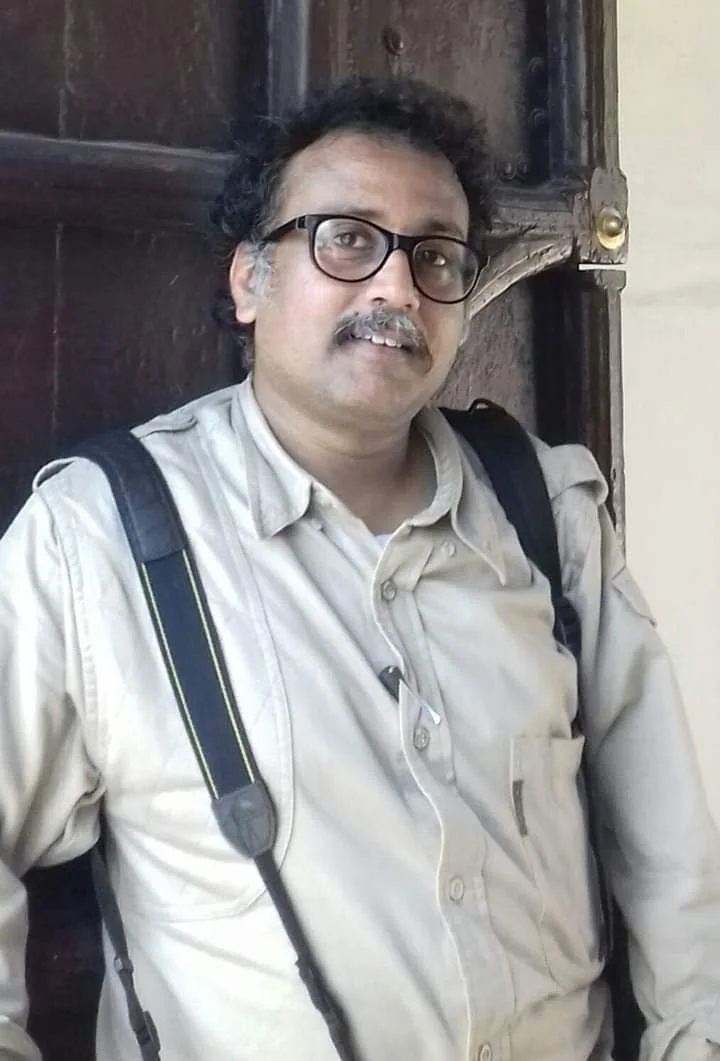
by Arin Dutta


Series Light & Shadow

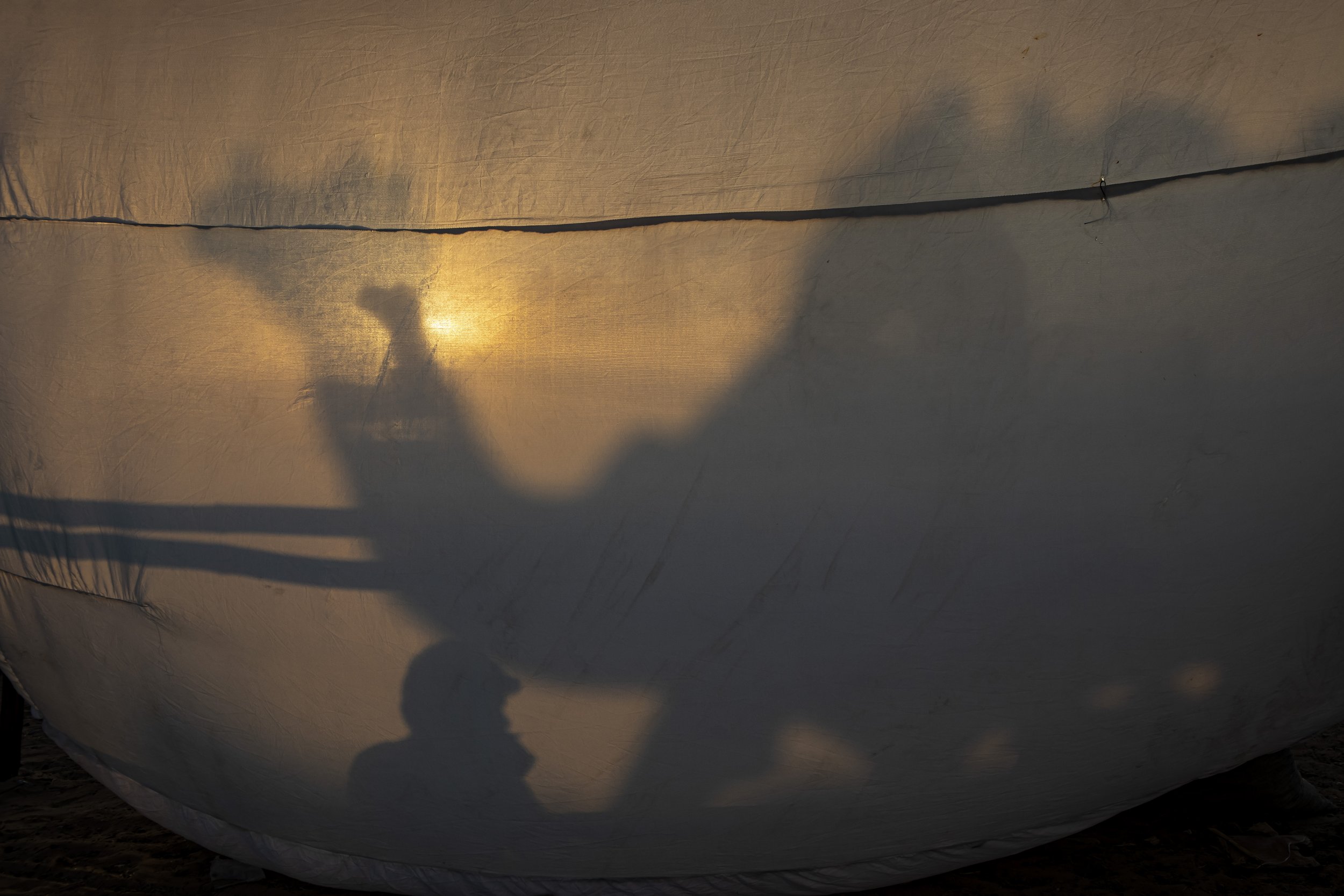
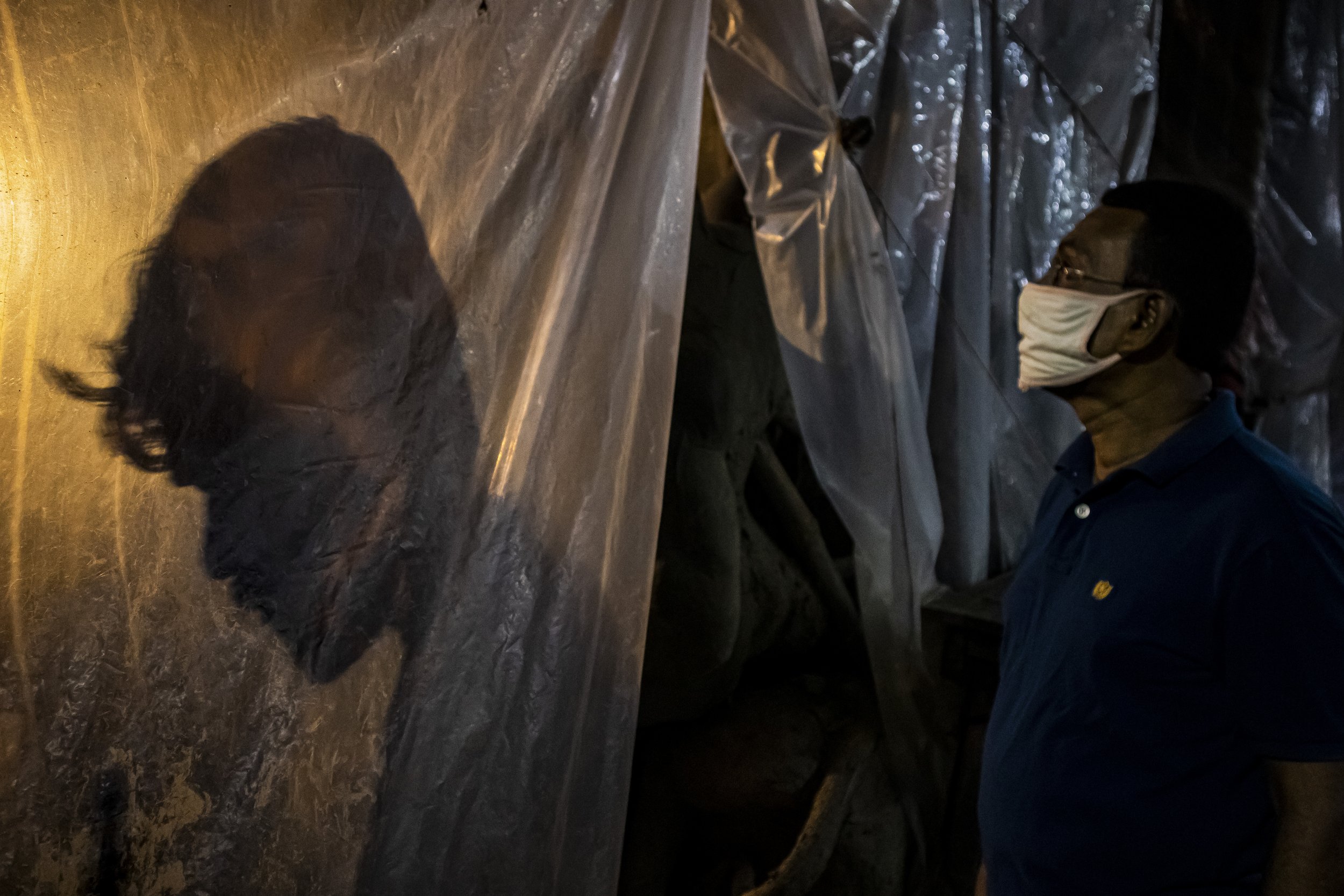
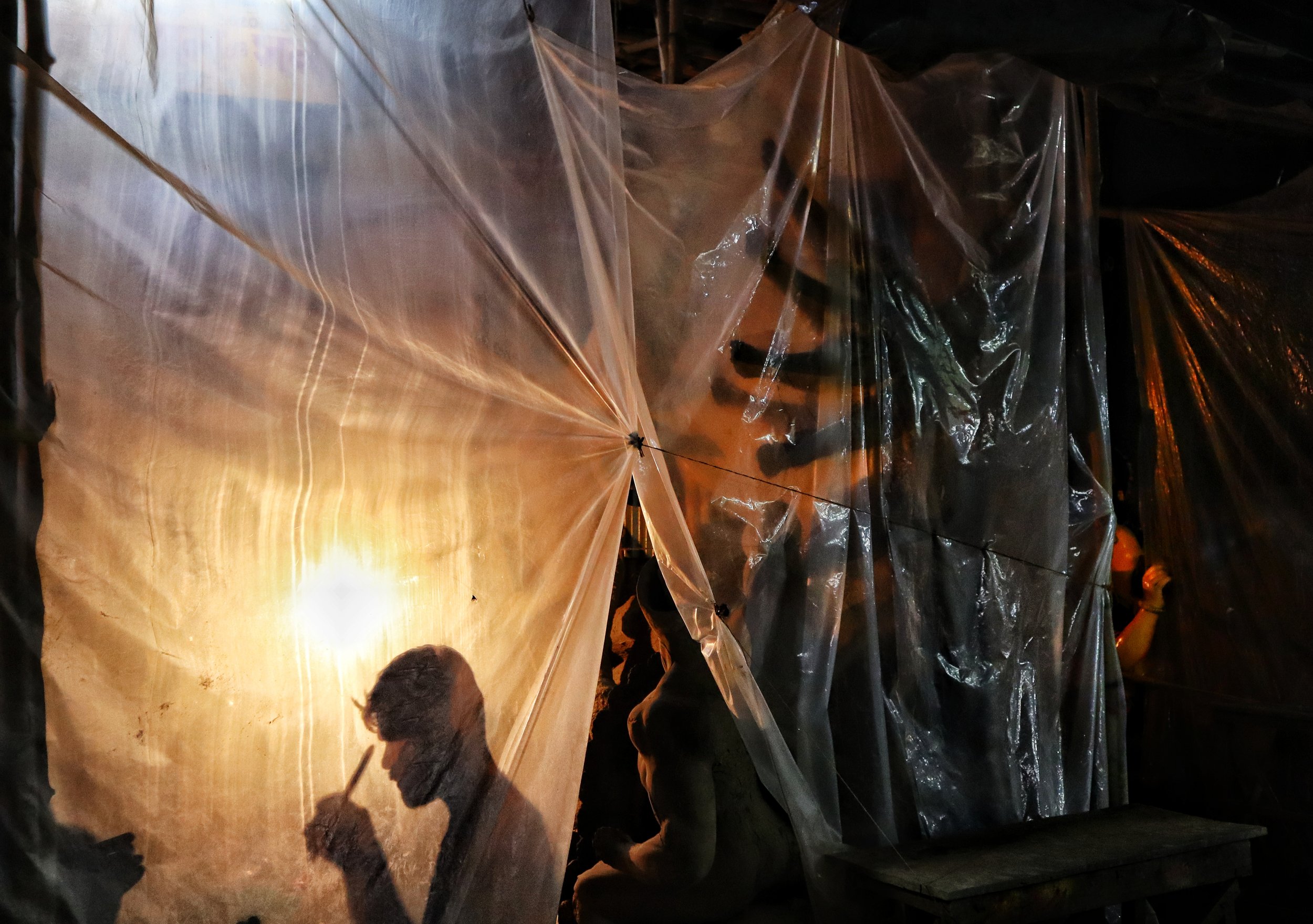
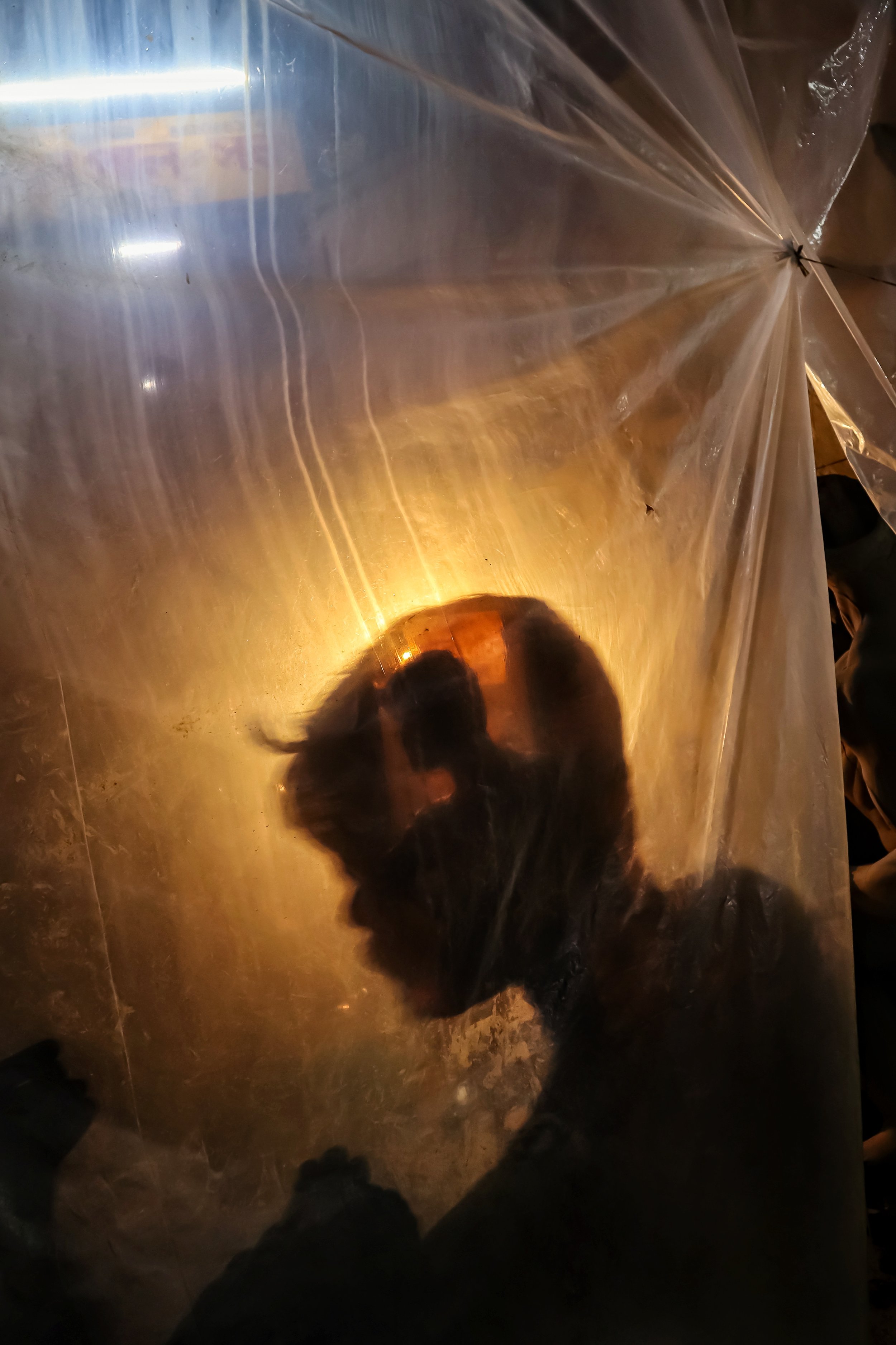
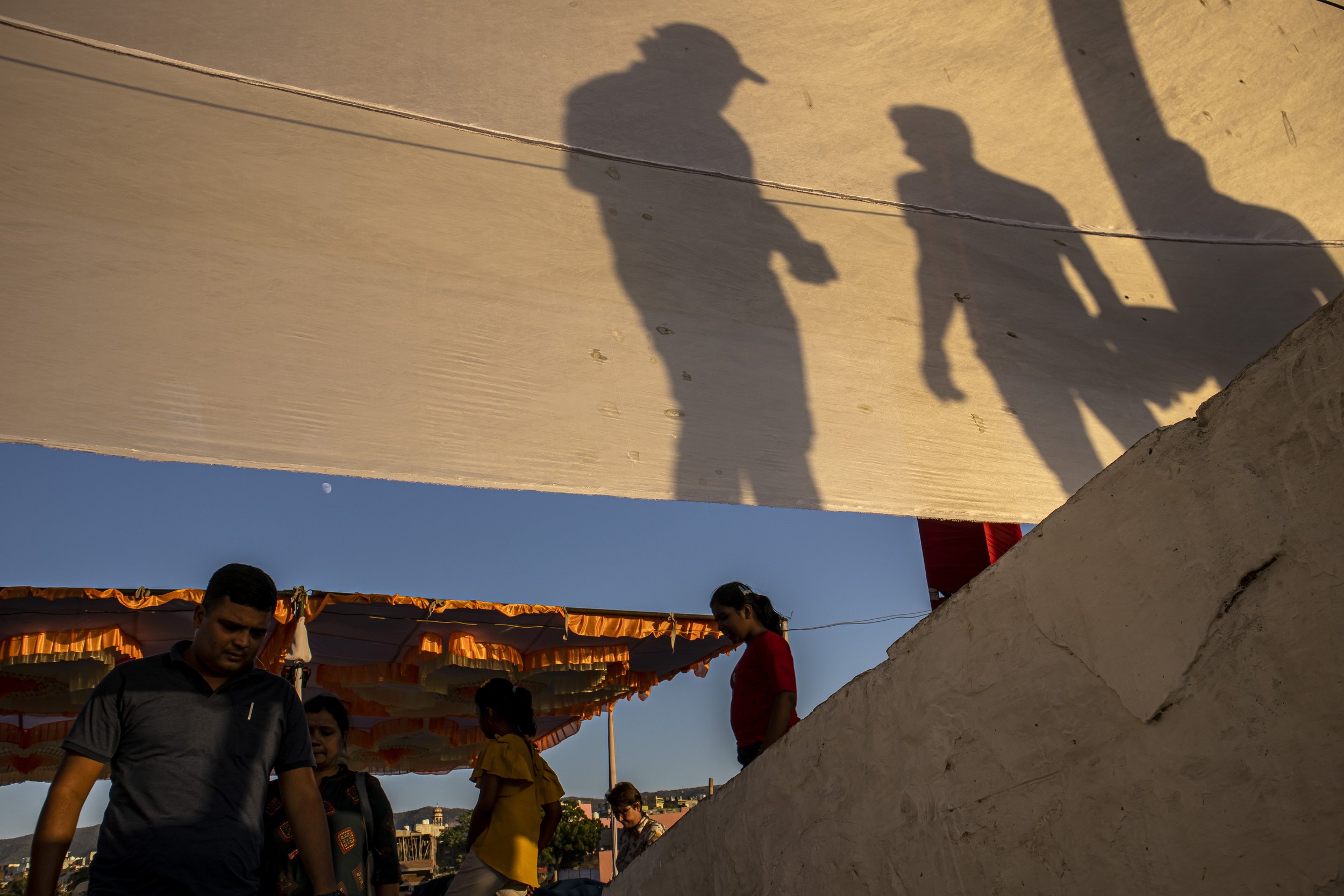
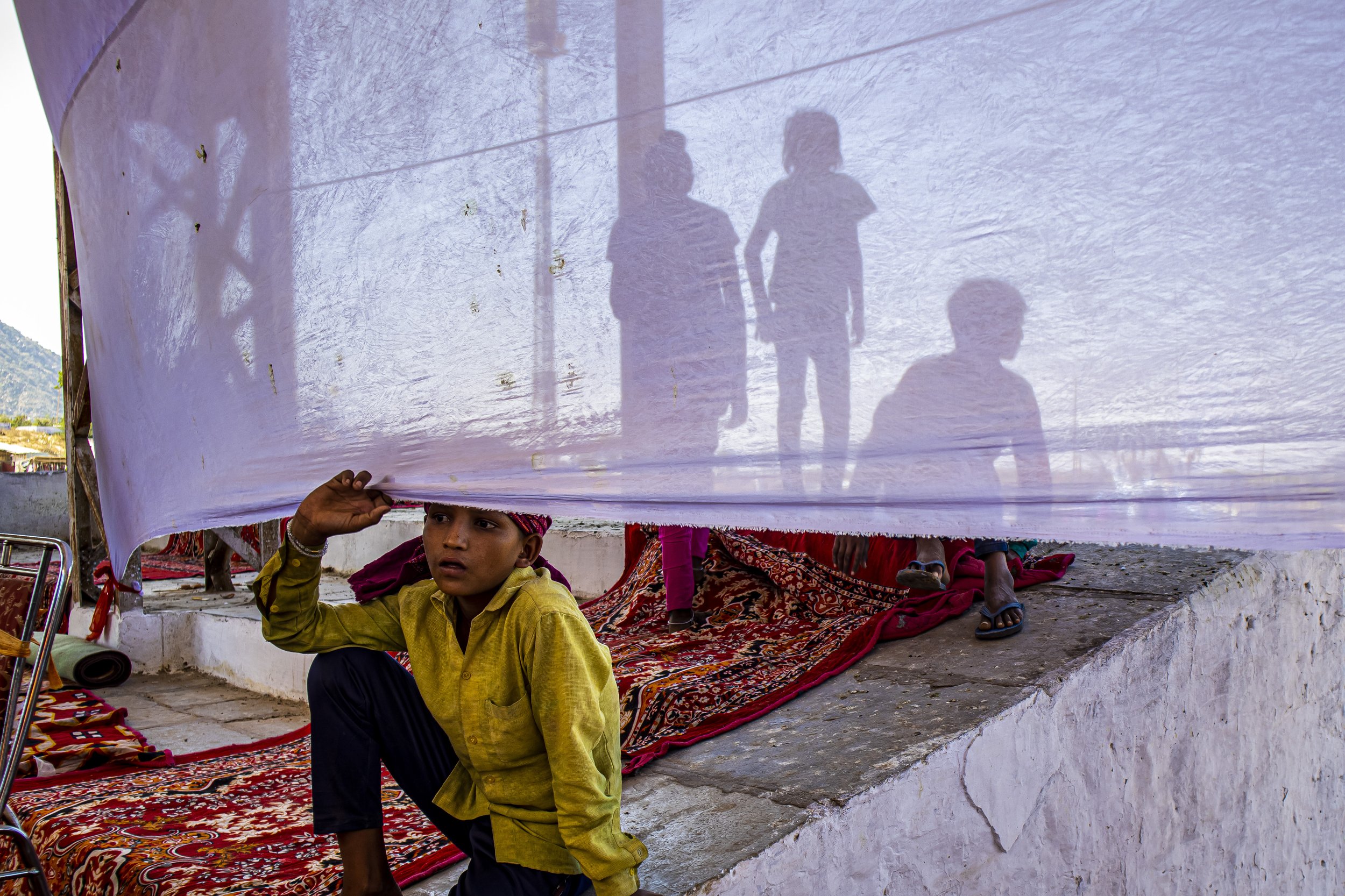
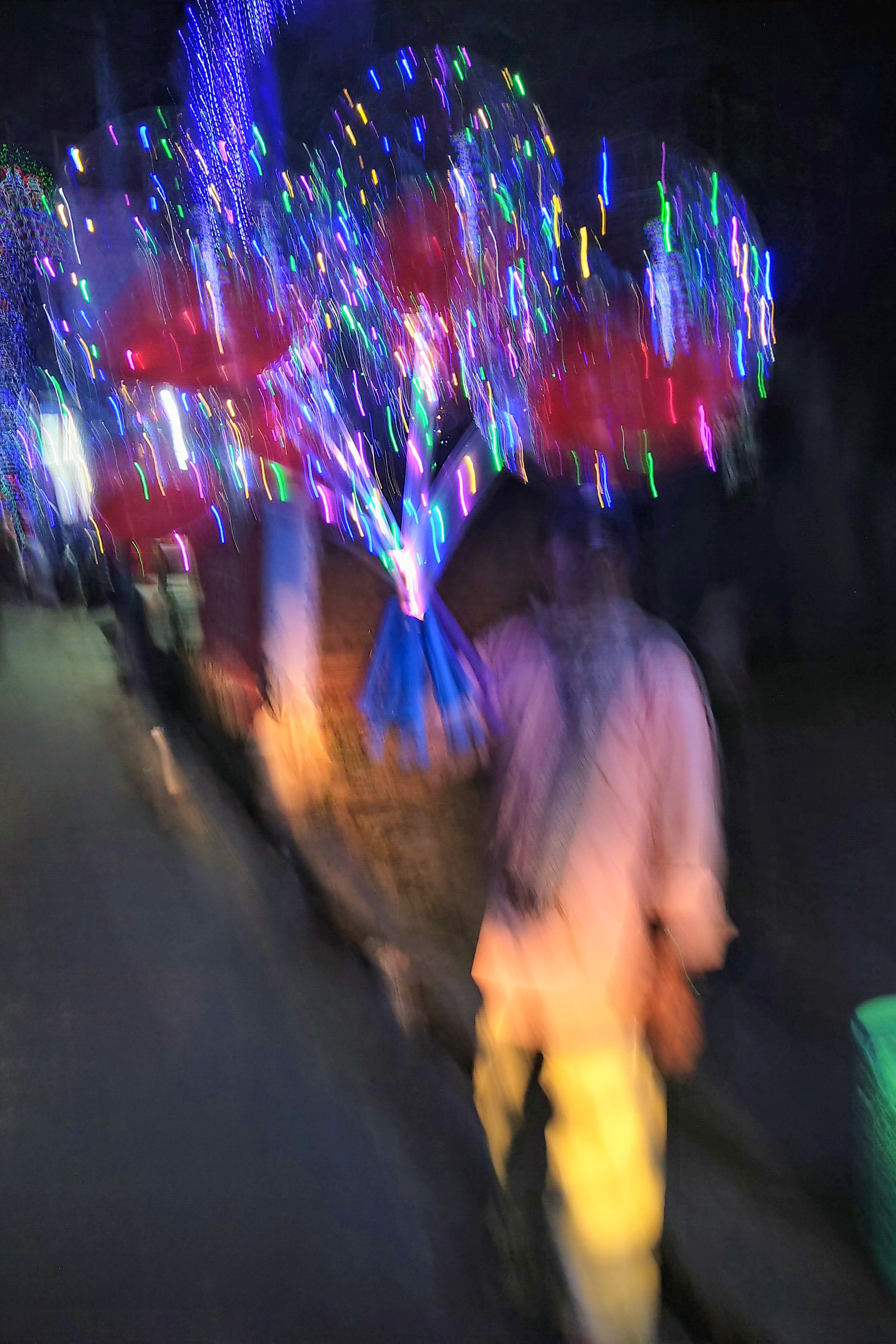
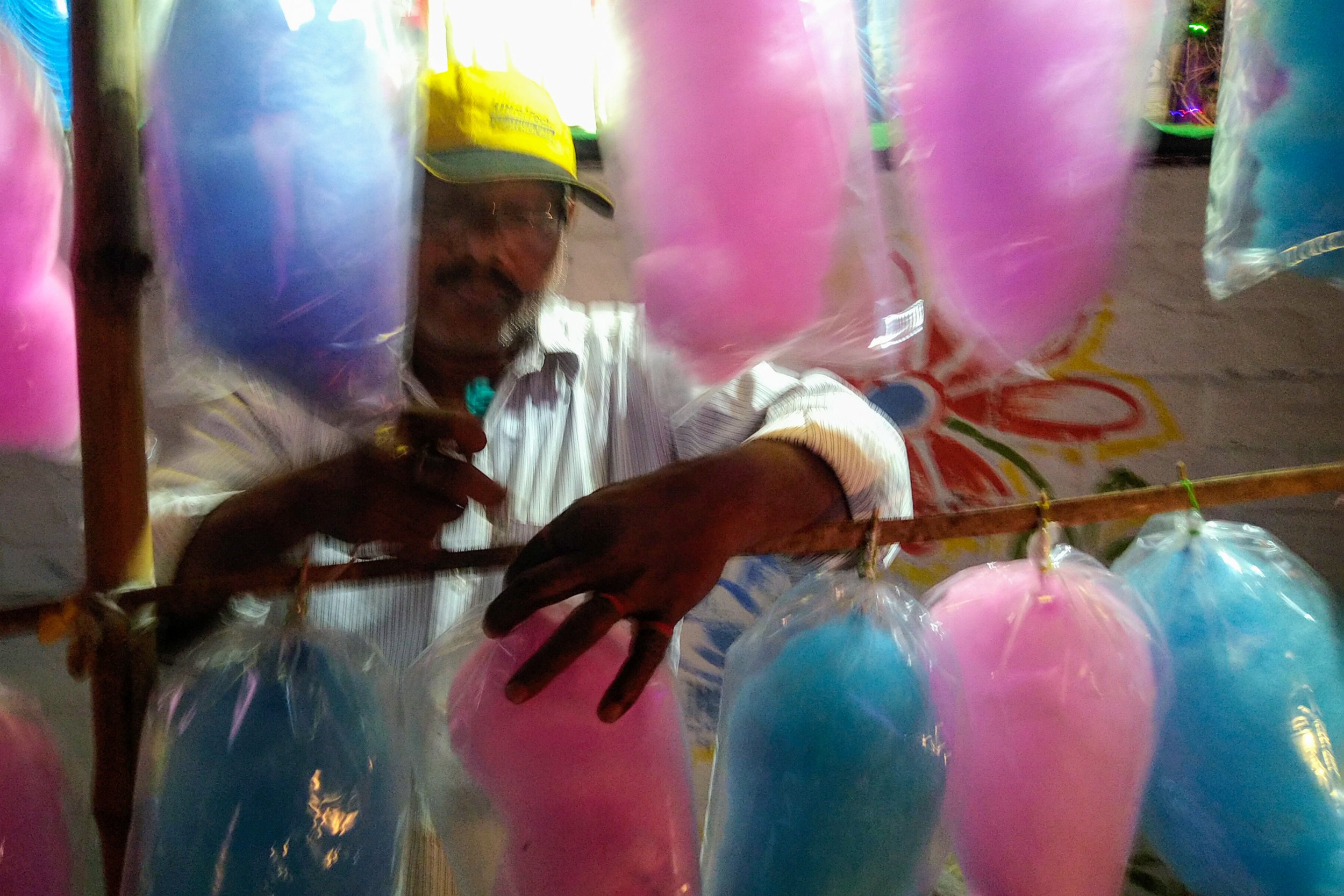
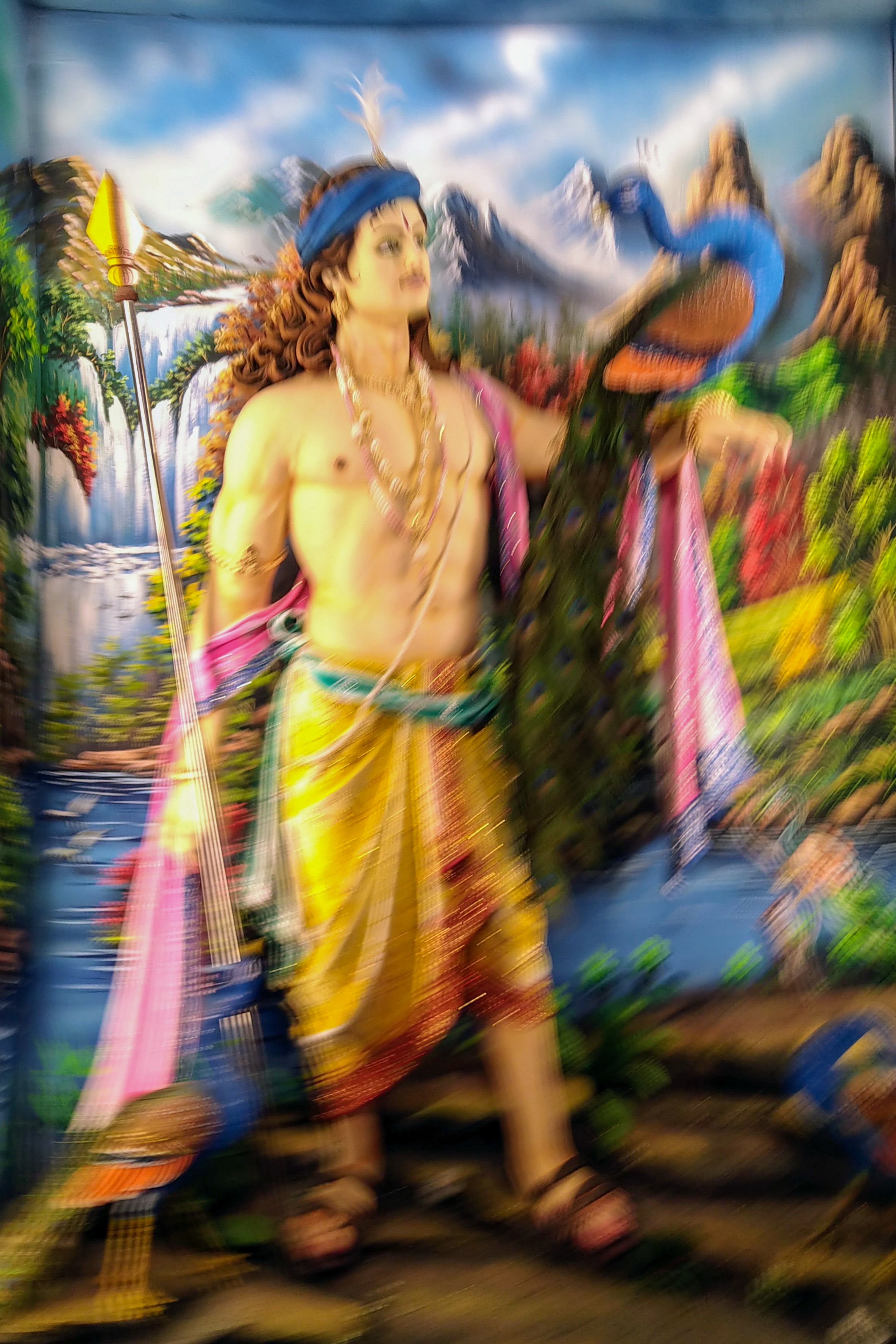
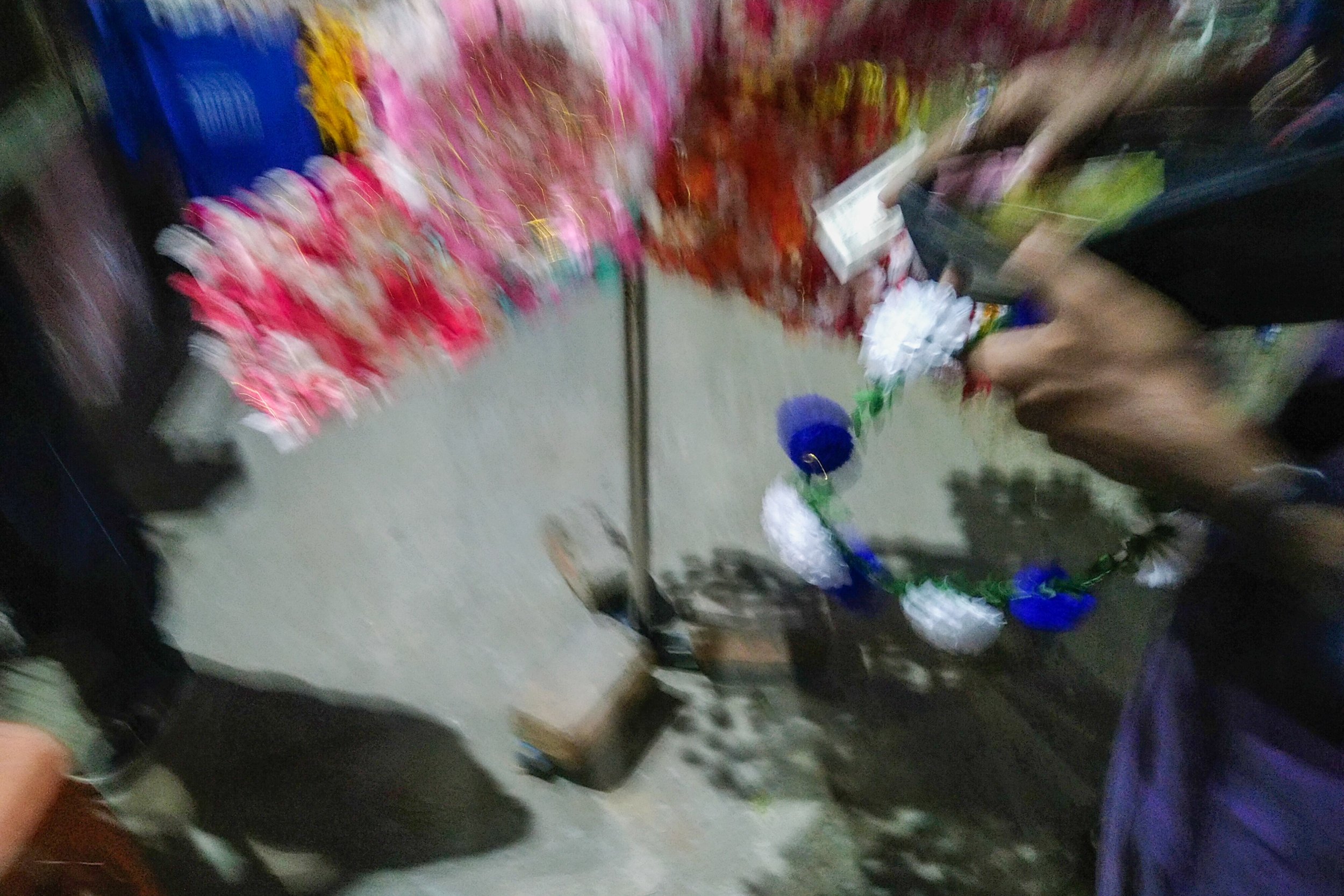
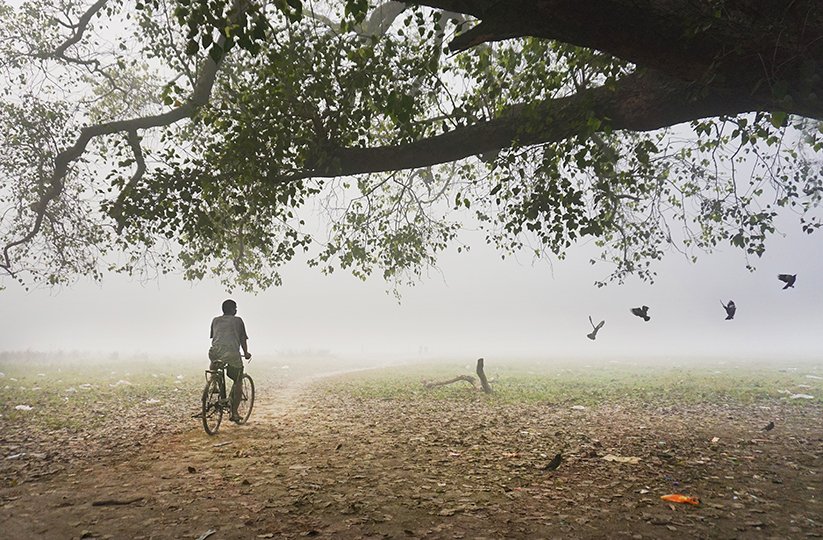
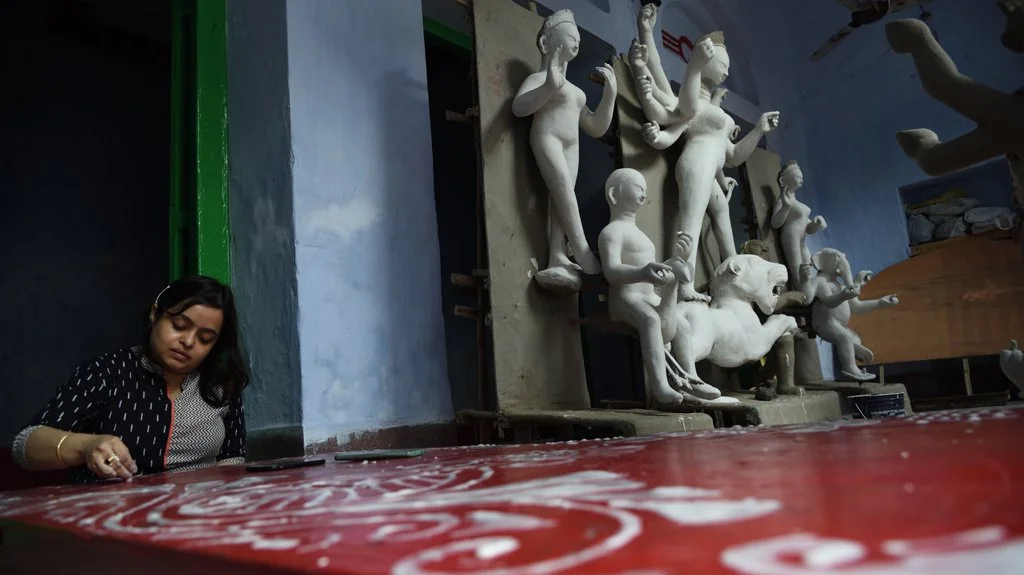
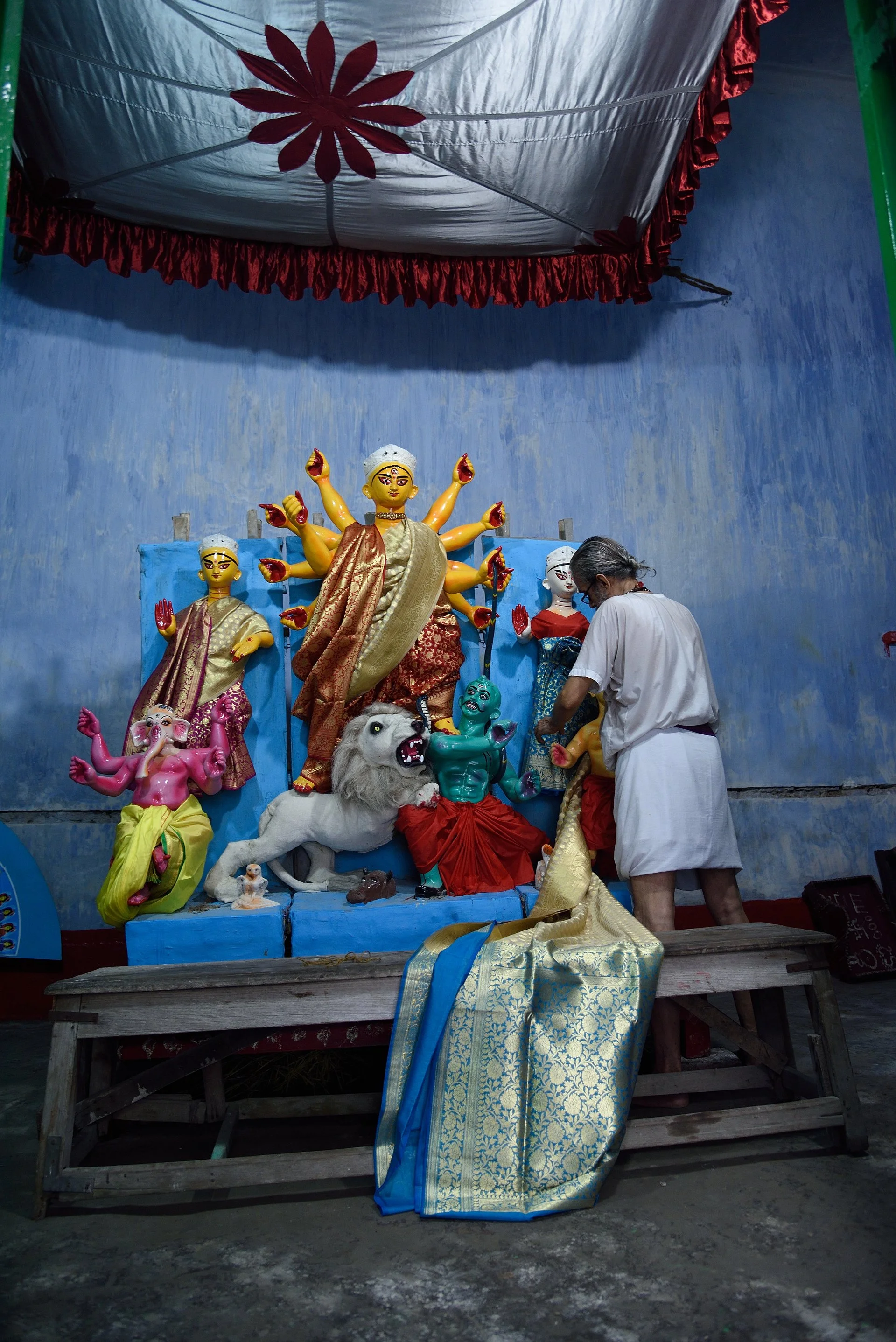
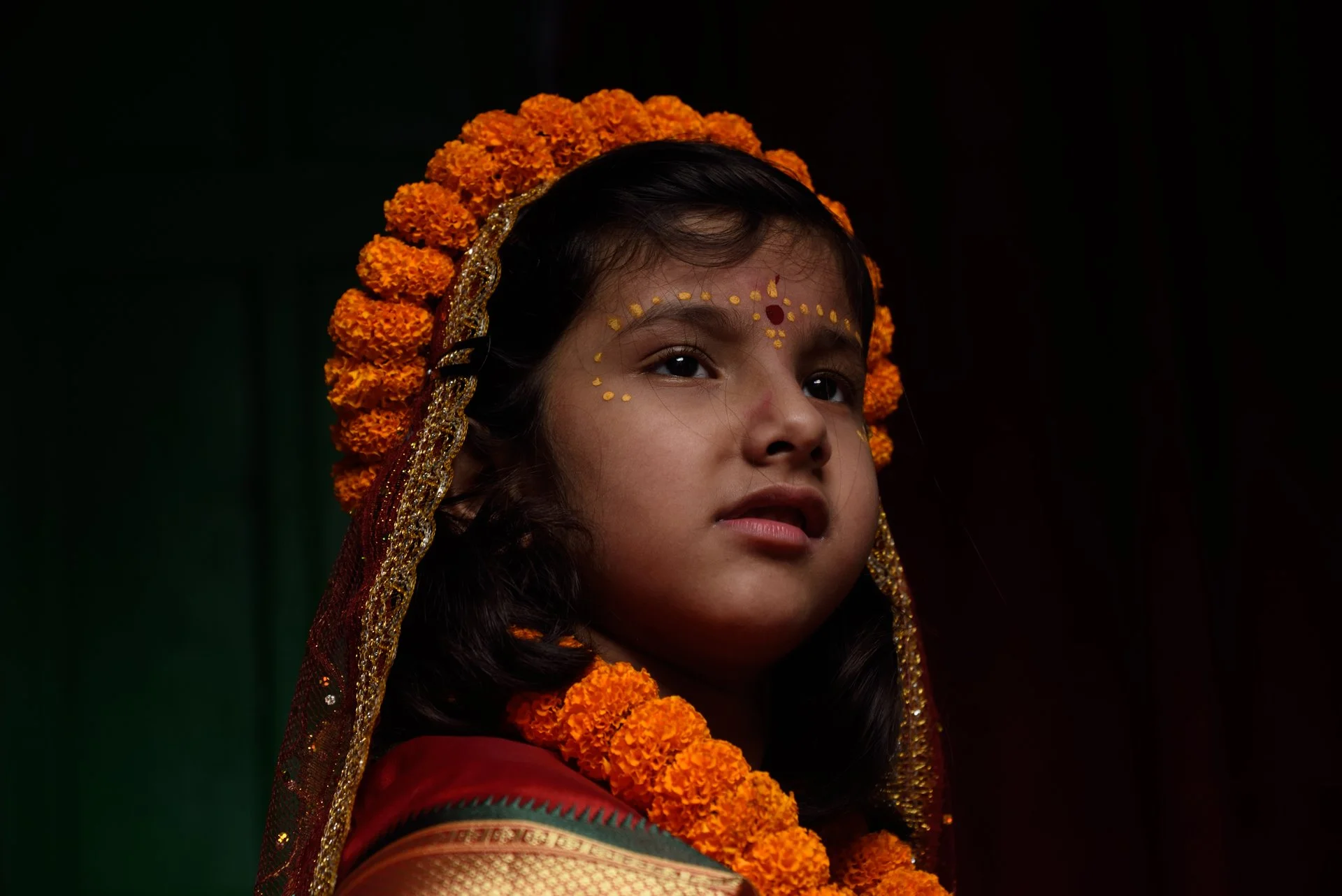
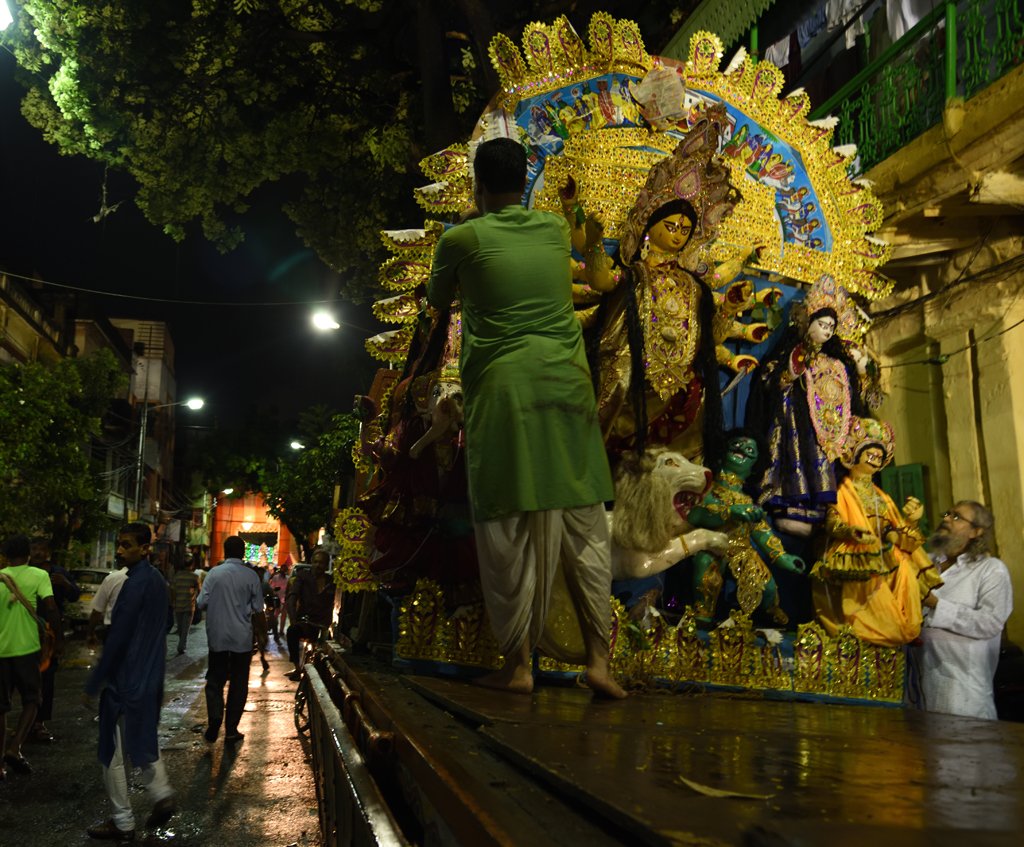
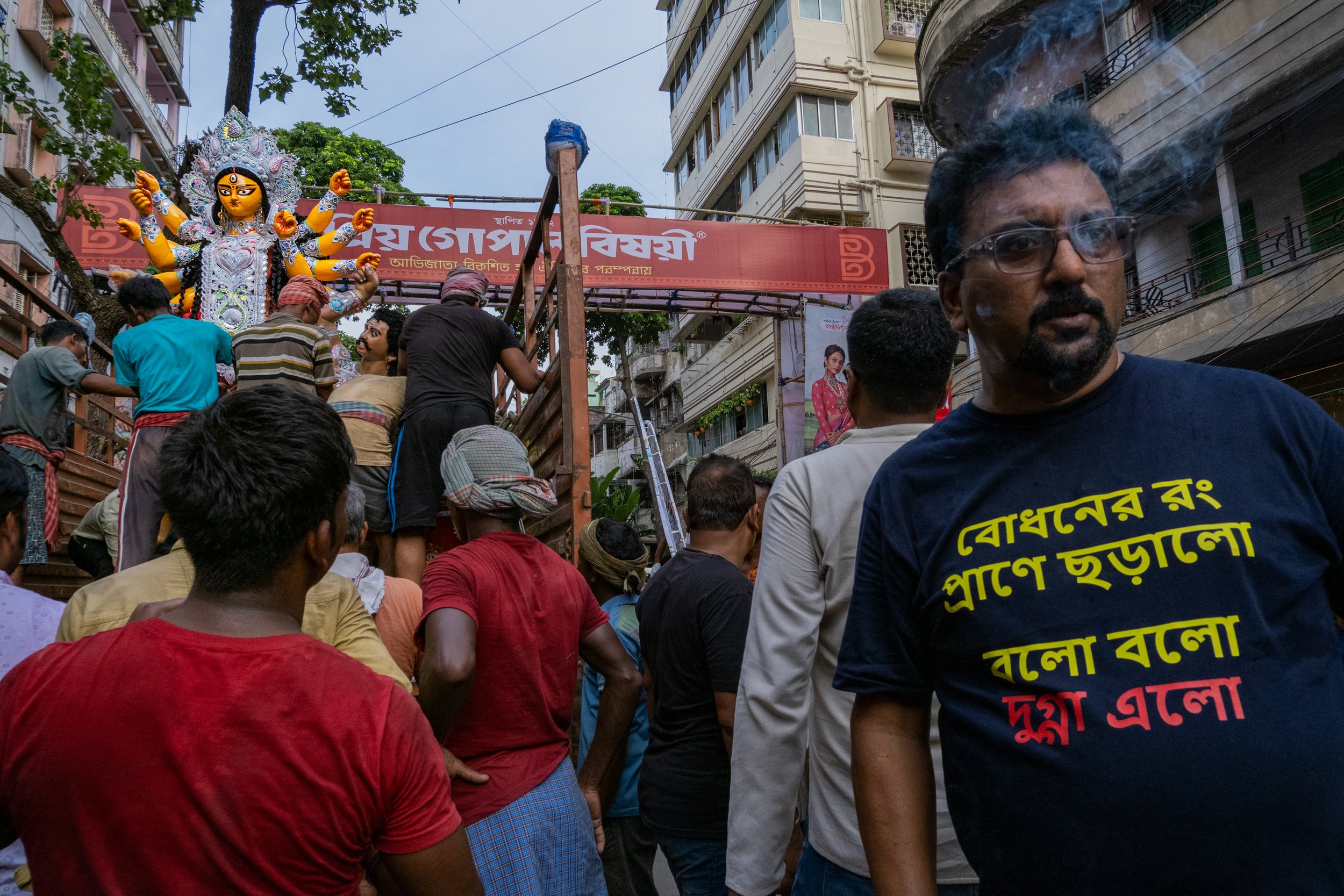
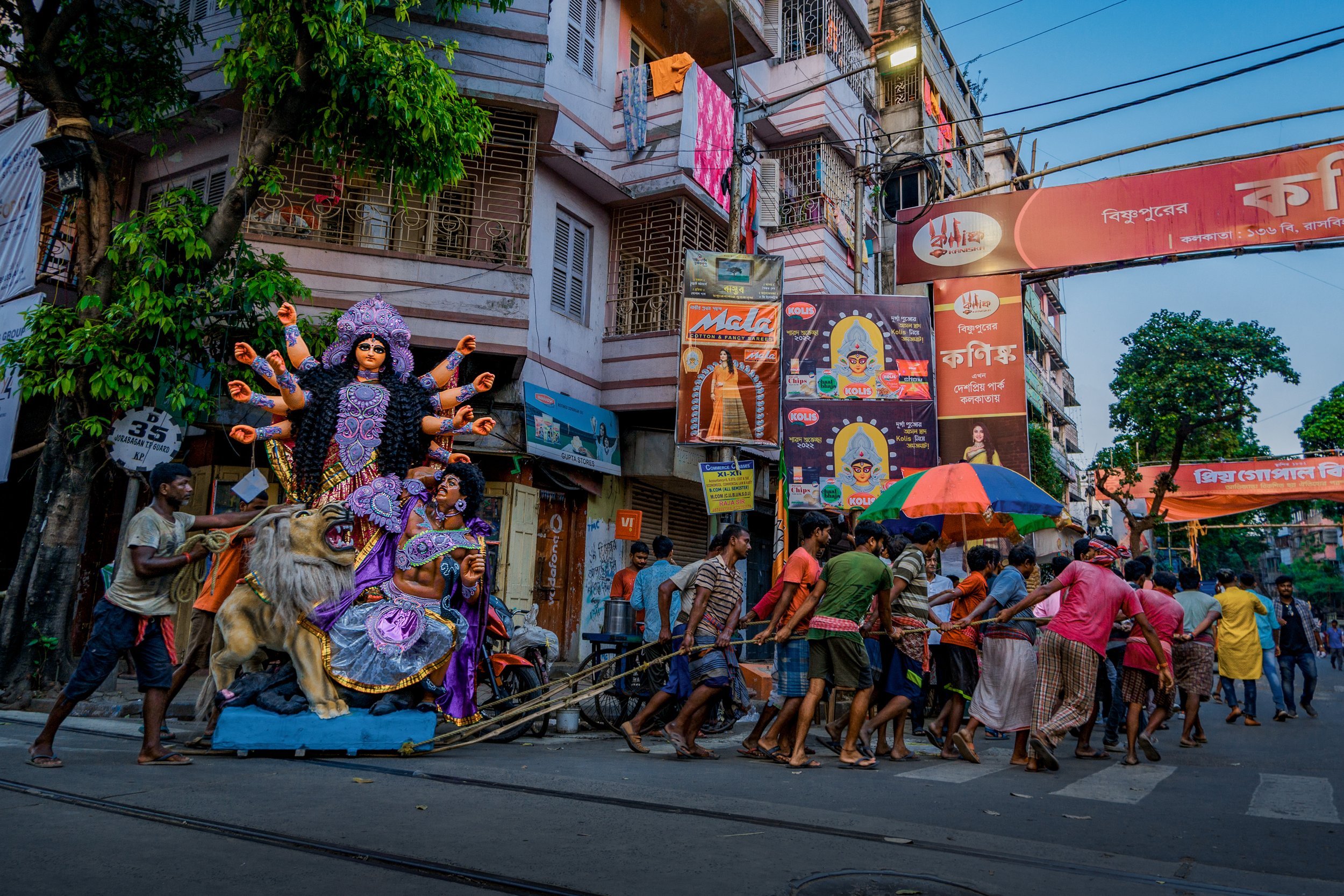
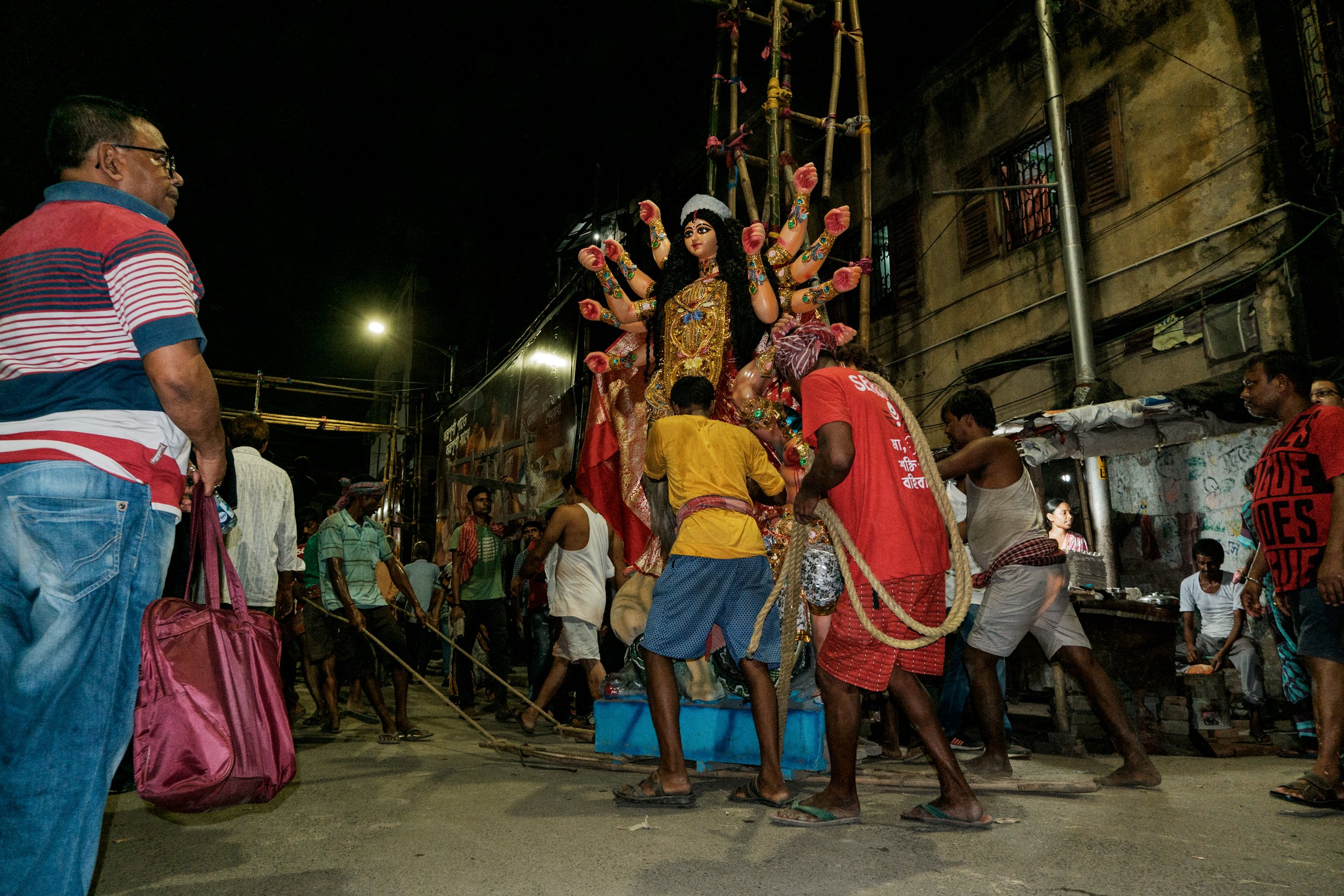
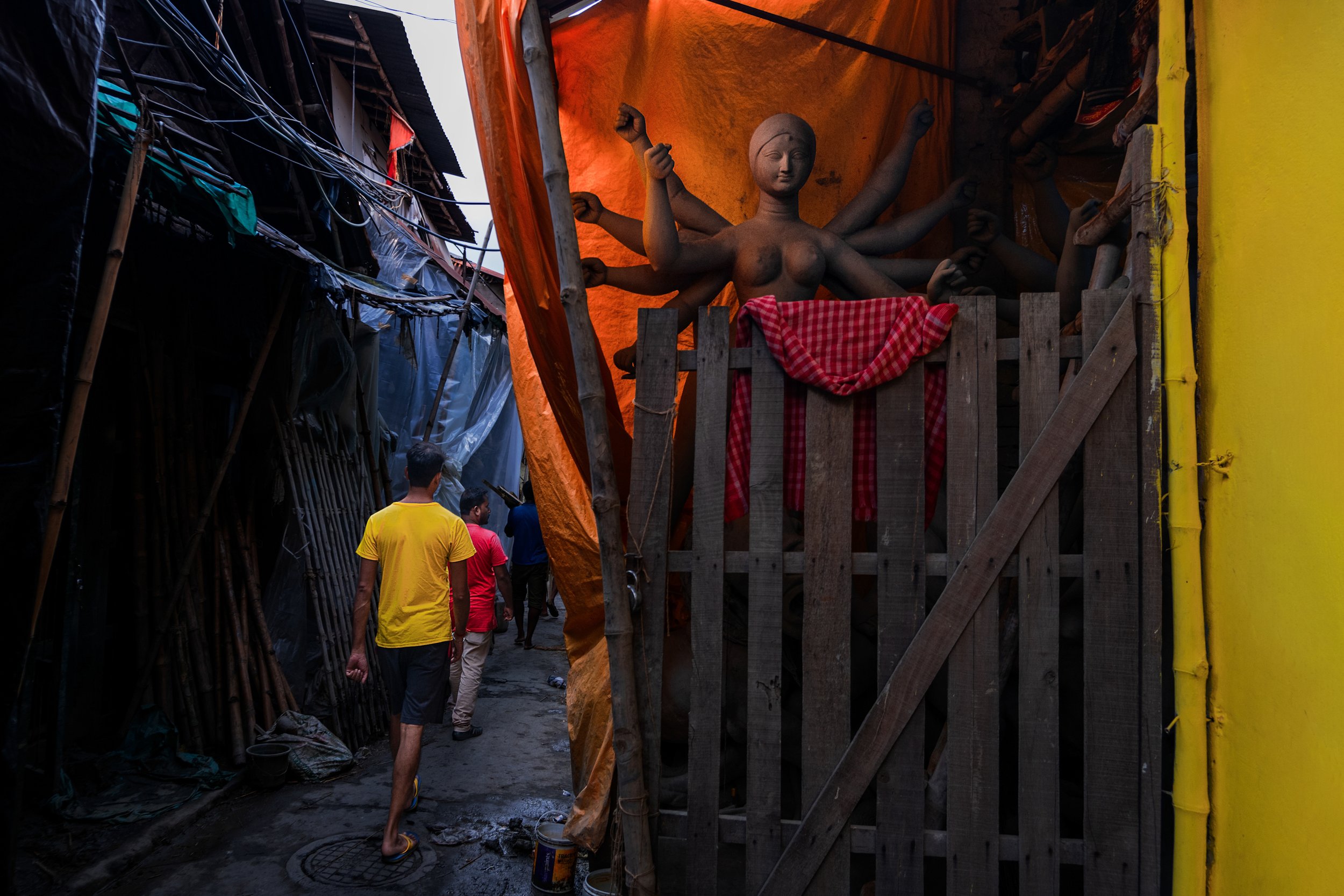
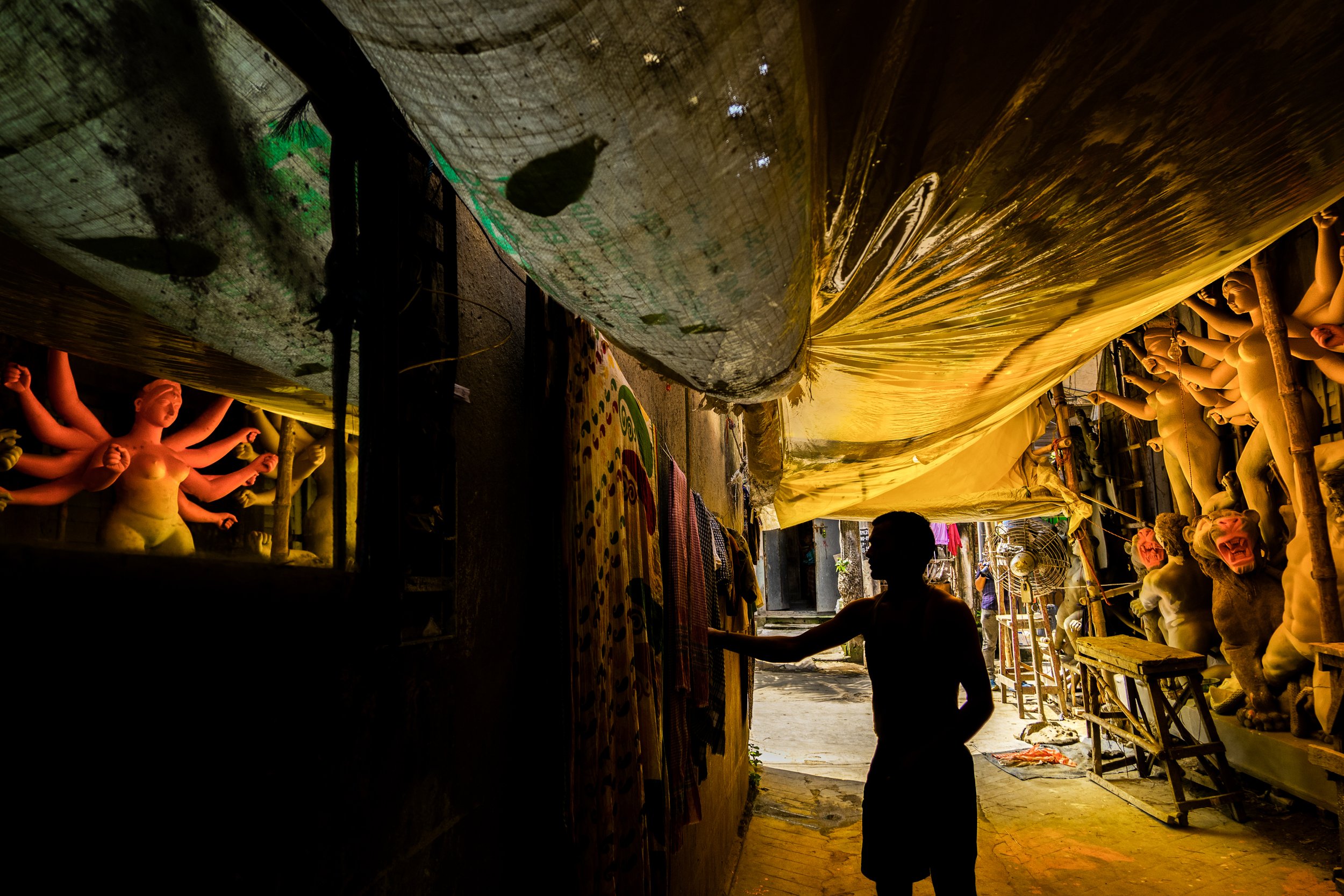
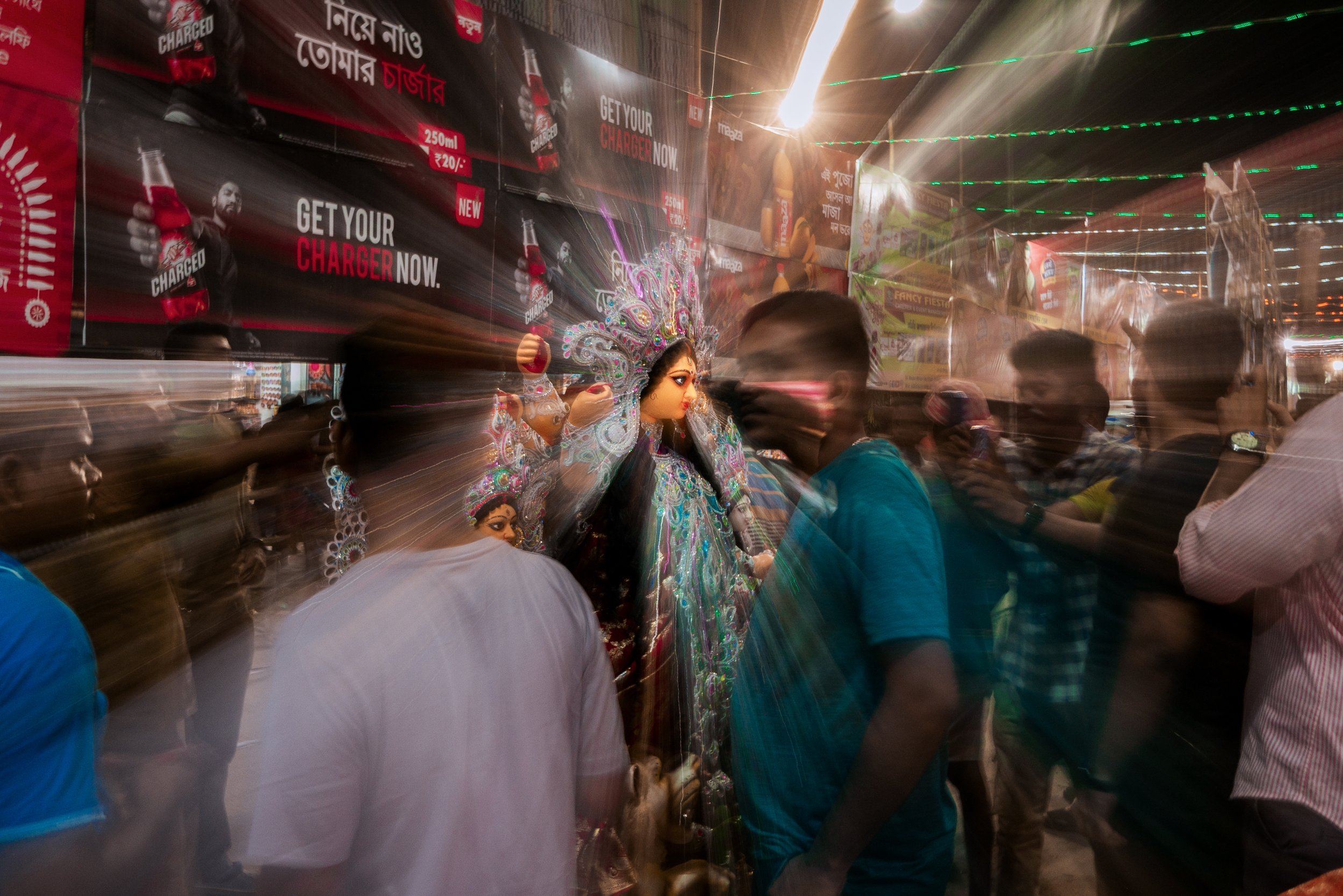
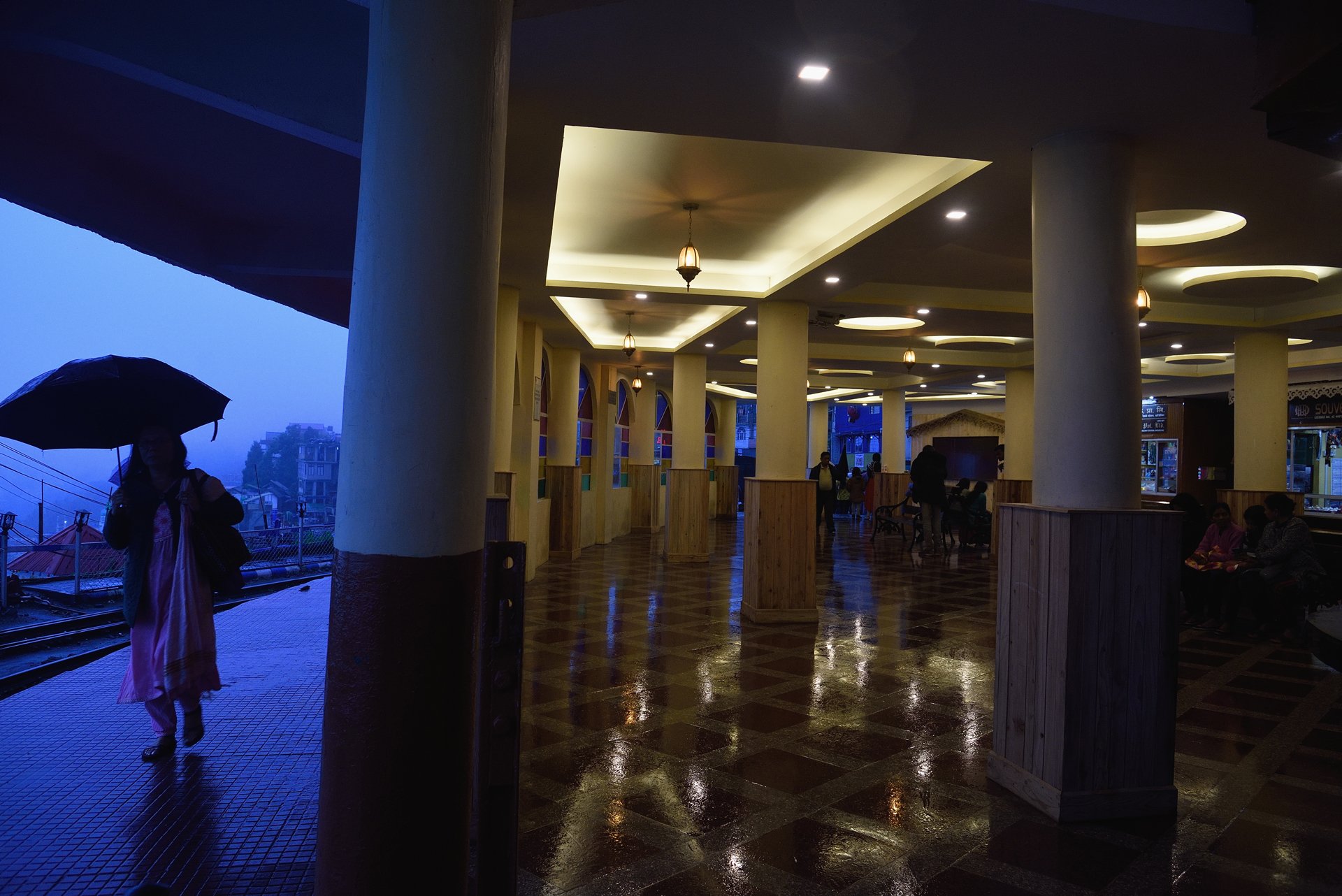
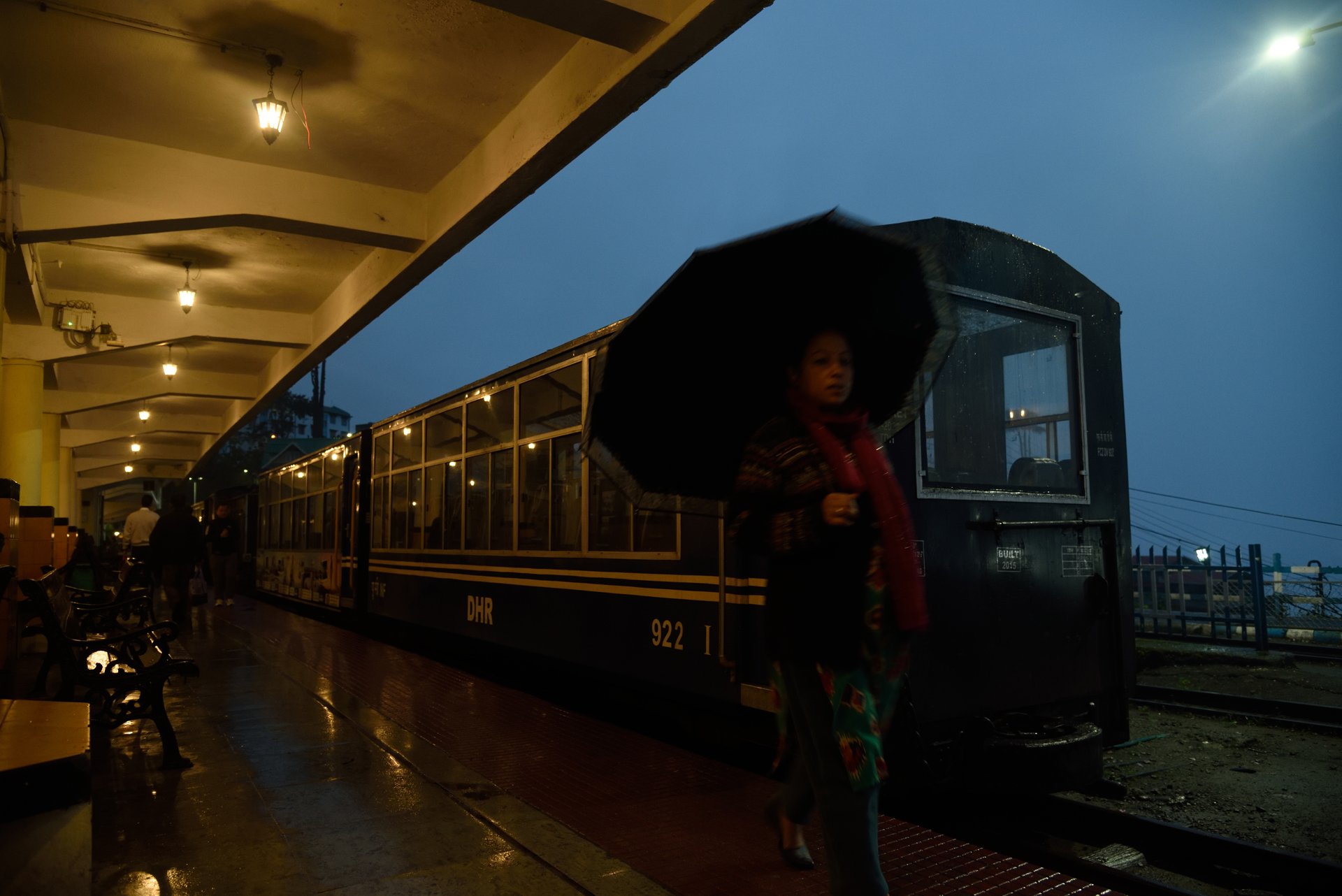
       Light, the main source of creating a frame, is better to say it is the backbone of Photography. The contrast of Light & Shadow is important for the proper balance of images. Light makes an image seen brighter while shadow can draw drama to a specific part of an image's composition.

     In 2020, I started the journey of Photography with my Sony DSC H400 gear ( primarily with all kinds of frames). Gradually I started taking interest in the street moment and raw sense of daily life. And now for the last 1 year, I have been completely concentrating on Street Photography genre.

       During my Street Photography journey, the most beautiful thing which attracts me is colour, light and shadow. Especially the magic of light and shadow is one of my favourite subjects.

      That’s why from mid in 2021, I started to capture these Light & Shadow frames and the journey still continues. Here in this ongoing series, I am trying to showcase my best 14 frames. Among them, 7 frames are in daylight ( Sun is the universal light source) and 7 frames are in artificial light (evening time). But all are strictly candid moments for capturing the actual emotions. 


Arin_Dutta_9836993924_1_Street_6-3.jpg
Arin_Dutta_9836993924_1_Street_55.jpg
Alo Chaya_Kumartuli.jpeg
20210908181659_IMG_0247-01.jpeg
Arin_Dutta_9836993924_1_Street_6-3.jpg Arin_Dutta_9836993924_1_Street_55.jpg Alo Chaya_Kumartuli.jpeg 20210908181659_IMG_0247-01.jpeg
 
View fullsize Arin_Dutta_9836993924_1_Street_44.jpg
View fullsize Arin_Dutta_9836993924_1_Street_3-3.jpg
View fullsize Arin_Dutta_9836993924_1_Street_7-3.jpg
View fullsize Arin_Dutta_9836993924_1_Street_5-3.jpg
 
Arin_Dutta_9836993924_1_Street_1-2.jpg
Arin_Dutta_9836993924_1_Street_54-1.jpg


|| Senior Manager Operation Apollo Pharmacy (Retail) H.O-Estn Rgn

Arin Dutta
 
Friday 12.16.22
Posted by Progressive-Street
 

A migraine patient

A migraine patient

by Agnimitra Banerjee

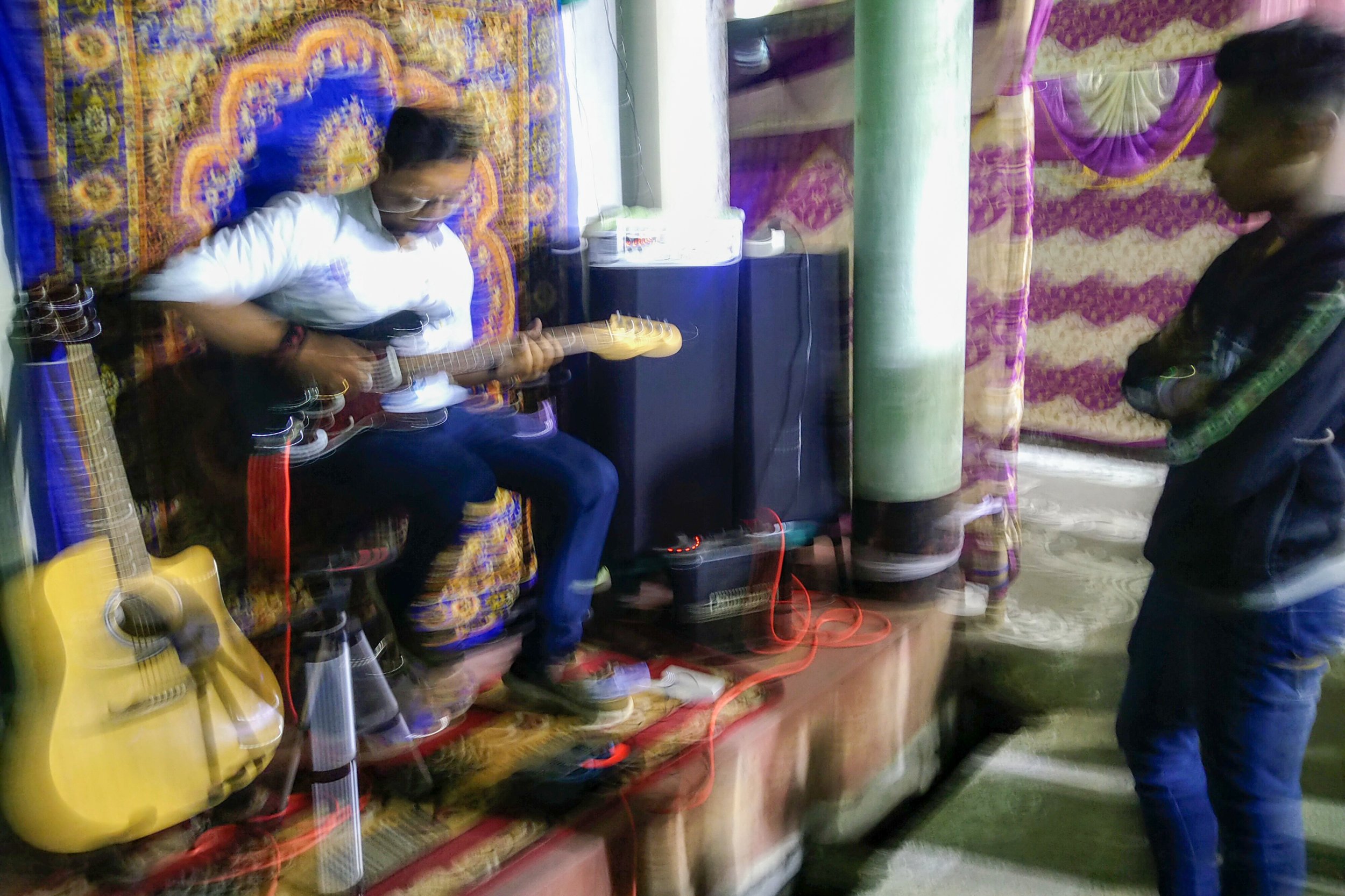
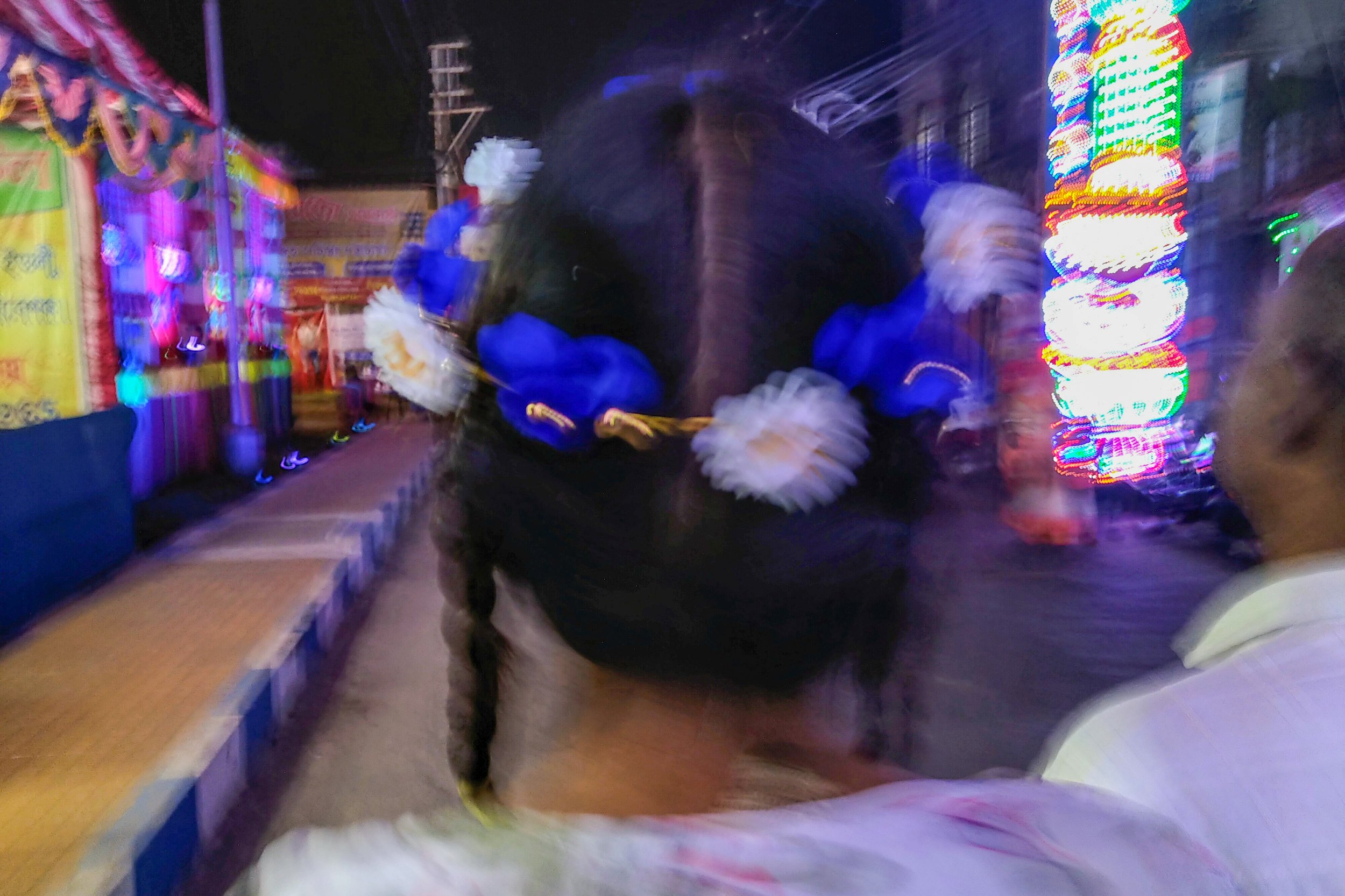
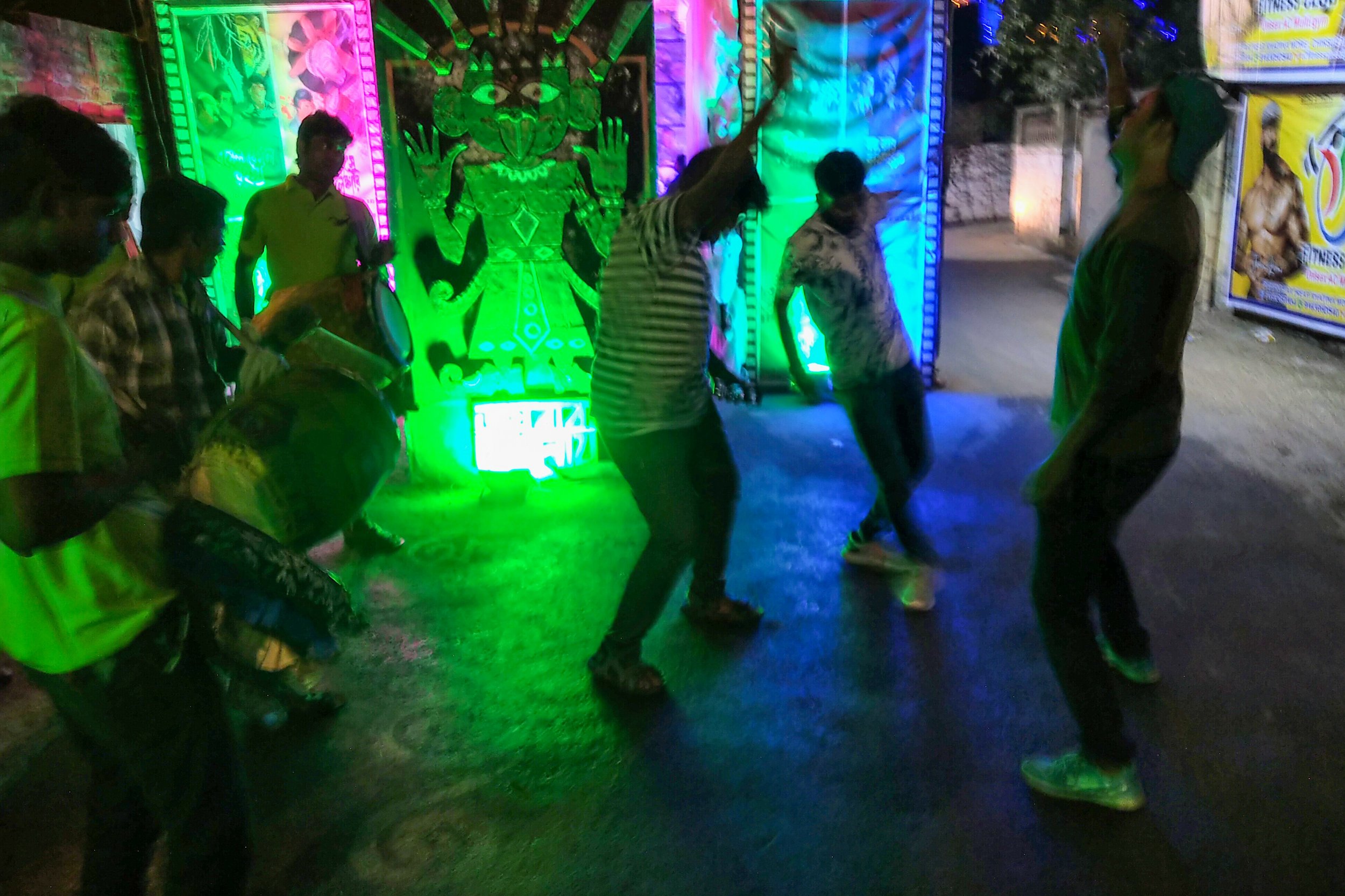
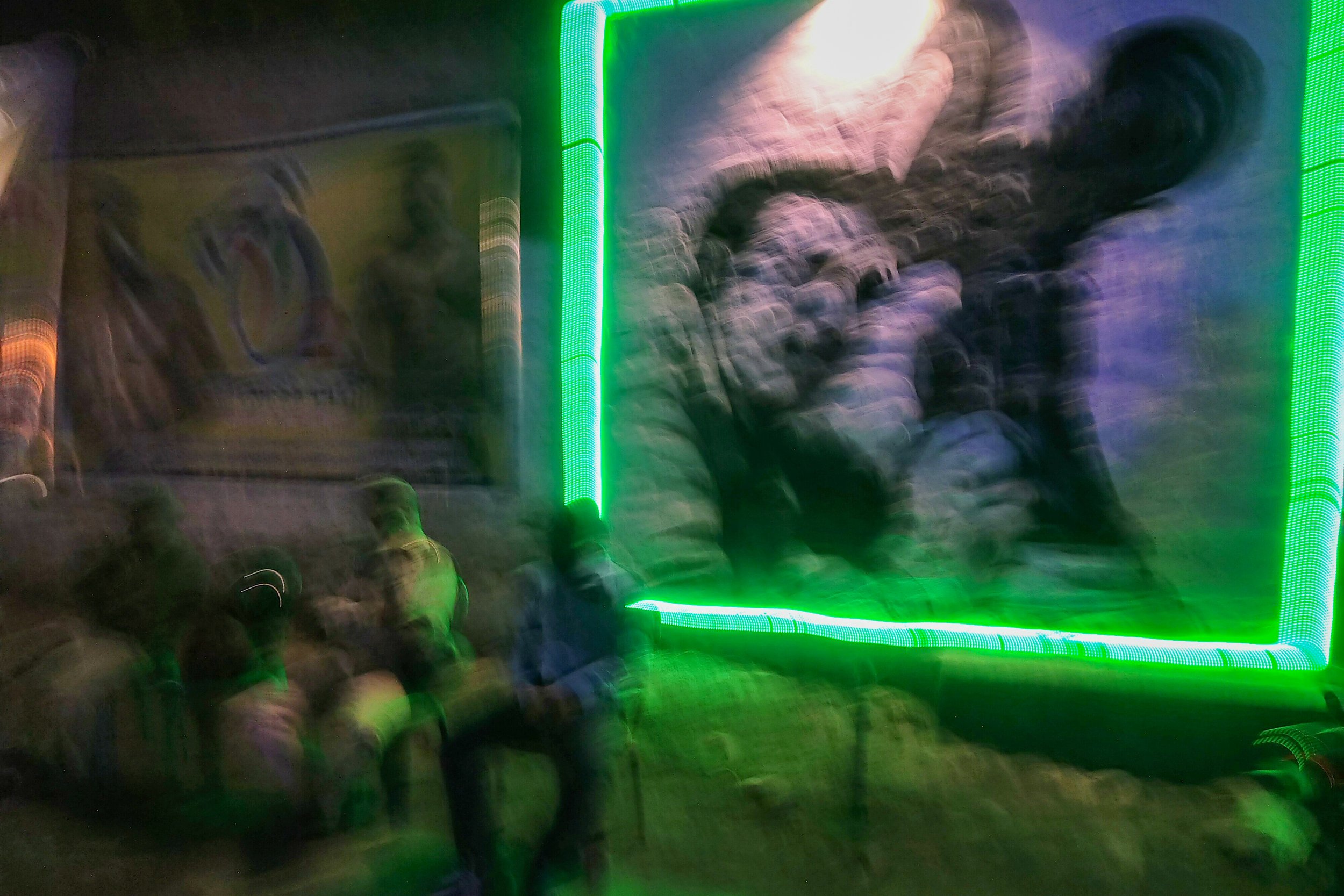
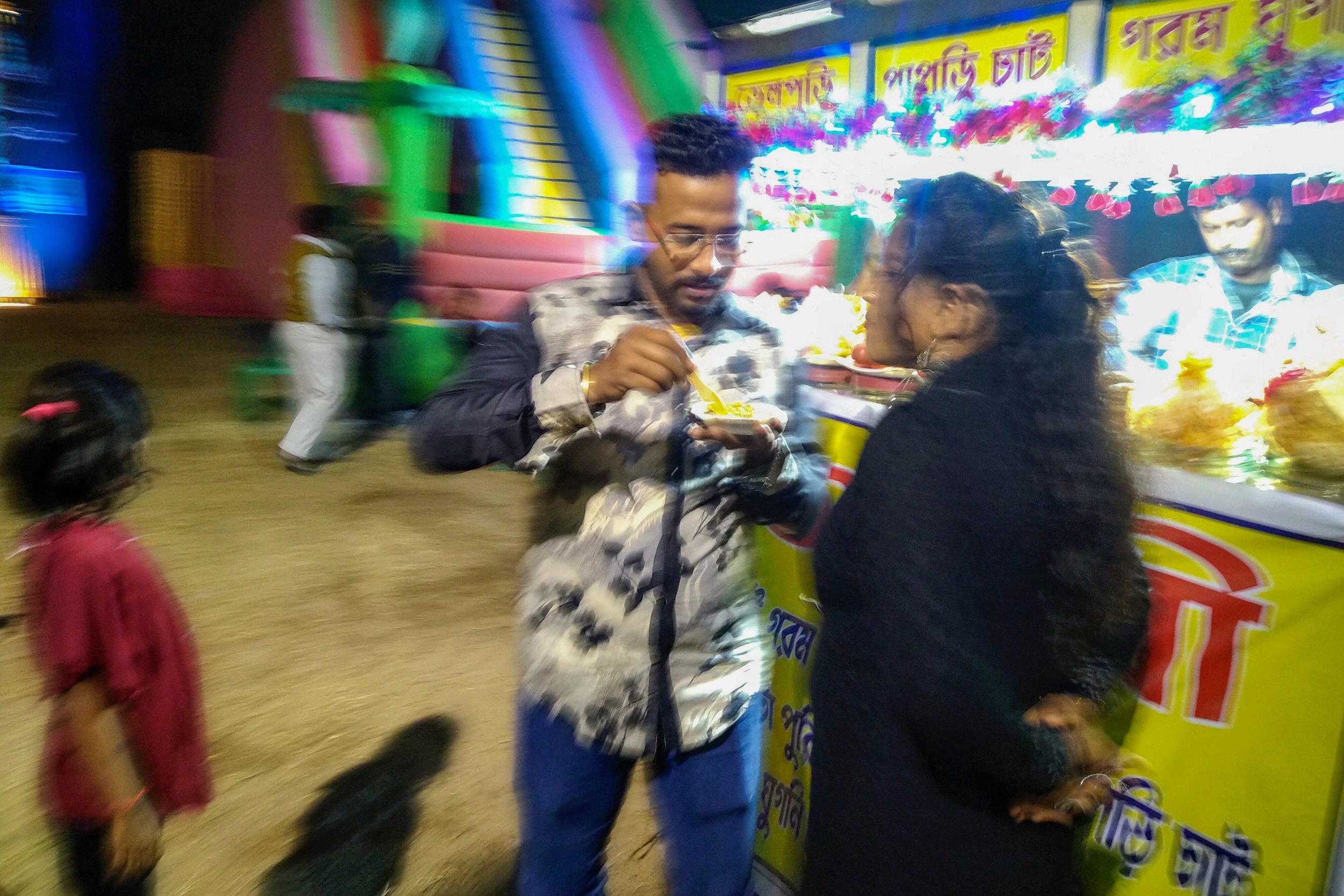
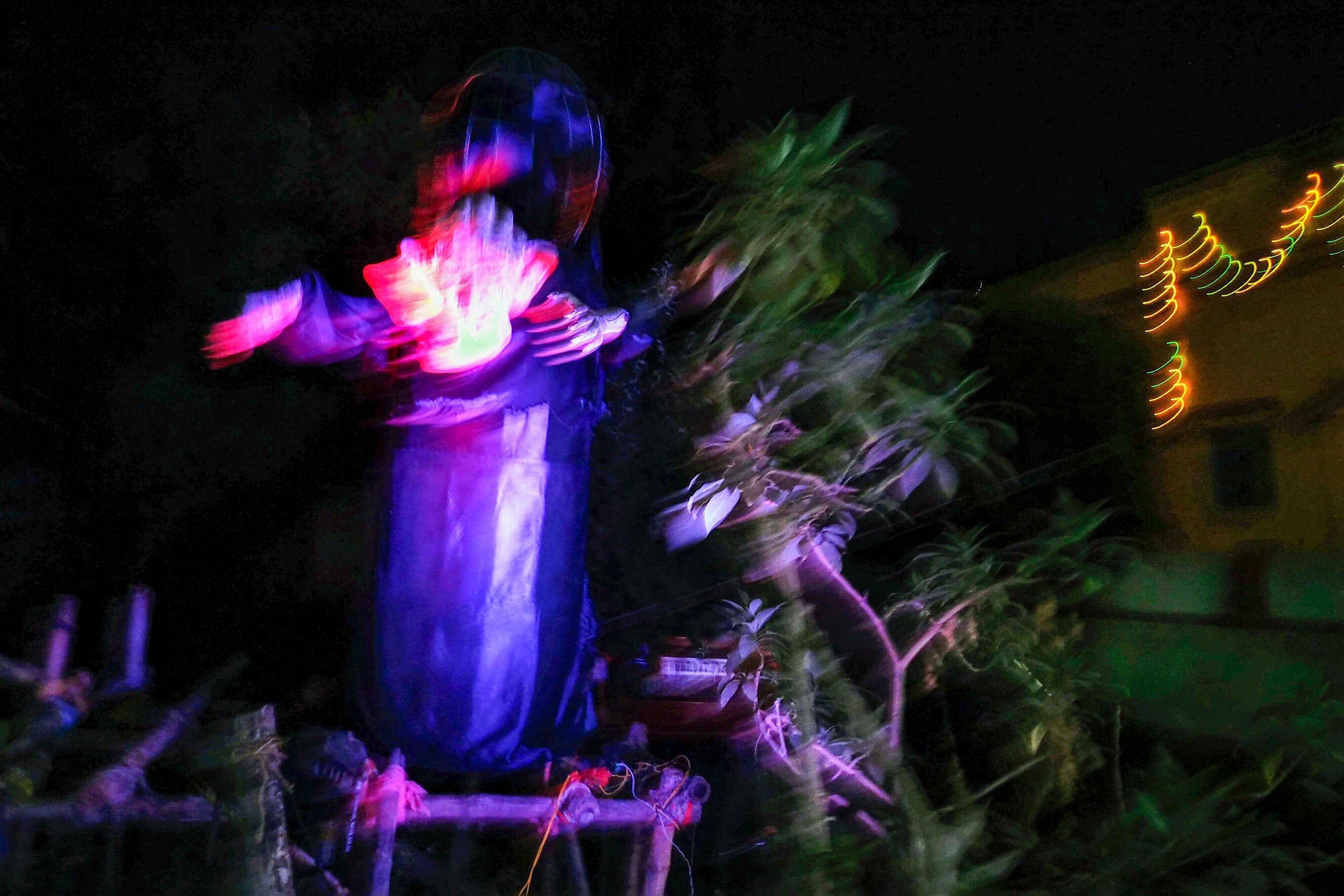
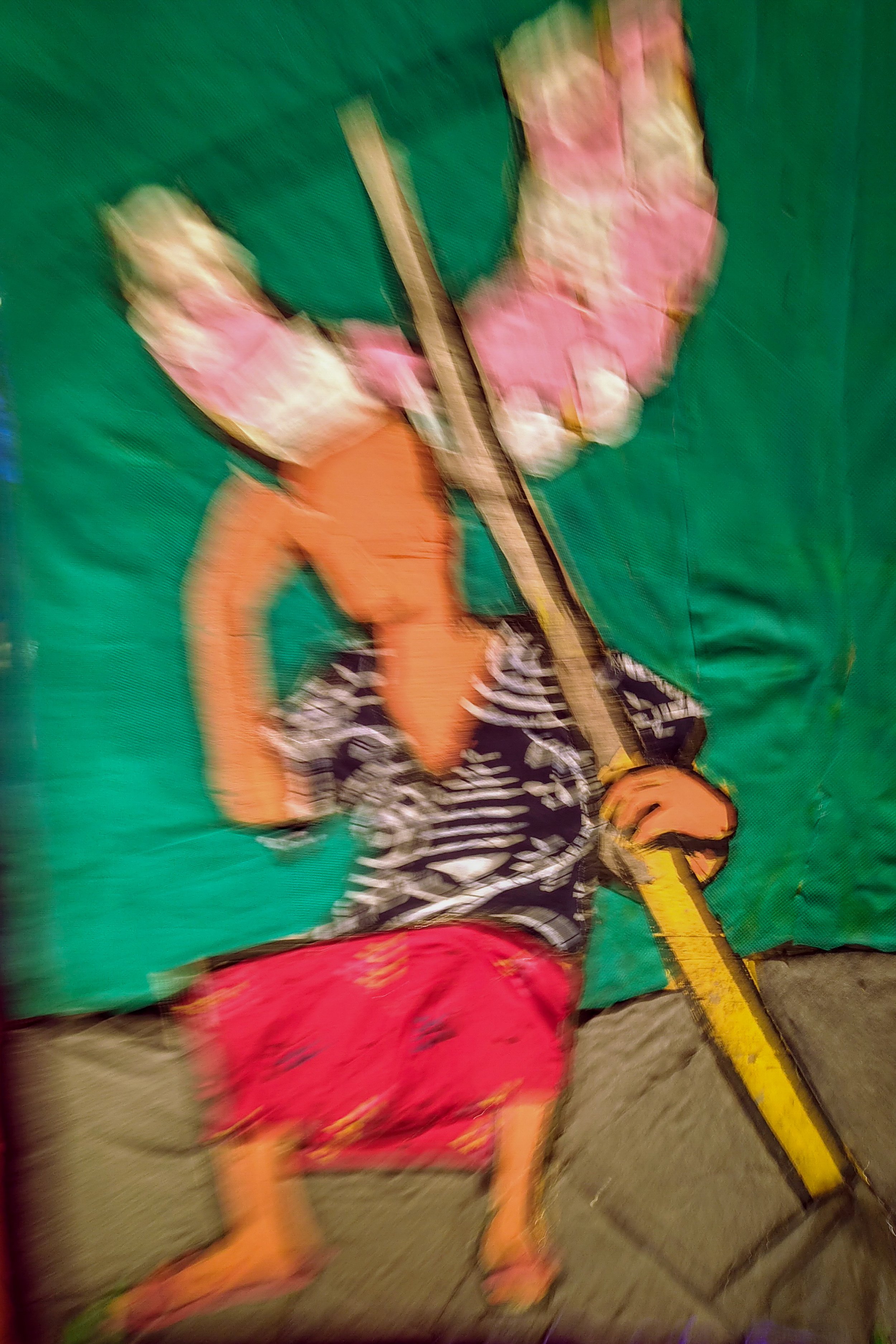
I am a migraine patient. Most of the time I am suffering from headaches. But I have a keen interest in Street Photography and for this reason, to satisfy my thirst, recently I went to Bansberia – which was one of the main cities of ancient Saptagram in Hooghly, West Bengal – to observe the celebration of “Kartik Puja” with one of my friends. Here the Kartik Puja festival is celebrated like the Durga puja of Kolkata.

But again my ailment did not spare me for that day also.

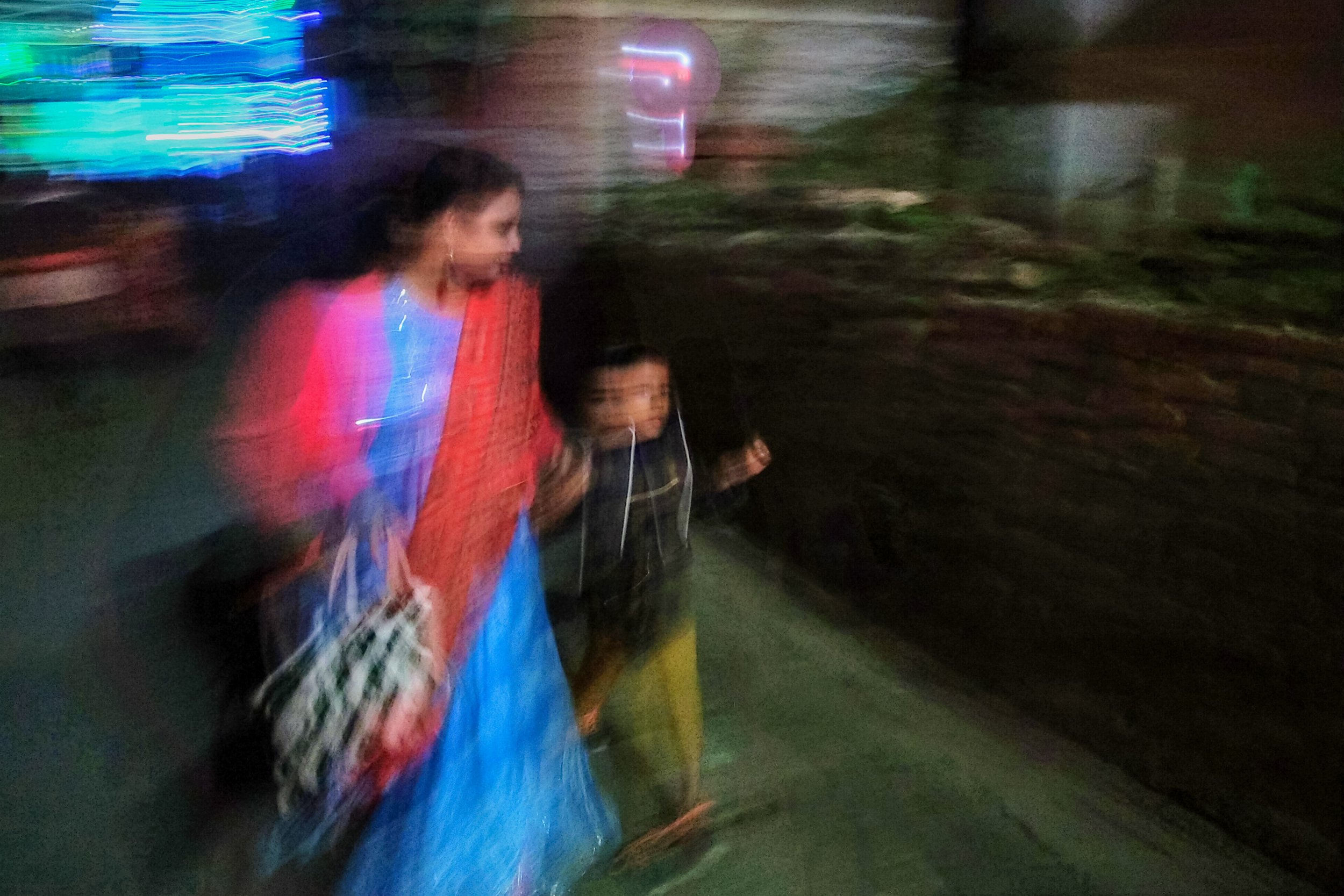
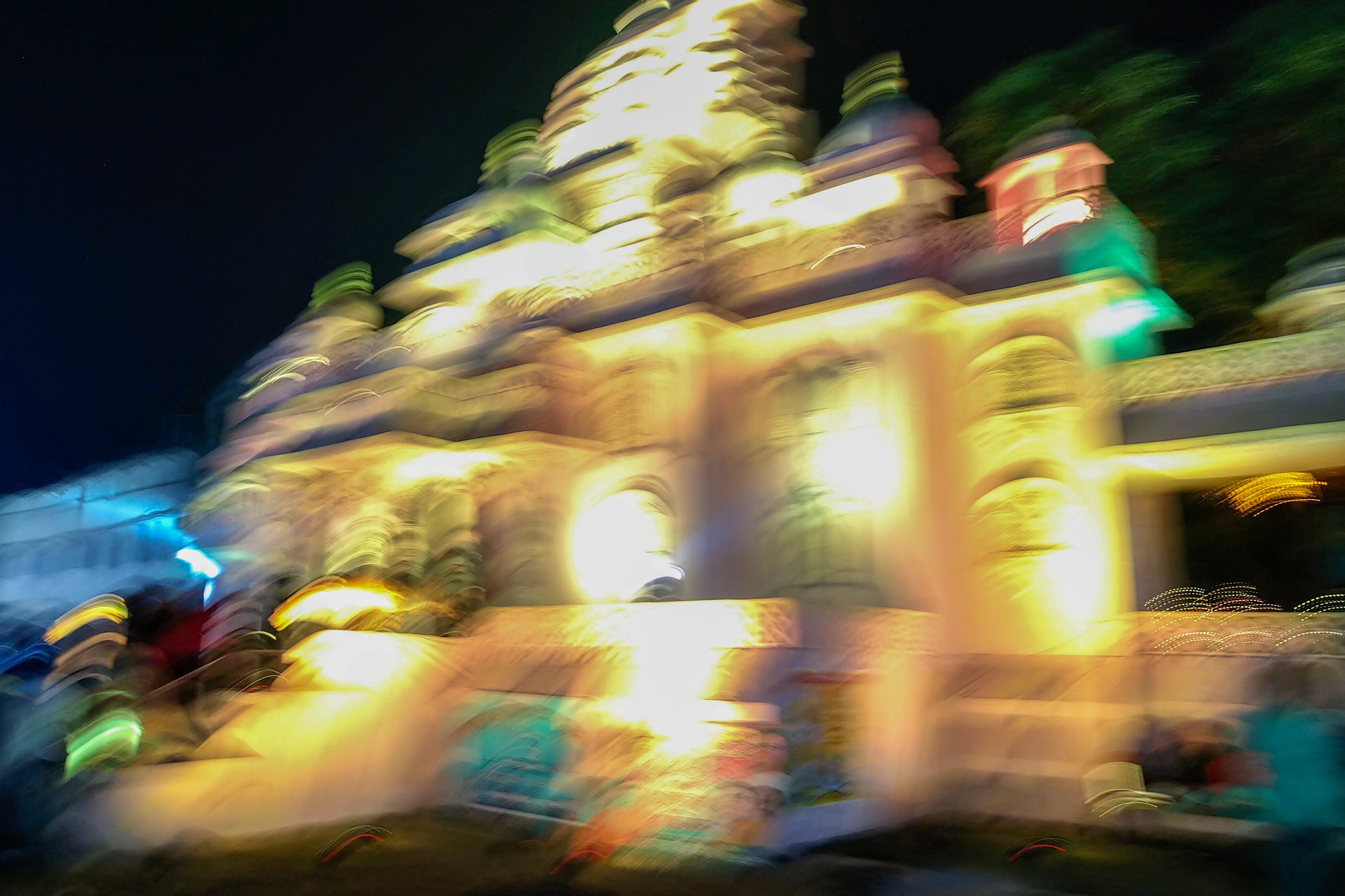
When my migraine becomes severe, I couldn’t tolerate much light, sound or chaos. Everything becomes so messy in front of my eyes as it seems to me that every noise, every light and chaos gives me more and more headaches and for that, my eyes could not tolerate that thing and do not want to remain open and I start to feel very dizzy.

But still I wanted to escape from my sickness for that day by taking photographs. And after that day when I was looking through my pics, I found some ones of that day which I think are exact interpretations of my situation on that day.

I think those pictures can best depict how I was feeling, my mood, and my physical situation on that day at that place.

Thus these pictures become my close-to-heart photographs of the street for that day.

02.jpg
03.jpg
04.jpg
05.jpg
06.jpg
07.jpg
08.jpg
09.jpg
10.jpg
11.jpg
12.jpg
13.jpg
14.jpg
02.jpg 03.jpg 04.jpg 05.jpg 06.jpg 07.jpg 08.jpg 09.jpg 10.jpg 11.jpg 12.jpg 13.jpg 14.jpg
 

I am Agnimitra Banerjee, from Madanpur village in Nadia district in West Bengal, India. I am taking up photography from my deep interest in art and I want to express myself through my photographs. I also want to show the audience what I actually see or feel at any given moment. For these photographs, I used my mobile phone Asuszenfone Max Pro M2.

Thursday 12.08.22
Posted by Progressive-Street
 

Chasing the Fog by Dipanjan Chakraborty

Chasing the Fog

by Dipanjan Chakraborty

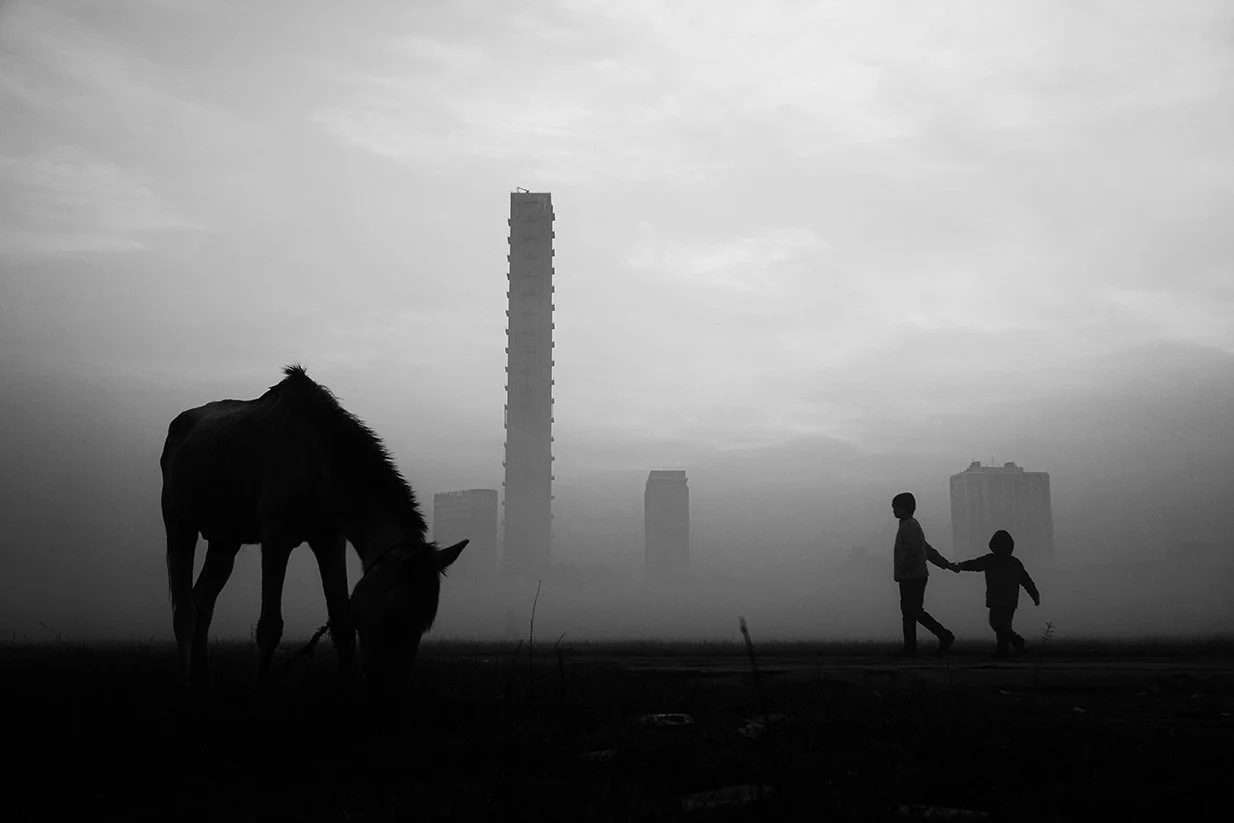
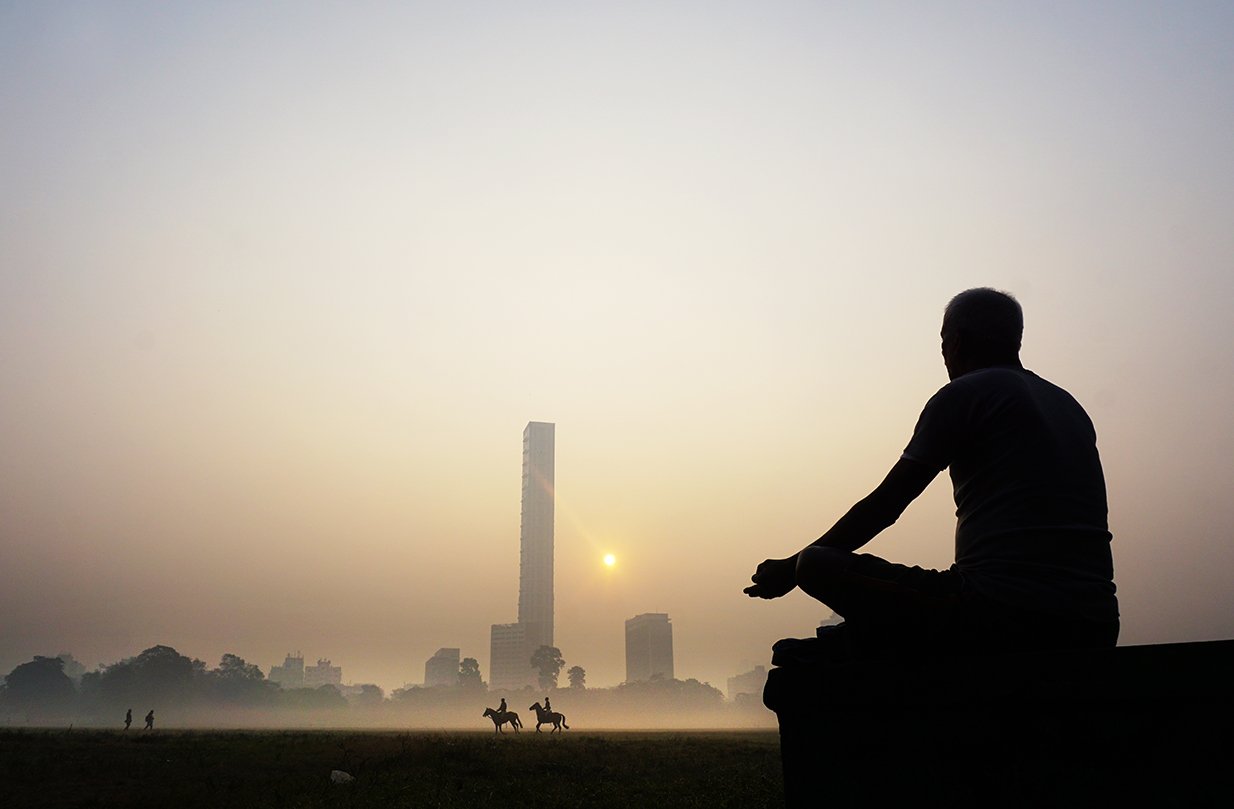
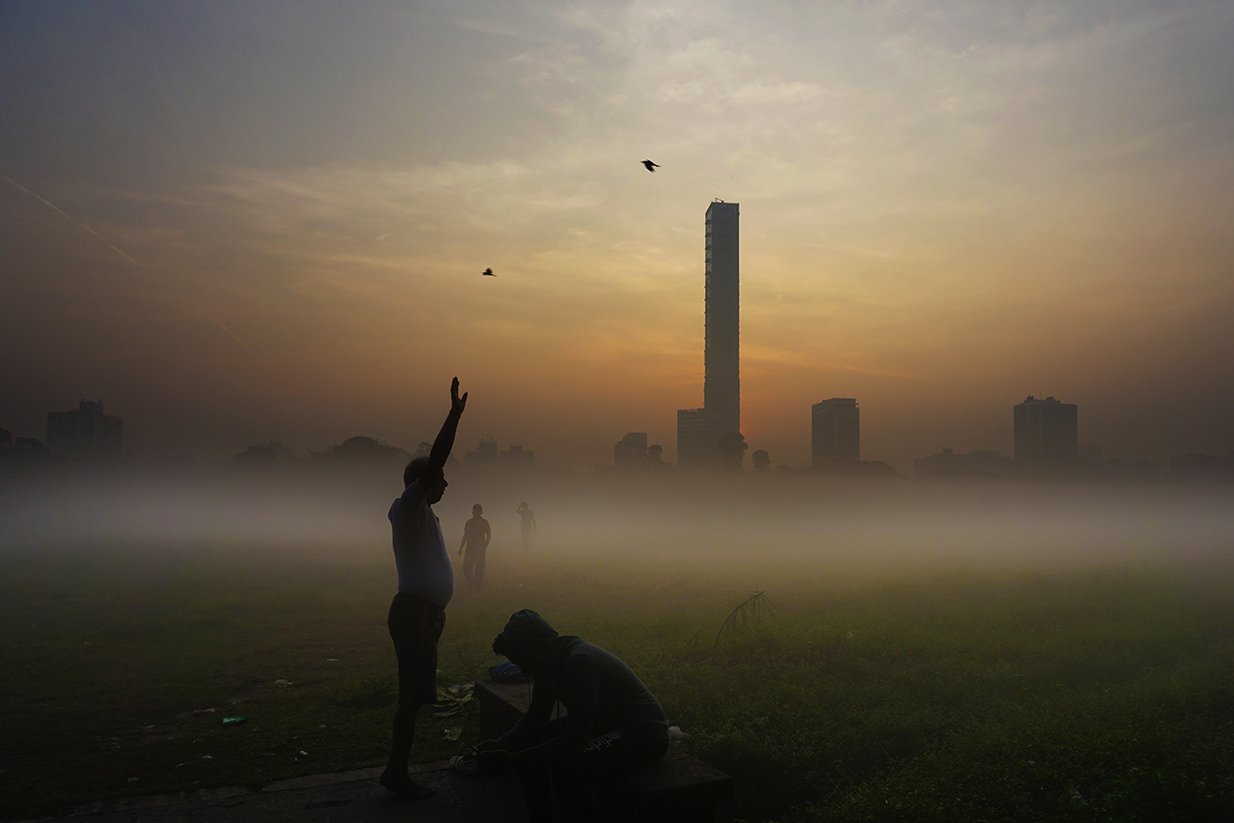
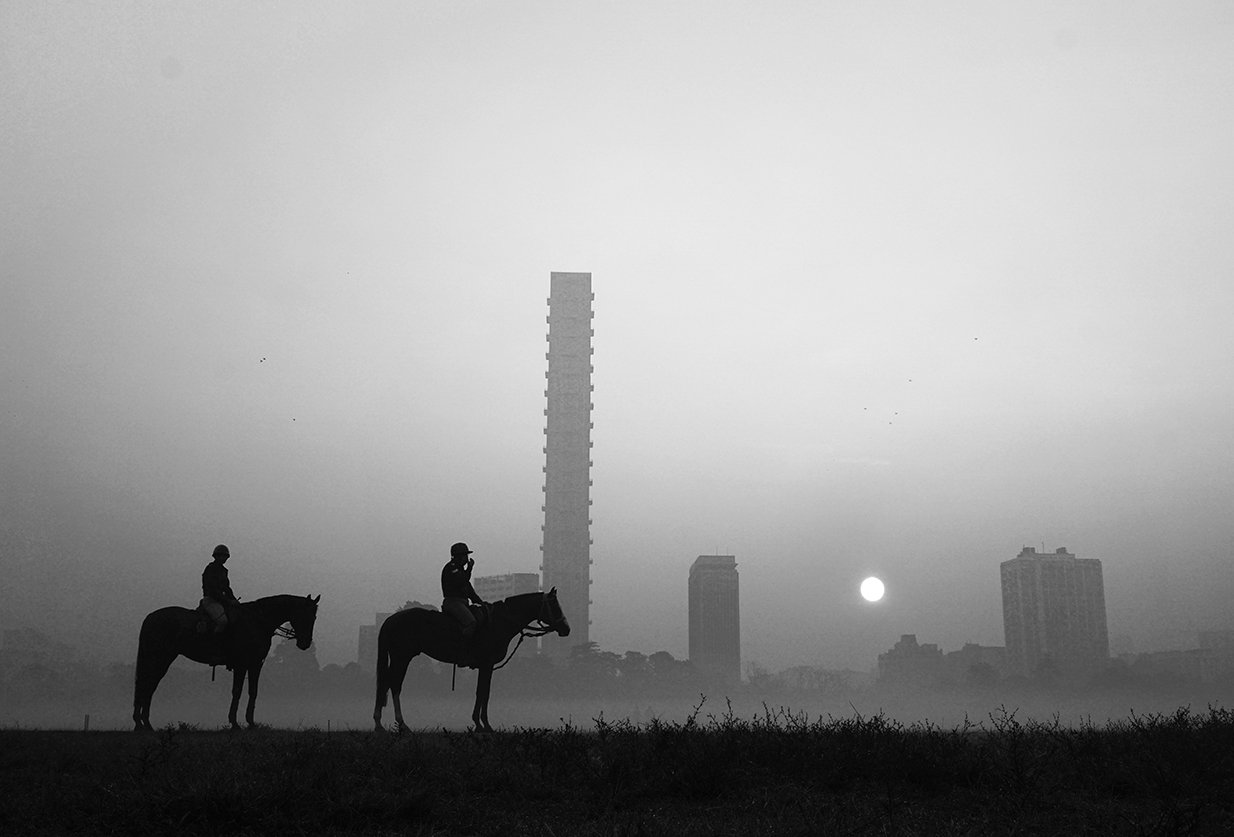
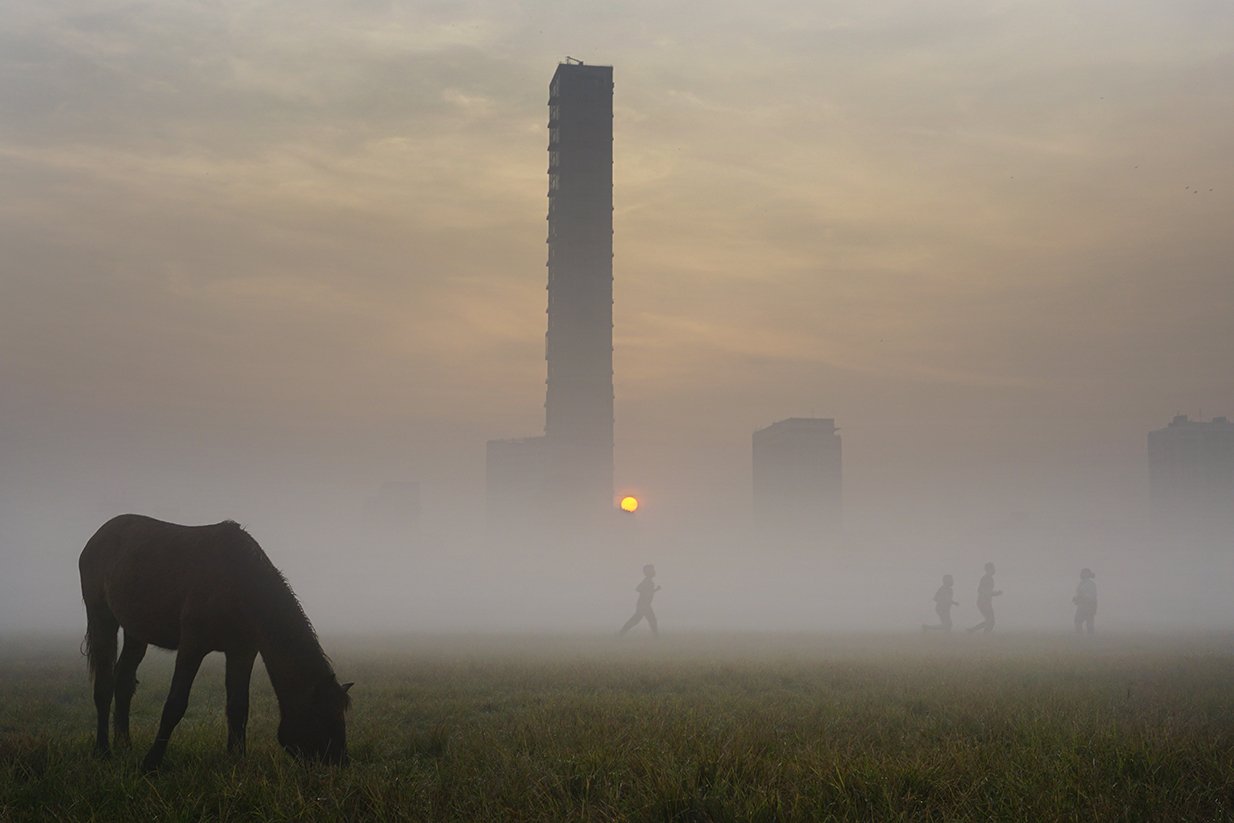
I have been chasing the fog for the last few years. Fog is such a gallant thing which mesmerizes me the most. After welcoming winter, I get up early in the morning and go out with my camera to capture the mystic and foggy Kolkata maidan. People's activity, horses, and sunrise through dense fog attract me again and again.

Mist and fog are wonderfully atmospheric and dreamy phenomena to photograph. They can be poetic, romantic, haunting, and quietly spectacular. But they can also be challenging and unpredictable.

Mist and fog move constantly can disappear in an instant, and have a very ephemeral quality that can easily result in flat, bland images. Capturing them perfectly takes a lot of practice and experimentation, which is why the process can be so rewarding for the photographer willing to study their qualities and adopt a patient, exploratory mindset.

So what are the most helpful techniques photographers can use to capture great images of mist and fog? Well, here, we will cover the basic conditions in which mist and fog differ and go through some key aesthetic considerations, illustrating each point with inspiring imagery.


1. Understand mist and fog

Mist and fog are both clouds that are less dense than the ones you see in the sky. While many tend to interchange the terms, they actually differ in density and longevity and, most importantly, visibility. Because mist is less dense than fog, it lasts shorter and allows visibility as far as 2 km. Meanwhile, you might be able to see only as far as 1 km in fog.

2. Plan Your Shoot

As with other genres of photography, planning your shoot is important in capturing mist and fog. Without a plan, time and effort could be wasted. Weather, location, camera settings, and gear are especially important factors to consider in your shoot.

Weather

Because mist and fog can quickly dissipate, timing is important to get right. Weather forecasts are excellent for planning purposes. Most weather sites specifically predict mist, but if the one you’re using doesn't, just keep an eye on the predicted visibility.

Exposure

Conditions may change very quickly, and a camera will often be confused by the diffused light, so you need to know how to manually set exposure. Familiarize yourself before the shoot by trying out different exposure settings in varied light conditions.

Gear

Aside from your camera, a long lens, a tripod, and wet-weather gear will be useful in capturing mist and fog. Those using an SLR camera will find a wider angle useful. Otherwise, bring a long lens to emphasize the depth of the image. A tripod, meanwhile, will come in handy if you want to play around with exposure settings. And you will need wet-weather gear, including something to clean the lens with, when it gets wet.

3. Enhance colours and details

Mist and fog act as giant diffusers, so contrast and colour will often be quite low, and this can easily make images look a bit lifeless. You need to look at the things that you can adjust to liven them up.

Weather

Because mist and fog can quickly dissipate, timing is important to get right. Weather forecasts are excellent for planning purposes. Most weather sites specifically predict mist, but if the one you’re using doesn't, just keep an eye on the predicted visibility.

Colour

Further, there is precious little colour in many misty scenes, so it’s important to keep an eye on the auto colour balance. Auto white balance (AWB) is best when trying to capture the cool blue of an early morning. If unsure, just try out different settings. The best bet, however, is to shoot in RAW, so you can post-process your photos without losing too much detail.

Lighting

In fog and mist, you can also expect to find only little light, which will consequently soften contrast—sometimes, a little too much. To add contrast, shoot in a location with the light in or near the edge of the frame.

Note that mist and fog look particularly good when illuminated from behind, and one of the most spectacular lighting effects can be seen when the sunlight is strong enough to peek through a thin mist and create shadows. In cityscapes, street lights and advertising boards can be used as great sources of color and light.

4. Compose the image creatively

It is all too easy to get caught up in the technical demands of shooting mist. In creative terms, the most exciting part often lies in composing the image. The primary challenge here is to avoid a flat or washed out look in the image, which you can do by exploring some of the following:

Layering

The strongest images of mist and fog usually have a strong sense of depth, which is created by thinking of the image in terms of layers. This layered effect can be created by including elements of interest very close to the camera, in the middle ground, and in the background. A long lens can also be used to strengthen this impression.

Silhouetting

Mist and fog will often reduce the color, details, and textures of objects to mere outlines. This is why misty images can often look dull, but this effect can also be used to introduce a lot of drama and contrast to the image. Just expose for the highlights and create pin-sharp dark silhouettes. Have a look at the surfers in this image, for example.

Contrasting

Subjects with contrasting textures can also add a flair to your photos. For example, including rough edged cliffs or even boulders within the frame will emphasize the soft, watery texture of mist and fog.

Simplifying

Finally, a misty scene doesn’t need to be crammed with information. In fact, the best thing about mist and fog is that they force the photographer to use large areas of white space and embrace the delicate power of a minimalist aesthetic. A misty scene may even provide inspiration for a semi-abstract image.

5. Post process photos

Despite all best efforts, most images will still need some post-production work to increase contrast and color. If using Lightroom, work with the sharpening and dehaze filter. Also try playing around with saturation, contrast, and sharpness. No matter what program or app you use, it’s best to work on a duplicate version of the original image because it’s far too easy to overwork the image. After all, the most appealing thing about mist is that it’s a delicate, subtle subject.

Much of the time photographing mist and fog involves venturing out in the early hours of dawn, patiently fiddling around with your camera, and accepting unpredictable results, and for some, that’s what makes photography so much fun anyway—the real magic of the process.

website
 

I am Dipanjan Chakrborty. I am a Kolkata-based street and documentary photographer. I have been documenting Kolkata for the last few years. As a photographer, my perspective remains to explore street photography as a key to reaching the common people and their lives. I love to tell stories through my lens. Every frame tells a story but when we create a story within a frame, it makes the frame more beautiful. After being a street and documentary photographer my course of life has entirely changed. I started photography in my childhood. But I have had a craze for photography since my childhood,  whenever I could get a mobile or camera from anyone I would always try to capture my surrounding people and their daily life. I love to see photos daily, in social media I used to watch various kinds of pictures from different countries and different photographers that helped me to increase my knowledge. When I make a plan to go out for a shoot at first I used to make research that particular subject or project on which I am going to do my work, then I used to make a plan on that particular place and time when my shoot takes place, because time is more important in street photography. But sometimes when I go out with my equipment I capture various candid moments on the street  I am using a Sony A6000 mirrorless camera right now. I have used a DSLR earlier but mirrorless is giving me such a great output, especially in low light mirrorless is a revolution.

I think a picture is captured in our brain, a camera is just a device to print that image which has been captured in my brain. That's why many times I make plans for my shots and I make the composition in my mind. But sometimes the picture comes out without any plan because there are lots of candid moments in the street which are constantly creating. I like both colour and black & white pictures. But I feel that colour image portrays the nature and colourful clothes of people but black and white image portrays the soul of the people. I do not give much time to post-processing, I do post-processing a little bit like retouching but nothing more than that.

 
Thursday 11.17.22
Posted by Progressive-Street
 

The Festival Of Durga Puja by Tanmoy Chatterjee


Bengal is considered to be one of the richest states in India, in terms of culture, tradition, fairs, and festivals. The colourful festivals of the state are full of joyous ceremonies, abundant fun, and mouth-watering cuisines. In Bengal, there is a festival for every season and every kind of celebration. There is a popular Bengali proverb, ‘Baro Mase Tero Parban’, which means 'thirteen festivals in twelve months.

This signifies the umpteen number of fairs and festivals that are celebrated in this state. These celebrations reflect the hearty and composite cultural culture of India. Fairs and festivals form an inseparable part of the life of people in West Bengal. A Bengali calendar is embellished with celebrations throughout the year, with innumerable festivals for each season.

Today I am going to introduce my readers to the biggest and the grandest festival of all, The festival of Durga Puja.

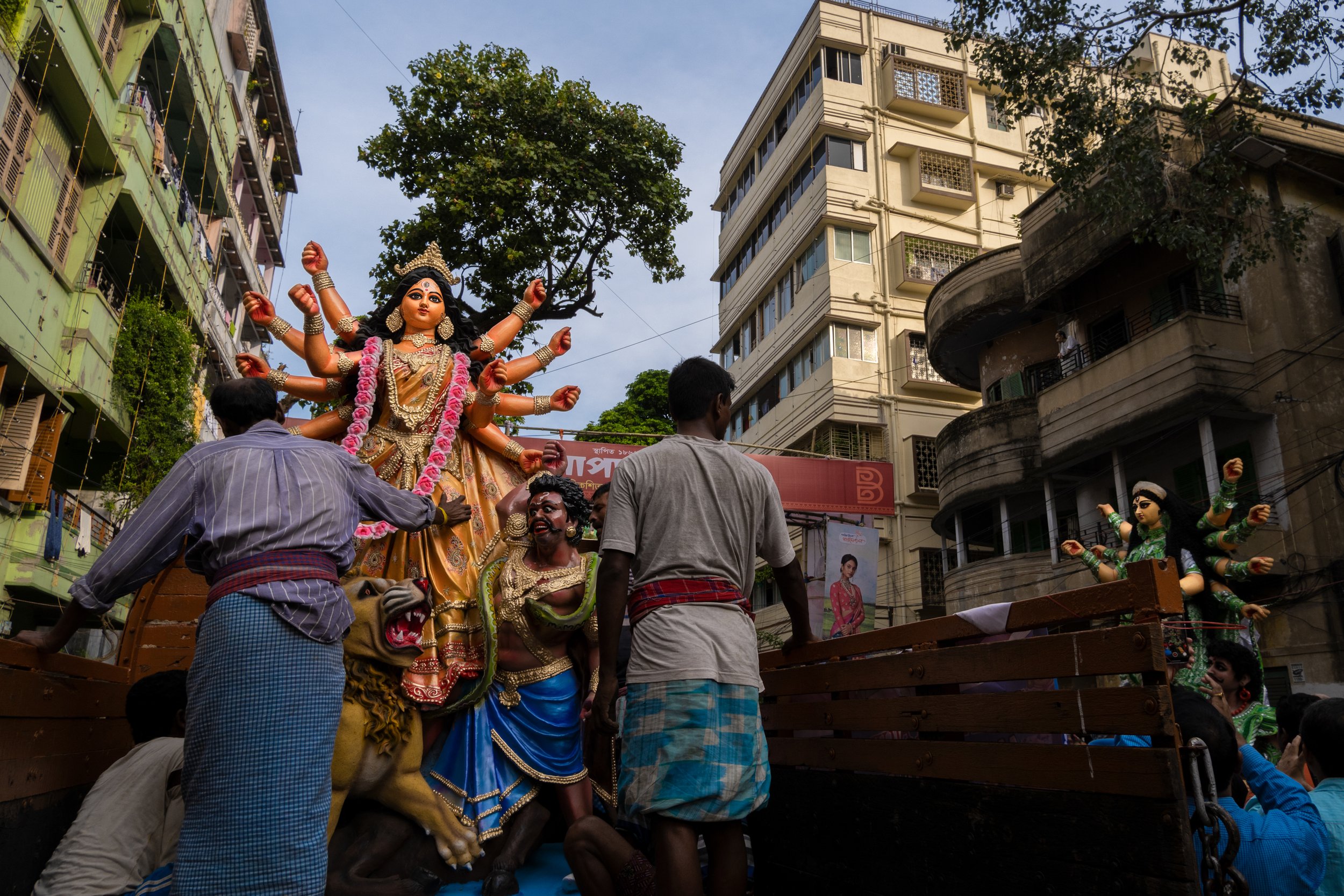
The Indian state of West Bengal comes alive in the festival of Durga Puja. Being the most prominent festival of the region, Durga Puja is the soul and pride of West Bengal. Every year in Kolkata, the capital city, the festival of Durga Puja brings great enthusiasm, joyous moments, and a chance to get together with families and friends in the most amazing manner like never before.

Durga Puja is never celebrated in the same manner every year. According to Hindu Mythology, Goddess Durga emerged from the collective energy of all the Kings and Gods (devas) as an embodiment of Shakti or divine feminine power, to destroy the demon Mahishasura; who was blessed to not be defeated by any man or god.

The name Durga in Sanskrit means 'the impenetrable'; she exists in a state of self-sufficiency and ultimate power. This powerful form of Mother Goddess is highly revered in Kolkata which is why her return is celebrated with much grandeur and ceremonies.

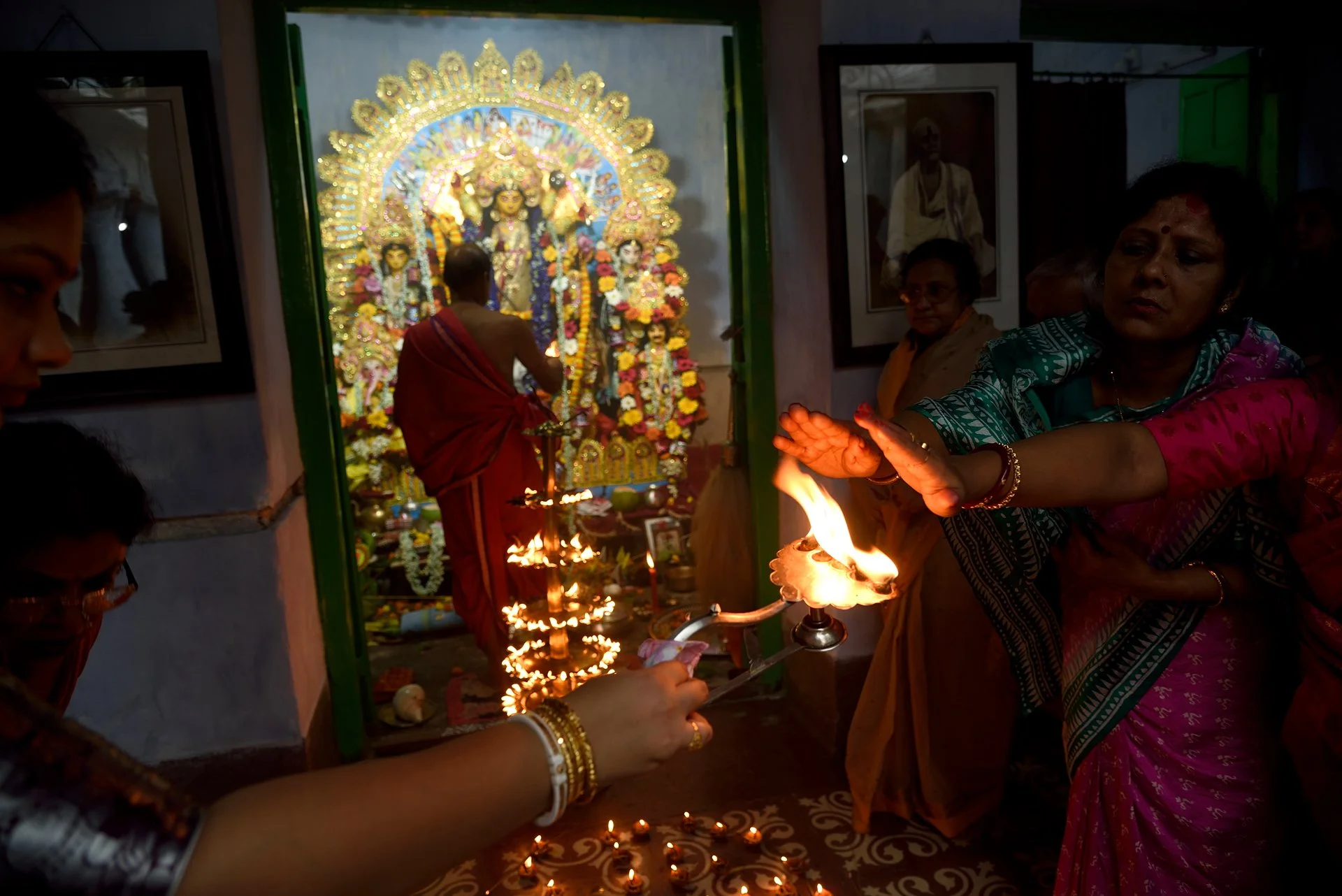
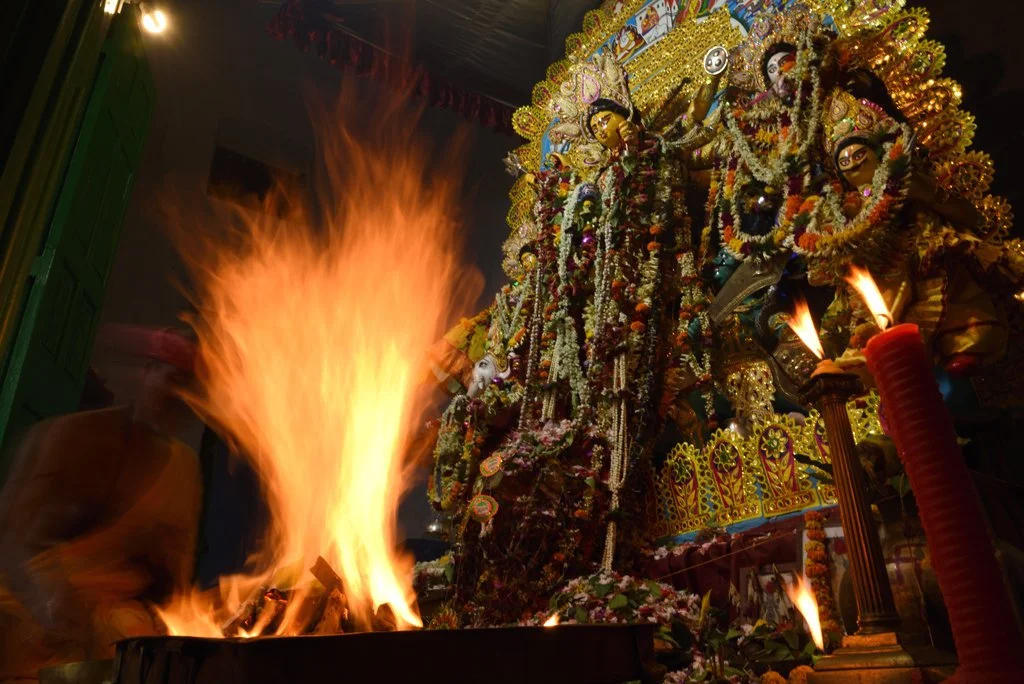
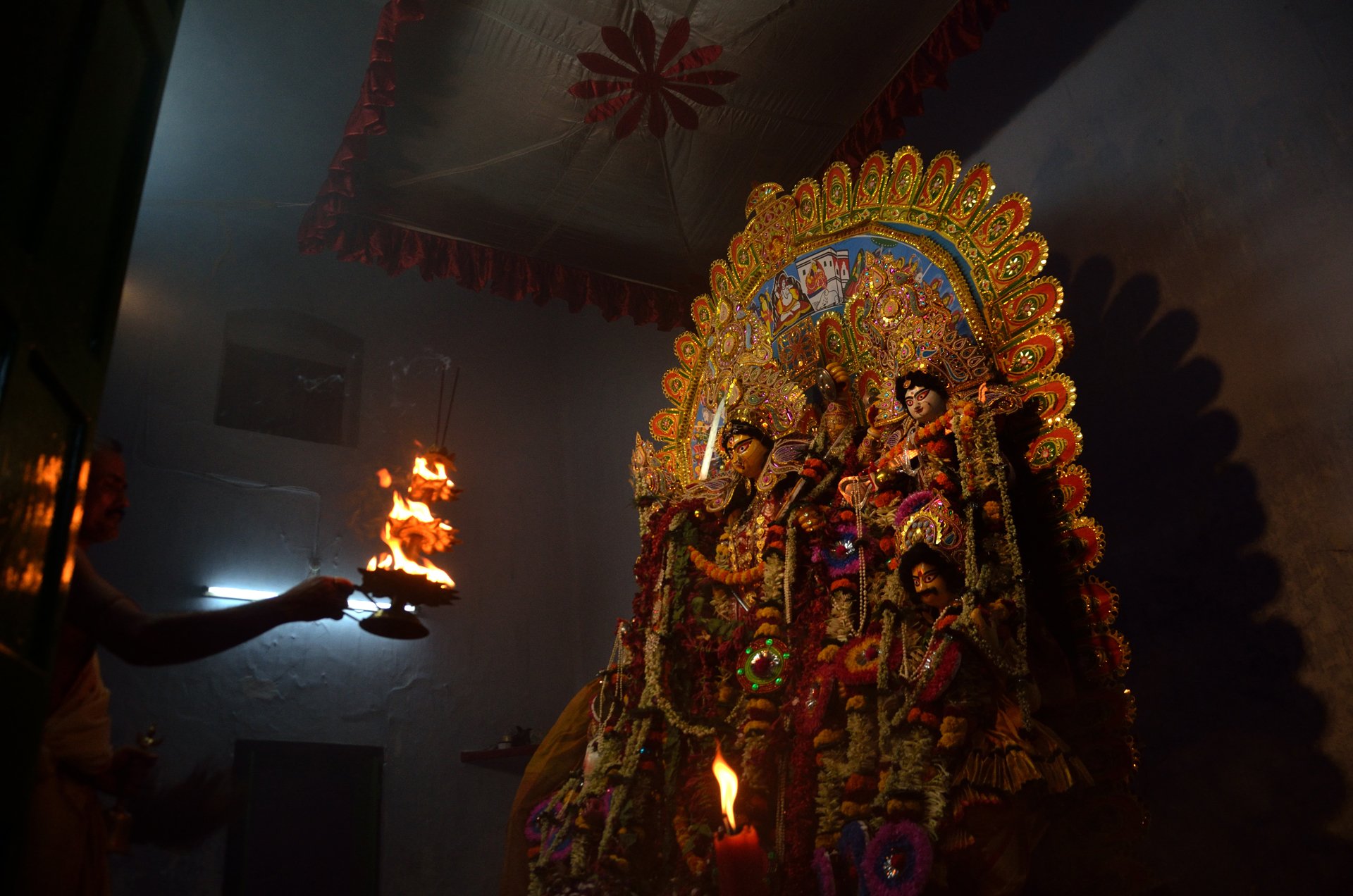
Generally overlooked by the Pandal hoppers are the Durga Pujas held privately in several families some of whom were affluent and stalwarts in yesteryear, especially during the Colonial Regime. Although the financial condition is not affluent as it was in earlier days (mainly because the Zamindari system was abolished post-independence), yet these families till date perform Durga Puja with dedication maintaining all the rituals. The Pujas are all 100+ years, some even 200+ and 300+ years old.

Every one of the families gathers to celebrate Durga Puja with pomp and show as an annual get-together.

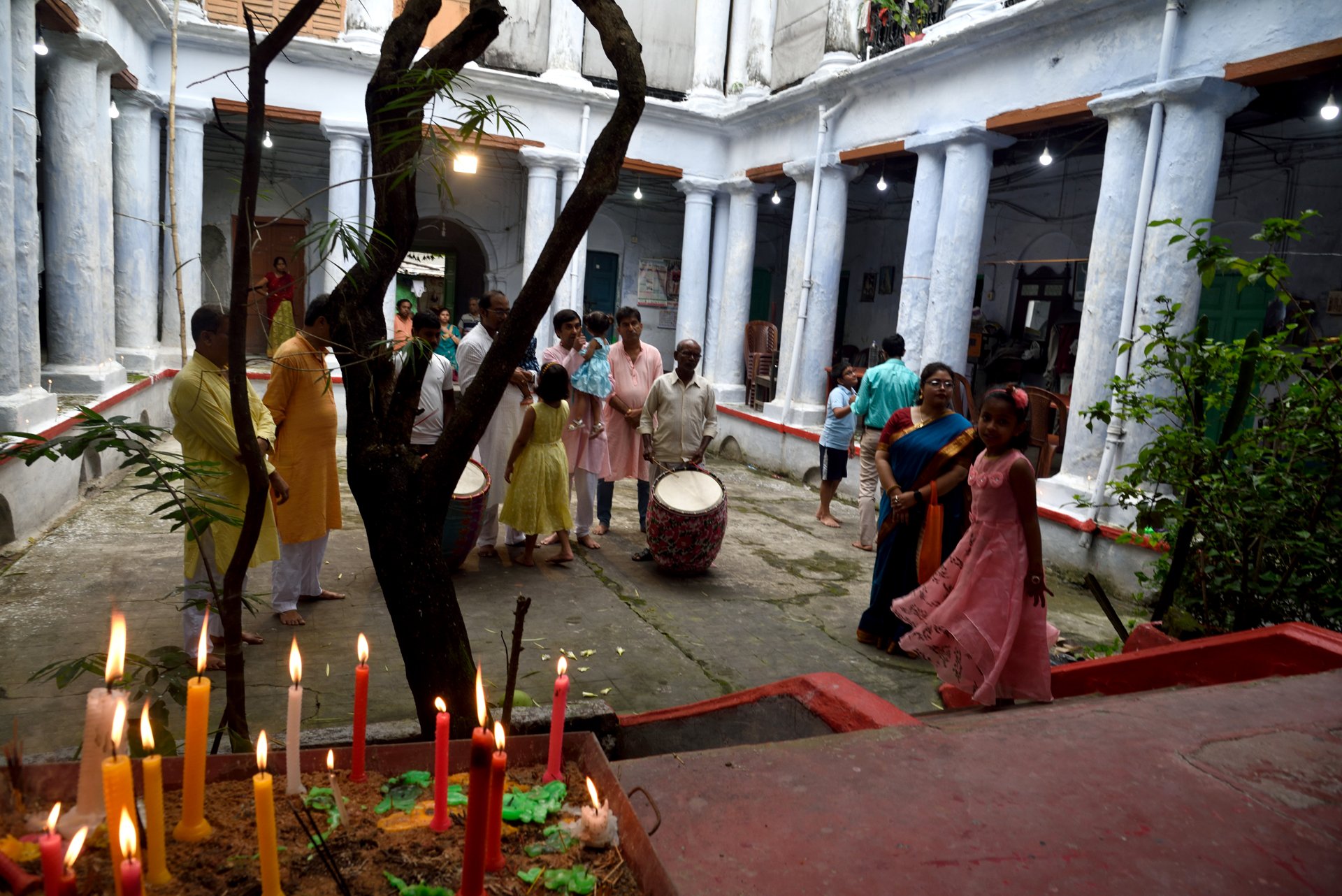
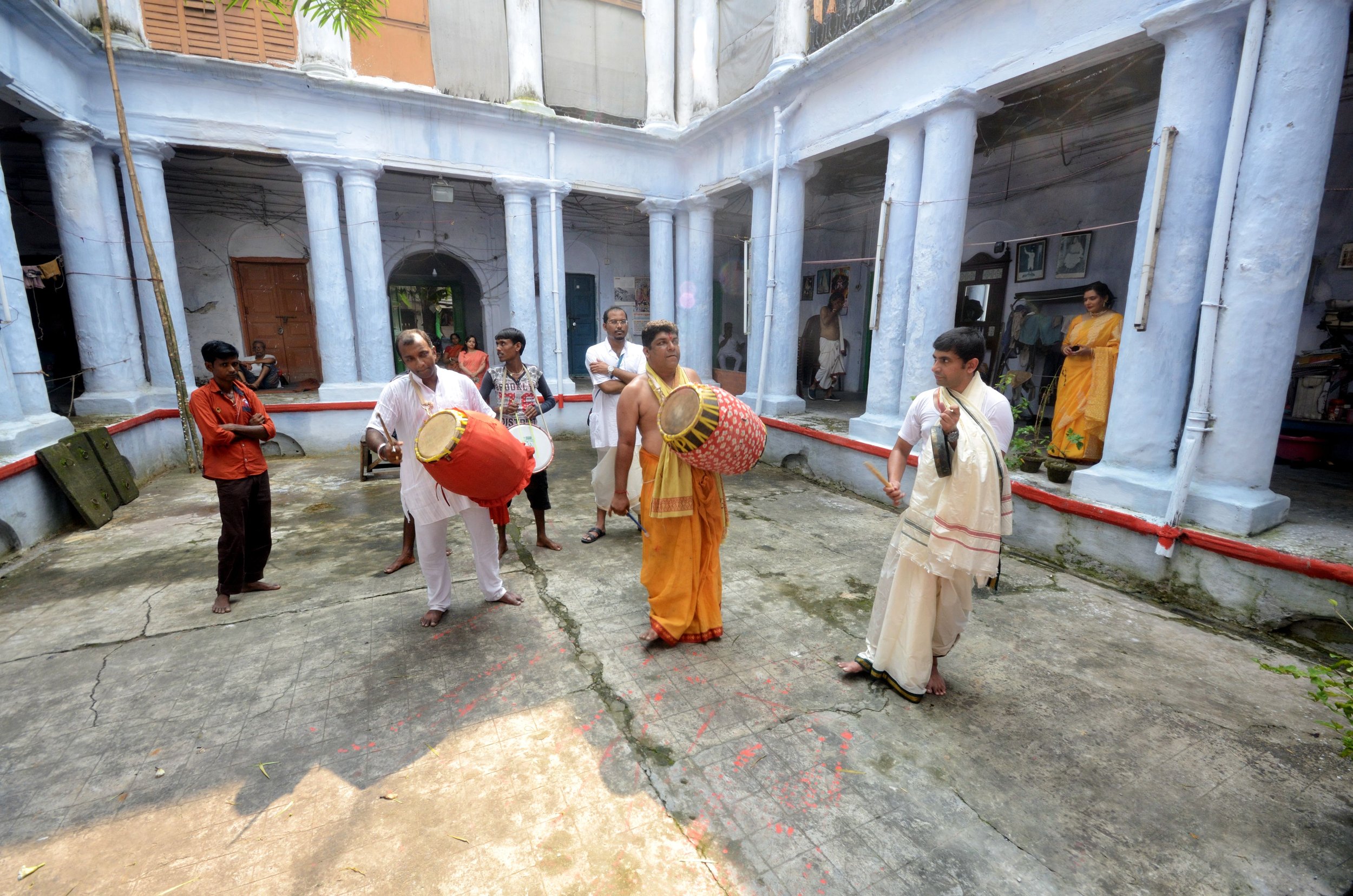
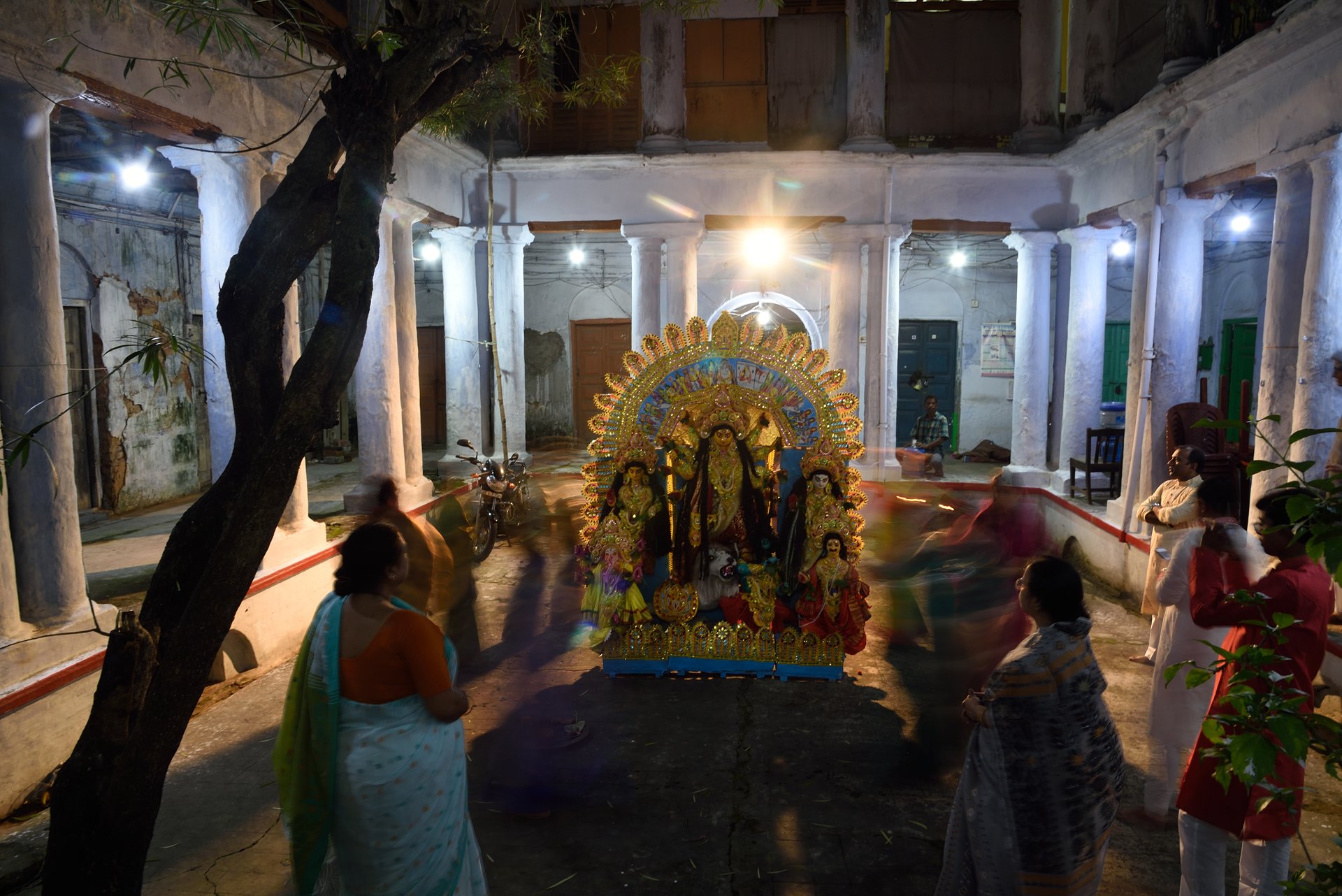
It is not just a festival but an emotional and colourful celebration of the daughter Goddess Durga visiting her paternal home along with her four children. I consider myself lucky to witness this grand festival in my own house since my birth. Along with the “Barowari” or community celebration of the festival, the Durga Puja celebration in the Bondi Barir Durga Puja in Kolkata and other parts of West Bengal is indeed a very unique and extravagant affair.

Many families in Kolkata do traditional Durga Puja in their houses. These families do Durga Puja with a strong dedication to maintaining all the rituals. These Pujas are older than 100 years or even more.

Bonedi Bari Durga Puja is one of the most important aspects of Durga Puja. Durga puja took birth in the palaces of erstwhile kings, Maharajahs, and the affluent. Credit goes to them for elevating this religious festival into the status of a social extravaganza.

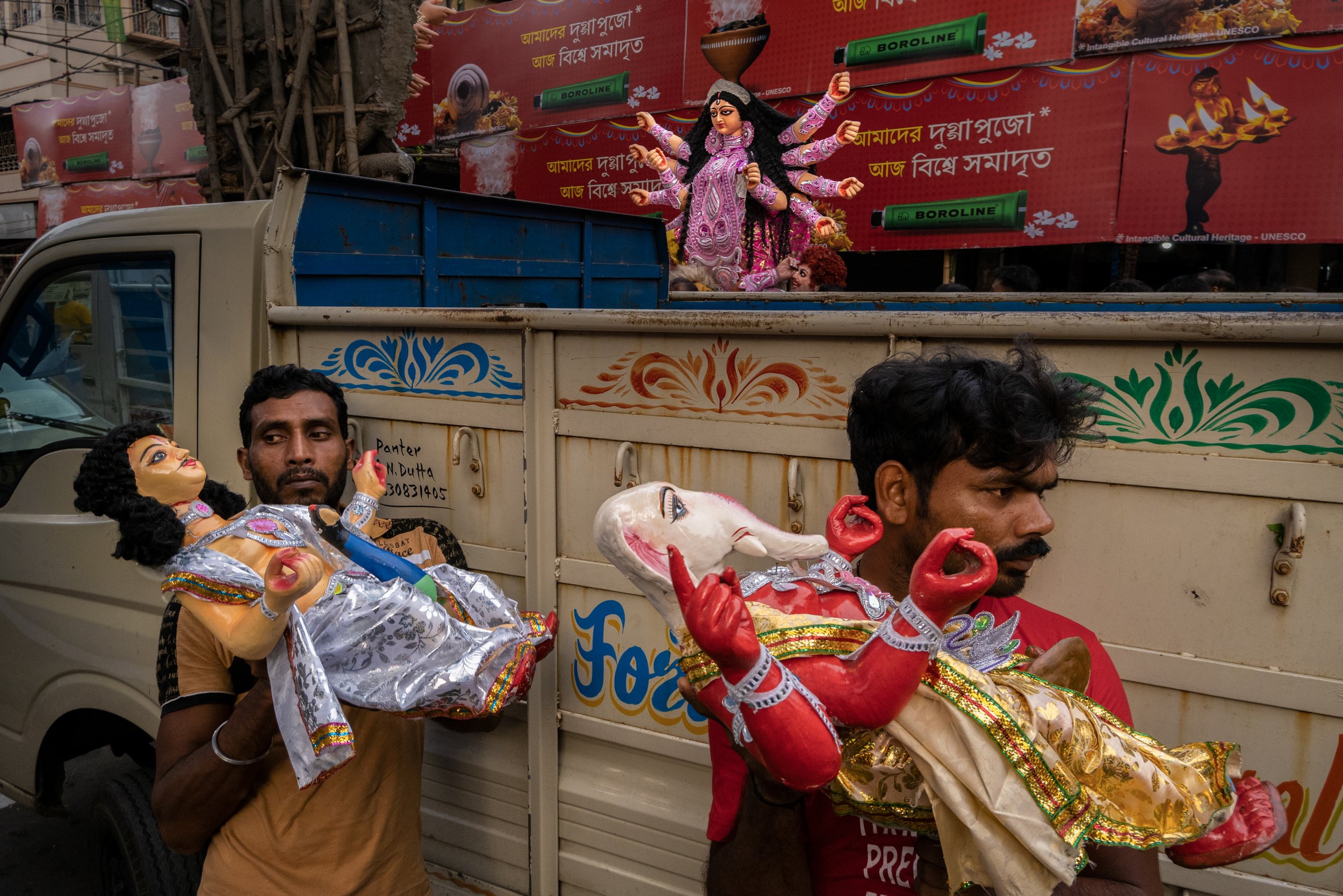
This year, UNESCO inscribed Durga Puja on the List of the Intangible Cultural Heritage of Humanity

However, today, most of these ancestral pujas have disappeared completely, or are on the brink of extinction. With the termination of modernisation and lack of manpower and enthusiasm, these pujas face an uncertain future.

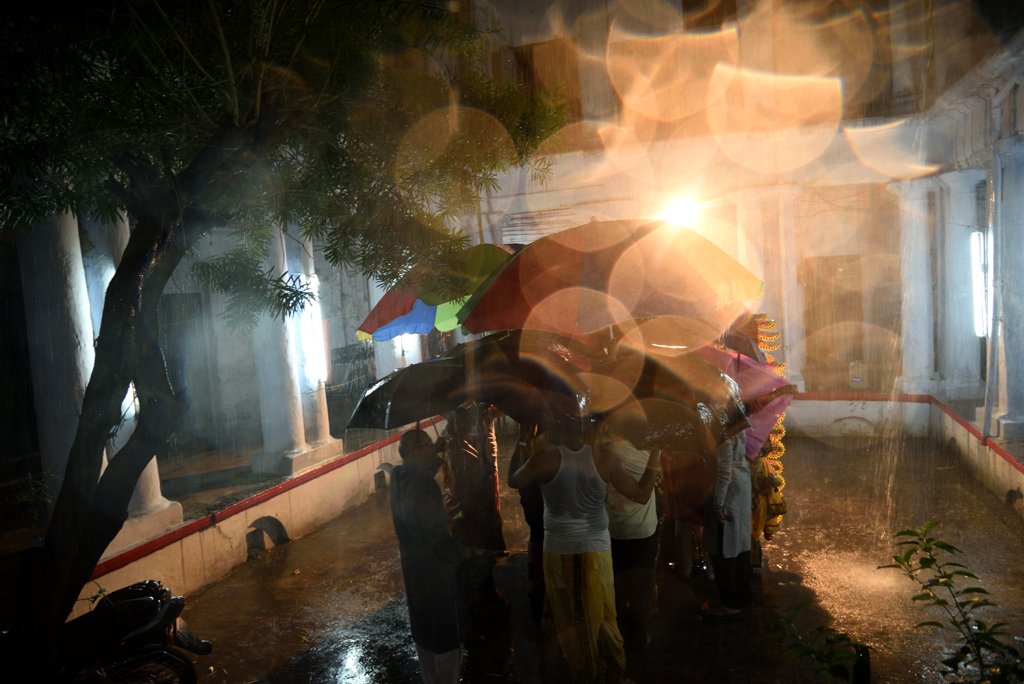
As a photographer, I found it my prime responsibility to document the celebration, the emotion, the colours, and the furore of Durga Puja at my own ancestral home, a celebration which takes place since 7 generations of my family.

 
View fullsize Tanmoy Chatterjee_03.JPG
View fullsize Tanmoy Chatterjee_04.JPG
View fullsize Tanmoy Chatterjee_05.JPG
View fullsize Tanmoy Chatterjee_06.JPG
View fullsize Tanmoy Chatterjee_07.JPG
View fullsize Tanmoy Chatterjee_09.JPG
View fullsize Tanmoy Chatterjee_10.JPG
View fullsize Tanmoy Chatterjee_11.JPG
View fullsize Tanmoy Chatterjee_12.JPG
View fullsize Tanmoy Chatterjee_13.JPG
View fullsize Tanmoy Chatterjee_14.JPG
View fullsize Tanmoy Chatterjee_15.JPG
View fullsize Tanmoy Chatterjee_16.JPG
View fullsize Tanmoy Chatterjee_18.JPG
View fullsize Tanmoy Chatterjee_19.JPG
View fullsize Tanmoy Chatterjee_21.JPG
Tanmoy Chatterjee_20.JPG
Tanmoy Chatterjee_22.JPG
 
Tanmoy Chatterjee_23.JPG
Tanmoy Chatterjee_24.JPG
Tanmoy Chatterjee_25.JPG
Tanmoy Chatterjee_26.JPG
Tanmoy Chatterjee_27.JPG
Tanmoy Chatterjee_23.JPG Tanmoy Chatterjee_24.JPG Tanmoy Chatterjee_25.JPG Tanmoy Chatterjee_26.JPG Tanmoy Chatterjee_27.JPG


I am Tanmoy Chatterjee a National Award Winning (Government of India), travel and documentary photographer based in Kolkata, India. With an experience of more than 20 years in this field, I have travelled across India, documenting various festivals, cultures and historical places.  

Instagram
FB
 
Thursday 11.17.22
Posted by Progressive-Street
 

Strangely Familiar

Strangely Familiar

by Steve Scott

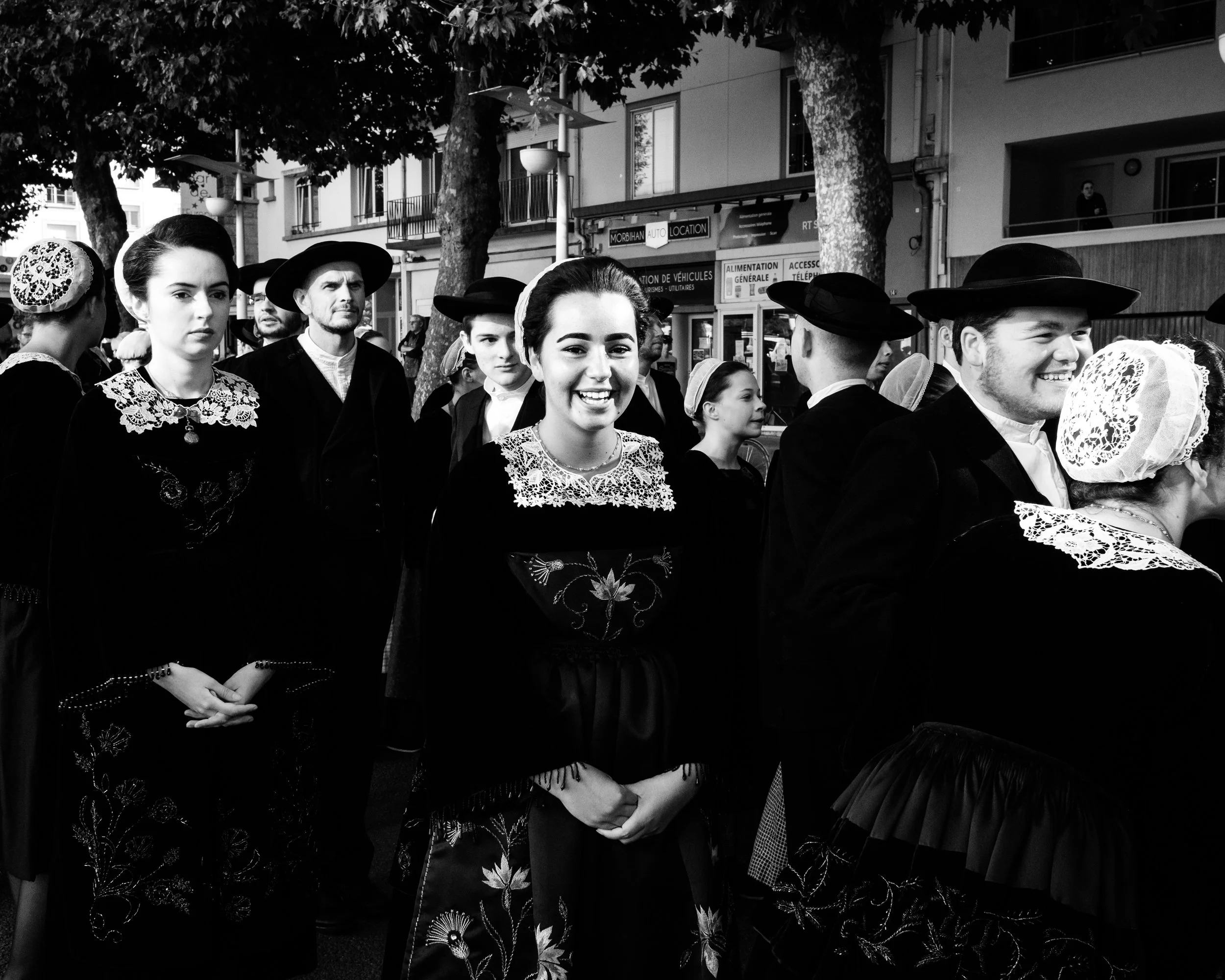
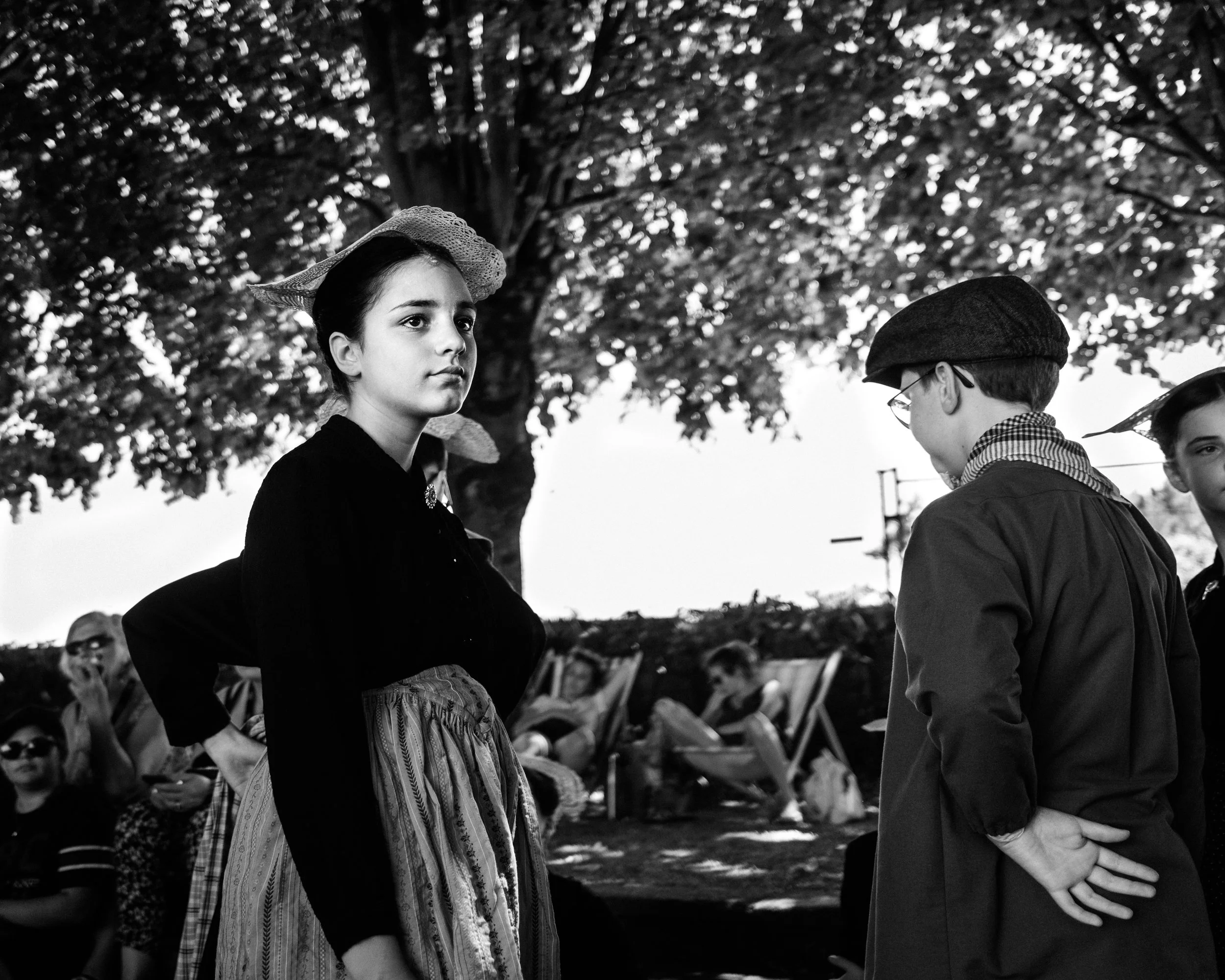
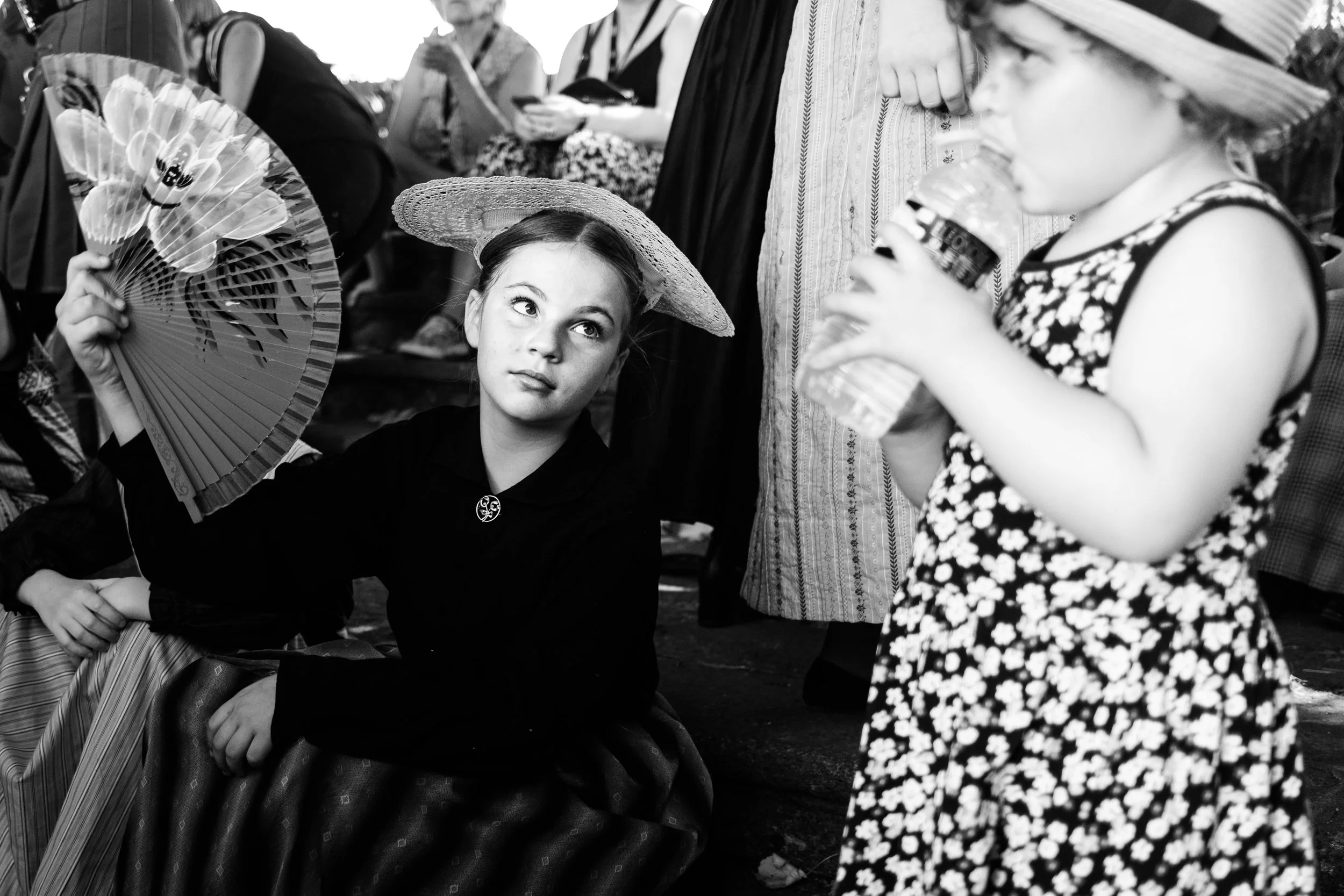
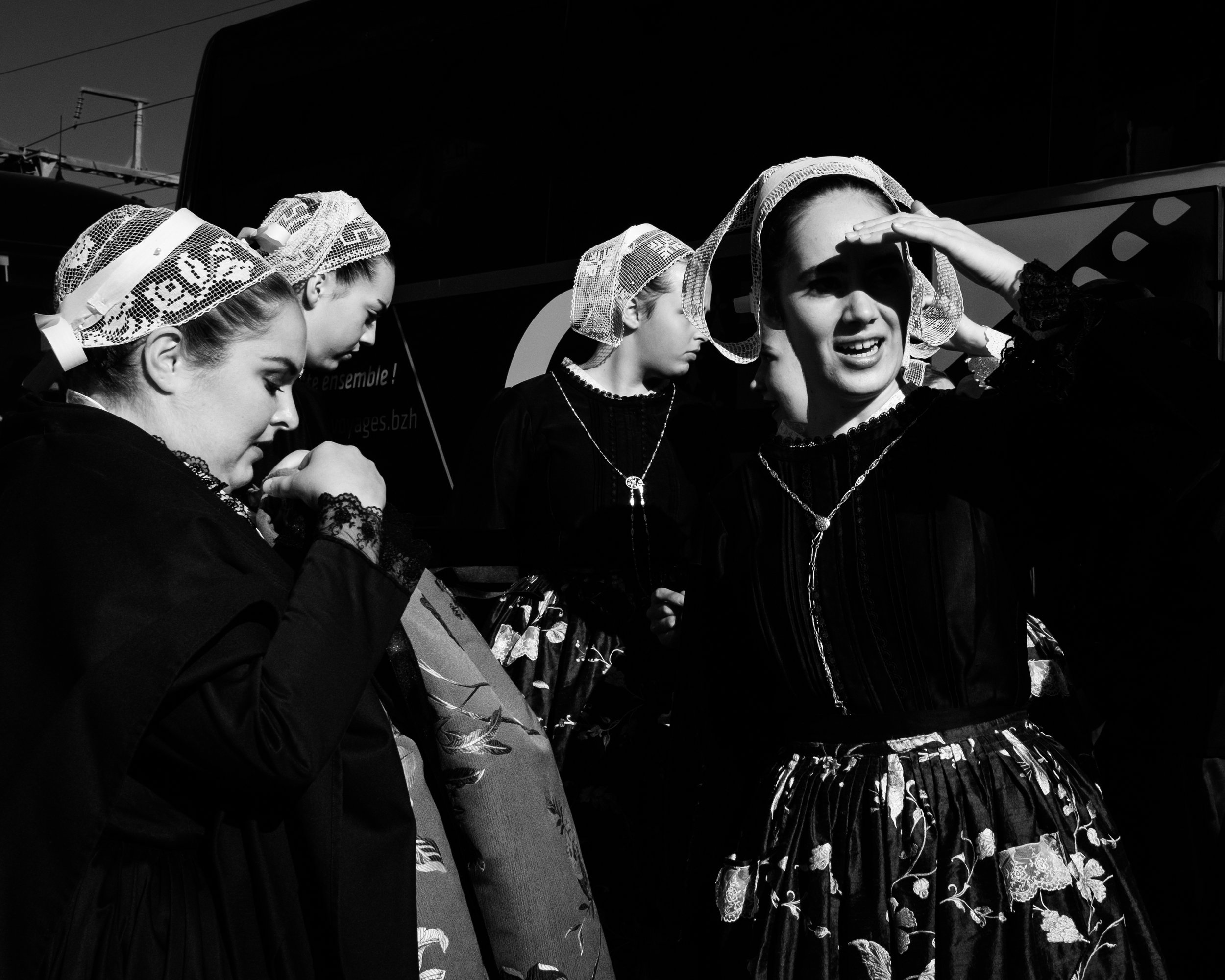
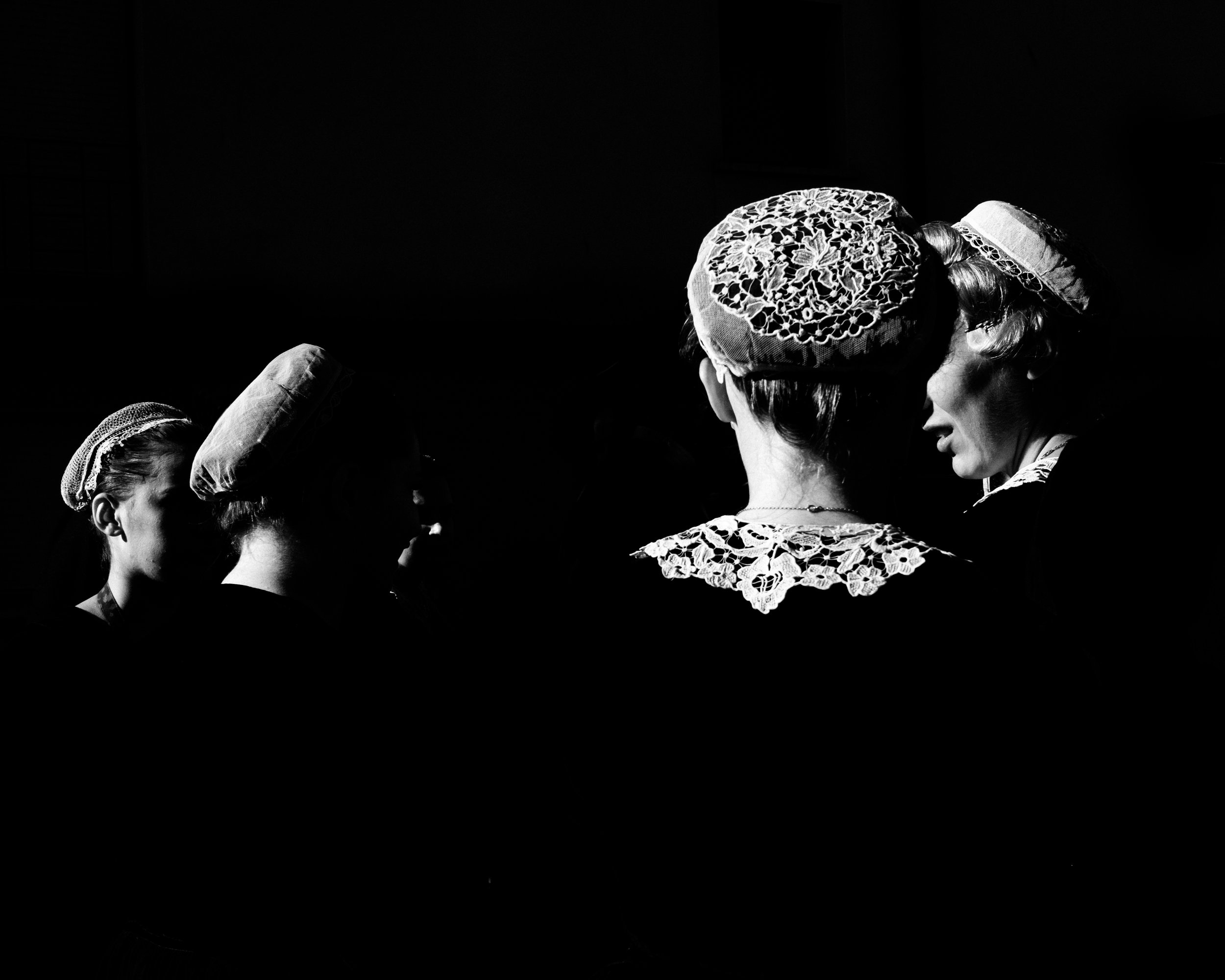
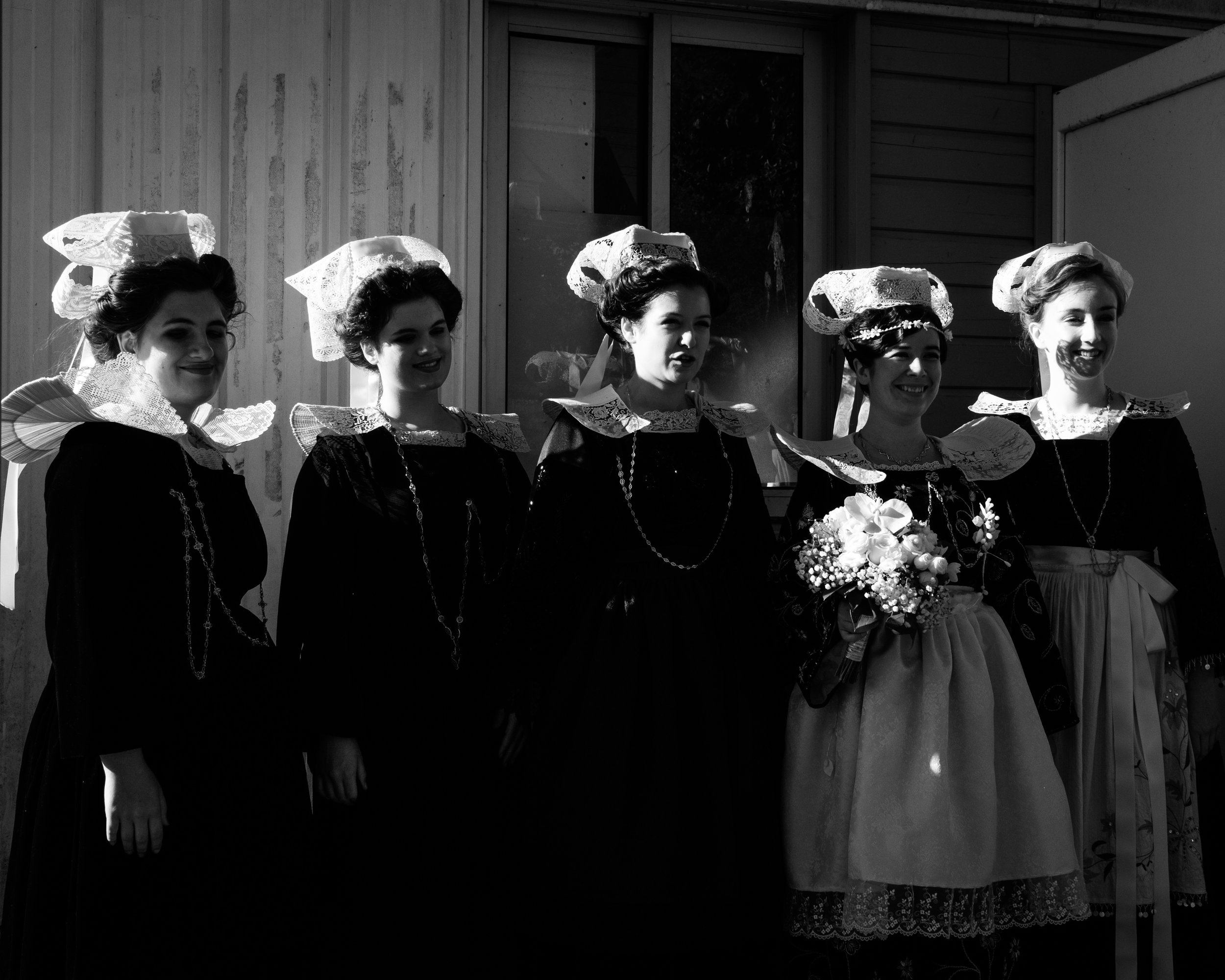
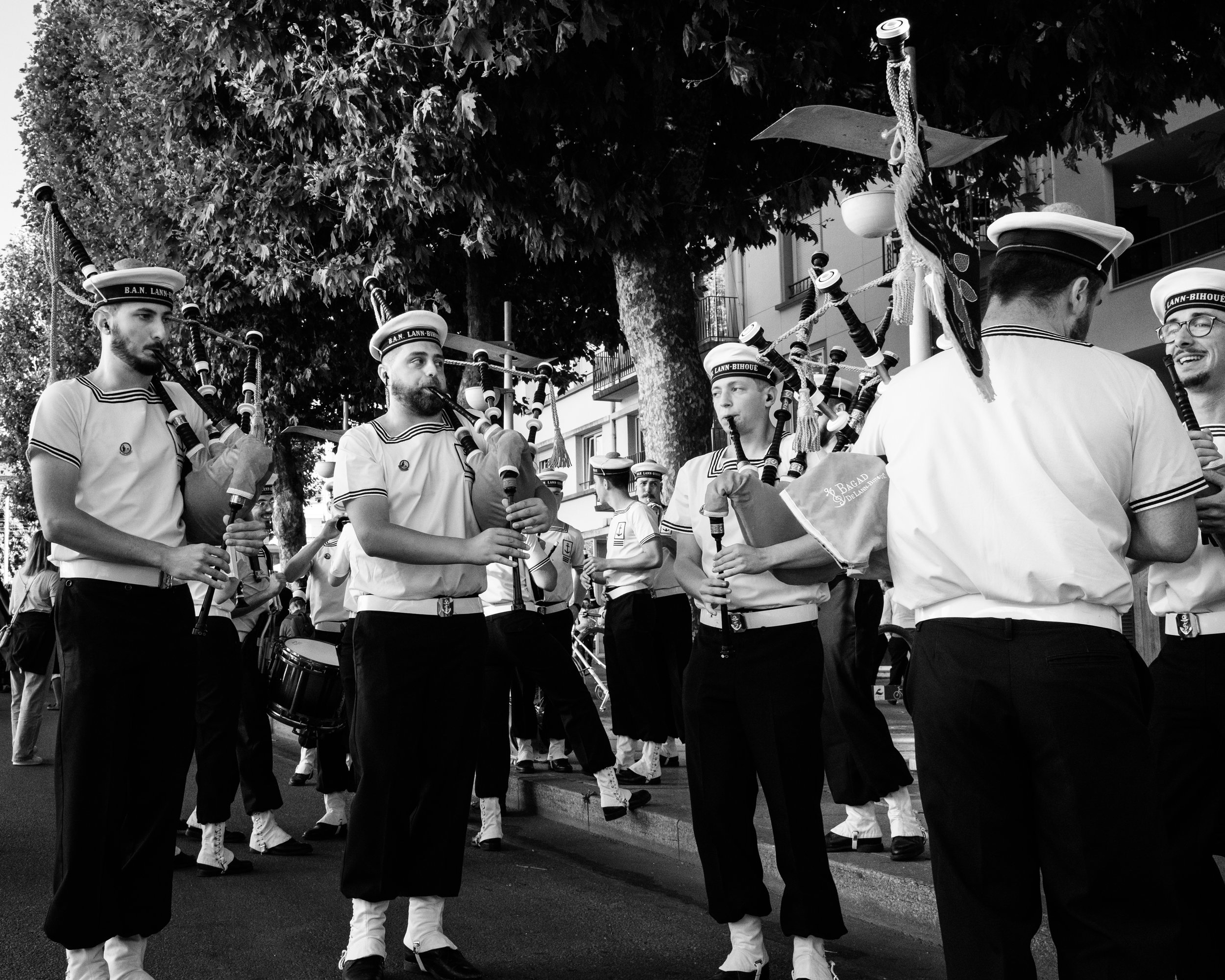
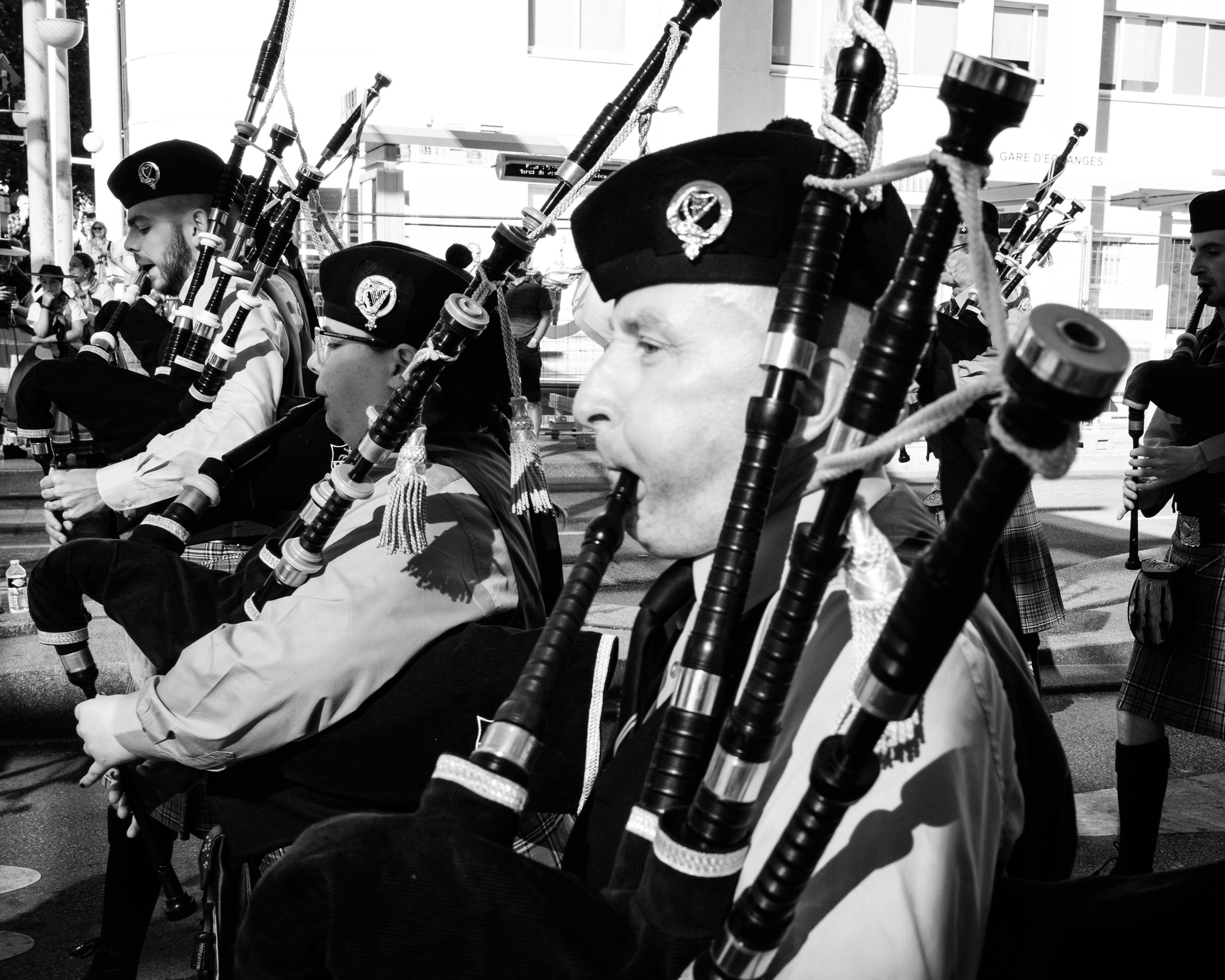
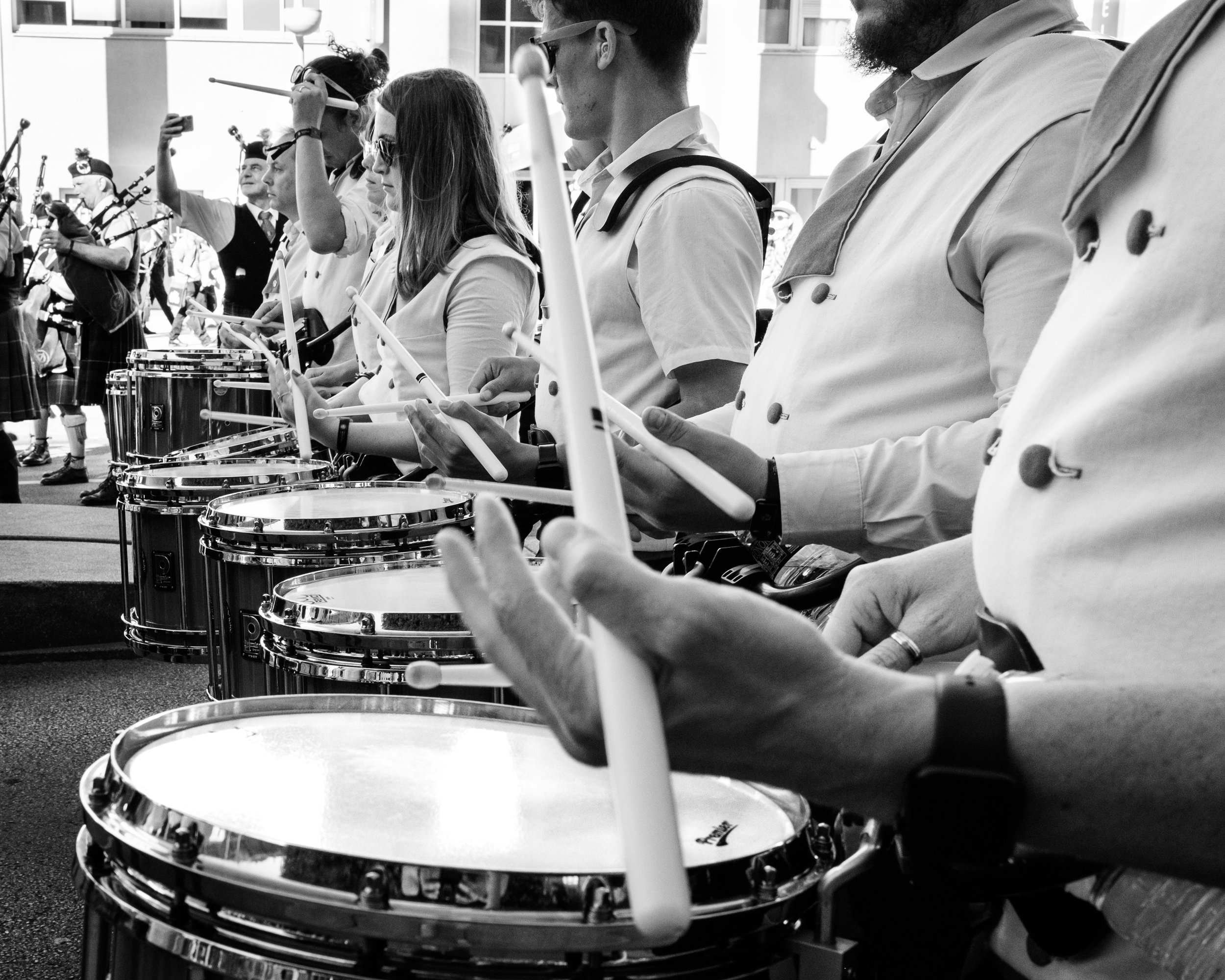
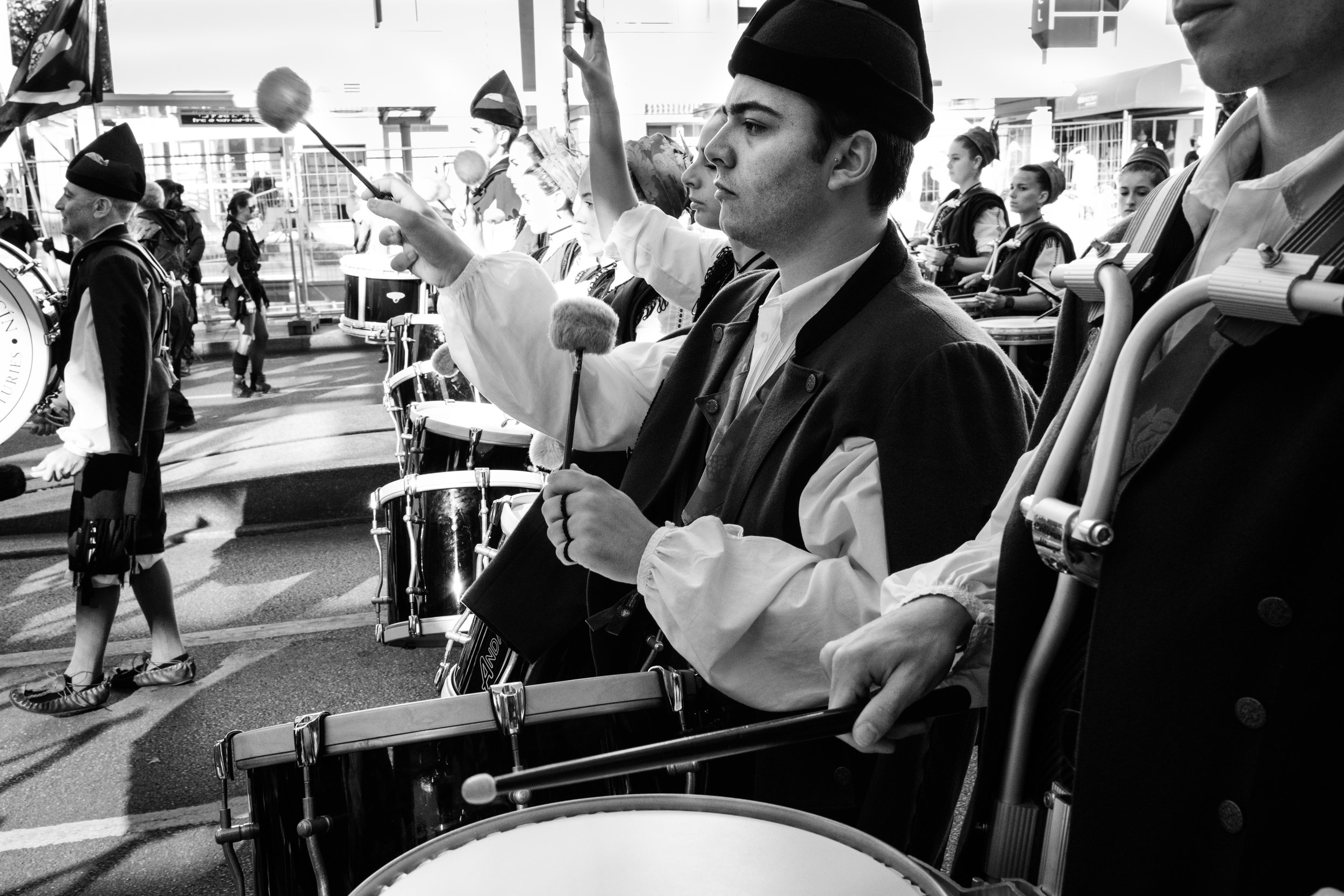
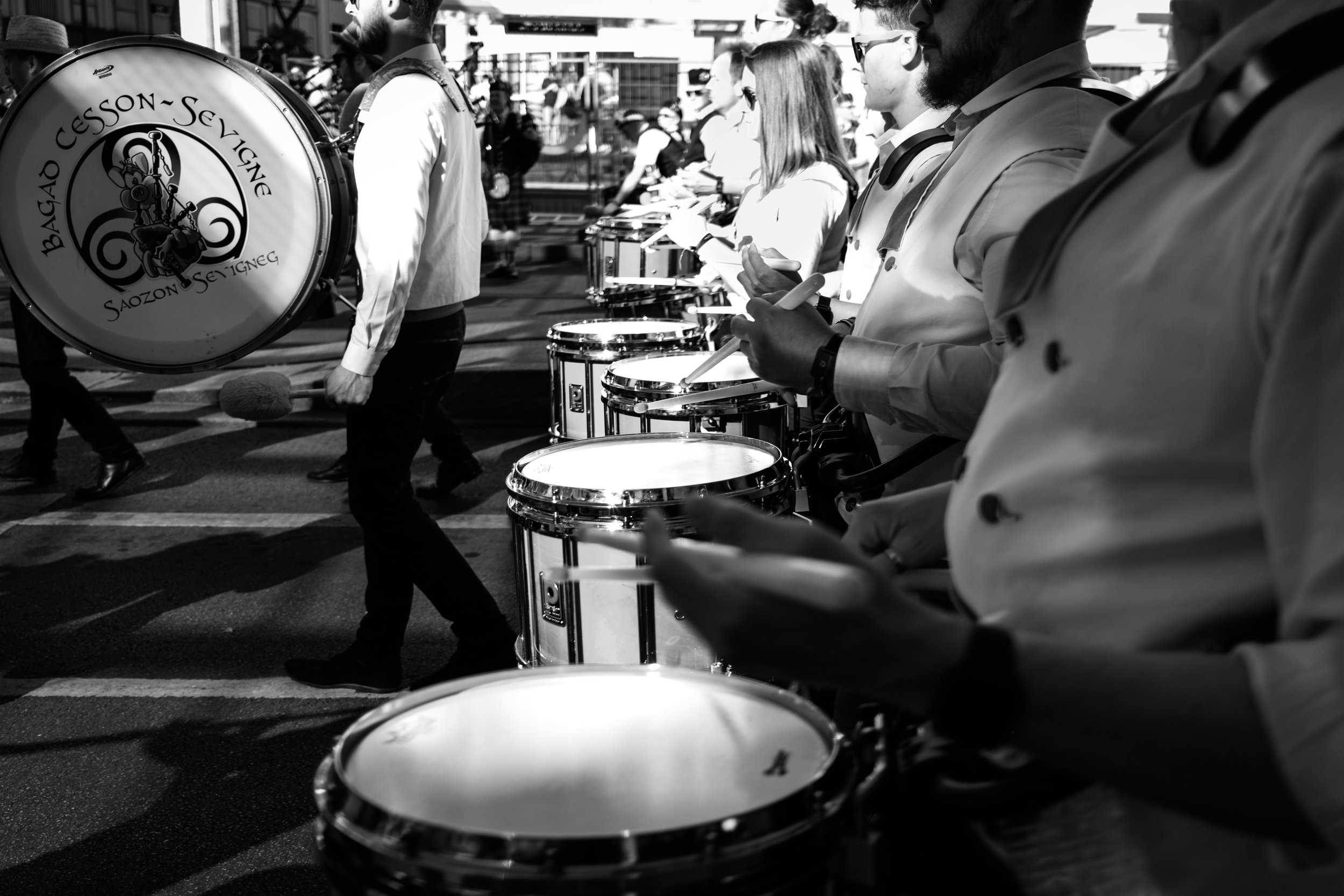
Festival INTERCELTIQUE Lorient 2022 (This year the festival attracted over 900,000 people over a 10-day period).

This annual festival takes place in the heart of the city of Lorient Breton every August and is dedicated to the cultural traditions of the Celtic nations, highlighting Celtic music and dance and also including other arts such as painting, photography, theatre, sculpture, traditional artisanry as well as sport and gastronomy.

Participants come from Brittany, Ireland, Scotland, Cornwall, Wales, Cumbria, the Isle of Man, Cape Breton Island, Galicia, Asturias, Acadia, and the entire Celtic diaspora.

I was invited to represent Ireland with my solo photographic exposition, while I was there, I wanted to capture with my camera the traditional costumes that were been worn by the various participants.

I was amazed at the detail and the passion along with pride that each and every one had wearing there costumes.

View fullsize DSCF1270.jpg
View fullsize DSCF1339.jpg
View fullsize DSCF1487.jpg
View fullsize DSCF1306.jpg
View fullsize DSCF1316.jpg
View fullsize DSCF1594.jpg
View fullsize DSCF1295.jpg
View fullsize DSCF1986.jpg
View fullsize DSCF1262.jpg
View fullsize DSCF1995.jpg
View fullsize DSCF1981.jpg
View fullsize DSCF2033.jpg
View fullsize DSCF2011.jpg
View fullsize DSCF2029.jpg
View fullsize DSCF2006.jpg
DSCF0965.jpg
DSCF1090.jpg
DSCF1099.jpg
DSCF1058.jpg
DSCF0965.jpg DSCF1090.jpg DSCF1099.jpg DSCF1058.jpg
View fullsize DSCF0984.jpg
View fullsize DSCF1136 copia.jpg
View fullsize DSCF1001.jpg
View fullsize DSCF0993.jpg
DSCF1230.jpg
DSCF1453.jpg
DSCF1535.jpg
DSCF1364.jpg
DSCF1613.jpg
DSCF1230.jpg DSCF1453.jpg DSCF1535.jpg DSCF1364.jpg DSCF1613.jpg
View fullsize DSCF1129.jpg
View fullsize DSCF1243.jpg
View fullsize DSCF1406.jpg
View fullsize DSCF1415.jpg
 
 
FB
Wednesday 10.26.22
Posted by Progressive-Street
 

Durga Puja by Kuntal Biswas

Durga Puja

by Kuntal Biswas

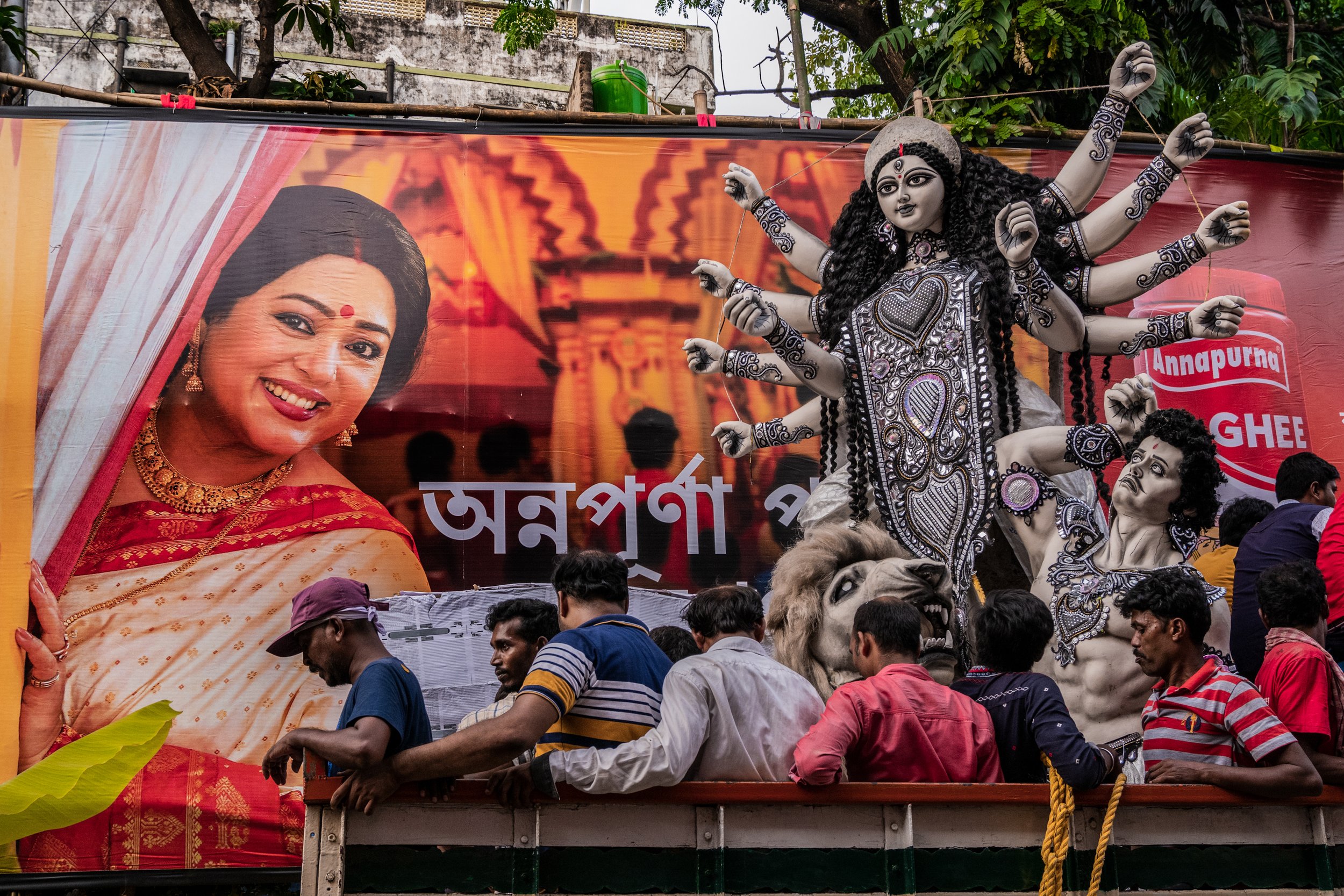
Durga Puja, also known as Durgotsava or Sharodotsava, is an annual Hindu festival originating in the Indian subcontinent which reveres and pays homage to the Hindu goddess Durga and is also celebrated because of Durga's victory over Mahishasur. It is particularly popular and traditionally celebrated in the Indian states of West Bengal, Bihar, Assam, Odisha, Tripura, and the country of Bangladesh. The festival is observed in the Indian calendar month of Ashwin, which corresponds to September–October in the Gregorian calendar. Durga Puja, is a ten-day festival, of which the last five are of the most significance. The puja is performed in homes and in public, the latter featuring a temporary stage and structural decorations (known as pandals). The festival is also marked by scripture recitations, performance arts, revelry, gift-giving, family visits, feasting, and public processions. Durga puja is an important festival in the Shaktism tradition of Hinduism. Durga puja in Kolkata has been inscribed on the Intangible cultural heritage list of UNESCO in December of 2021.

The mythology behind this festival:

Rama's 'Akal Bodhan'

Durga Puja is celebrated every year in the Hindu month of Ashwin (September-October) and commemorates Prince Rama's invocation of the goddess before going to war with the demon king Ravana. This autumnal ritual was different from the conventional Durga Puja, which is usually celebrated in the springtime. So, this Puja is also known as 'akal-bodhan' or out-of-season ('akal') worship ('bodhan'). Thus goes the story of Lord Rama, who first worshipped the 'Mahishasura Mardini' or the slayer of the buffalo-demon, by offering 108 blue lotuses and lighting 108 lamps, at this time of the year.

This year we will celebrate this festival from 1st to 4th October.

agomoni2 (1).jpg
agomoni5 (1).jpg
agomoni4 (1).jpg
agomoni6 (1).jpg
agomoni12 (1).jpg
agomoni10 (1).jpg
kumortuli1-01 (1).jpg
durga-silhoutte.jpg
her-arrival1 (1).jpg
 
 
Kuntal Biswas
Saturday 10.01.22
Posted by Progressive-Street
 

The Darjeeling Himalayan Railways

 Darjeeling (700 kilometres north of Kolkata) is sometimes called the "Queen of the Hill Station." Located in one of India's most beautiful regions, it was established in the mid-19th century and was originally a sanitarium built by the East India Company. Darjeeling has prospered as the centre of a tea-growing area. Today it is home to around 135,000 people. The town has more of a Nepalese feel than an Indian one. There is even a separatist movement that wants to establish a separate Nepalese state called Gurkaland. There is also a sizable Tibetan community. The name Darjeeling is derived from the Tibetan phrase "Dorje-Ling ("the place of the thunderbolt").

Situated at an elevation of 2042 meters (6,700 feet), Darjeeling is surrounded by lush tea plantations, flower-covered meadows and beautiful Himalayan peaks. Nearby is 8,595-meter (28,208-foot) Kanchenjunga, the third highest mountain in the world, and Buddhist monasteries and convents. Sprawled over a steep mountain ridge, Darjeeling is a quaint hill station with colonial-era buildings and gardens. One of the best ways to reach the city is by riding the 140-year-old Darjeeling Himalayan Railway that meanders through some of the most awe-inspiring landscapes in and around the hill station.

Riding the Toy Train of Darjeeling Himalayan Railways (DHR) has always remained a coveted experience for tourists. Only a few would let go of such an opportunity. And there is a clear reason why so. After all this Toy Train has been accorded UNESCO World Heritage Site status in December 1999 and the site became known as one of the mountain railways of India.

Operating on narrow gauge tracks since the 1880s and providing an important transport link to various parts of Darjeeling hills and lower plains, the toy train is an icon of our heritage since the colonial days and an engineering marvel that was achieved during that period. It also offers a wonderful way of absorbing the picturesque Himalayan scenery as you traverse through the mountains.

It is a journey through the mist. An incredible experience by Darjeeling Himalayan Railways, in short, “Toy Train”.

A beautiful railway track of 2ft (610mm) gauge railway was built between 1879 and 1881. It runs between New Jalpaiguri and Darjeeling in the Indian state of West Bengal covering a distance of 88 km (55 miles).

This train runs using six zig zags and five loops to gain altitude and climbs from about 100m (328 ft) above sea level at New Jalpaiguri to about 2200 m (7128 ft) at Darjeeling.

After visiting numerous times in Darjeeling, especially a great attraction of Darjeeling Himalayan Railway, I found the craziness on Toy Train (as it is called) as where else can you find a small steam engine pulling mini coaches up the steep mountains through breathtaking landscapes and overcoming almost impossible curves and gradients using sheer engineering ingenuity and creative skills. The snail pace at which the train moves through the hilly terrain is at times so slow that you can often see the local children hopping on and off the train on the move.

Especially after the pandemic due to Covid, this service was disrupted. But now this service is from Darjeeling to Ghoom and people from other sides of the world still visit and enjoy this Journey and I hope it does not fail any time as this is our heritage property.

View fullsize Tanmoy Chatterjee - 1.JPG
View fullsize Tanmoy Chatterjee - 2.JPG
View fullsize Tanmoy Chatterjee - 3.JPG
View fullsize Tanmoy Chatterjee - 5.JPG
View fullsize Tanmoy Chatterjee - 6.JPG
View fullsize Tanmoy Chatterjee - 7.JPG
View fullsize Tanmoy Chatterjee - 8.JPG
View fullsize Tanmoy Chatterjee - 9.JPG
View fullsize Tanmoy Chatterjee - 10.JPG
View fullsize Tanmoy Chatterjee - 13.JPG
View fullsize Tanmoy Chatterjee - 12.JPG
View fullsize Tanmoy Chatterjee - 14.jpg
View fullsize Tanmoy Chatterjee - 15.jpg
View fullsize Tanmoy Chatterjee - 16.JPG
View fullsize Tanmoy Chatterjee - 17.JPG
View fullsize Tanmoy Chatterjee - 18.JPG
Tanmoy Chatterjee - 19.JPG
Tanmoy Chatterjee - 20.JPG
View fullsize Tanmoy Chatterjee - 21.JPG
View fullsize Tanmoy Chatterjee - 22.JPG


I am Tanmoy Chatterjee a National Award Winning (Government of India), travel and documentary photographer based in Kolkata, India. With an experience of more than 20 years in this field, I have travelled across India, documenting various festivals, cultures and historical places.  It's an honour for me to send my essay, Below I have attached the photographs.

Facebook

Instagram


Wednesday 08.24.22
Posted by Progressive-Street
 

Faith – A Quaint Emotions

Faith – A Quaint Emotions

by Nilanjan Ray:

Faith is not about belief. Faith, in fact, has very little to do with what beliefs you hold, other than that it allows you to hold them. Faith is a sacred, deep, emotionally involved kind of trust. Faith is the kind of trust that you enter into with your whole being. Faith is the kind of trust that, when it has been broken, it hurts deep inside… but faith is the kind of trust that finds a way to trust again despite the hurt.
We are all people of Faith. Faith is a basic aspect of human nature. We live in a universe that is so awe-inspiring, so infinite, so grandly complicated that all of the human knowledge amounts to only a tiny fraction of reality. Indeed, much of human perception about reality is pure construct… because the whole of infinity cannot be understood by finite human minds.
A Religious Faith is not a collection of people who share beliefs, but a community of people who have made the commitment to trust one another to care for each other’s spirits and souls, and who join together for a Faith-filled purpose.
Blind Faith is a trust that is not examined, not understood, and of which requires only body and soul, neglecting the mind and the spirit.
Pure Faith is the kind of trust that you hold even when your rational mind says you should not. This is a two-edged sword, because at times the ability to hold a pure Faith is a blessing, at other times it is simply Blind Faith in disguise.

View fullsize F_02.jpg
View fullsize F_03.jpg
View fullsize F_04.jpg
View fullsize F_05.jpg
View fullsize F_06.jpg
View fullsize F_07.jpg
F_08.jpg
F_09.jpg
F_11.jpg
View fullsize F_10.jpg
View fullsize F_12.jpg
View fullsize F_13.jpg
View fullsize F_14.jpg
View fullsize F_15.jpg
View fullsize F_16.jpg
F_18.jpg
F_19.jpg
F_20.jpg
F_21.jpg
F_22.jpg
F_23.jpg
F_25.jpg
F_24.jpg
F_26.jpg
F_27.jpg
F_28.jpg
F_18.jpg F_19.jpg F_20.jpg F_21.jpg F_22.jpg F_23.jpg F_25.jpg F_24.jpg F_26.jpg F_27.jpg F_28.jpg
F_29.jpg
F_30.jpg
 

Nilanjan Ray: (born: 6th January, 1959) has a handful of exposed stock on “HUMAN INTEREST” and keeps stock of other people’s money in a Bank since it is his profession. 

Instagram

Has received wide appreciation Internationally as well as Nationally.  Has received Merit Prize from National Geographic, USA & National Award from Photo Division, Govt. of India. Solo Photography Exhibition on ‘VARANASI - AN ETERNAL CITY’ organized by OXFORD BOOKSTORE, Kolkata, NATIONAL CENTRE FOR PERFORMING ARTS, (NCPA), Mumbai and INDIA INTERNATIONAL CENTRE (IIC), New Delhi. Solo Photography Exhibition on “FAITH – A QUAINT EMOTIONS” was organized by INDIA INTERNATIONAL CENTER, NEW DELHI from 29th Novemvber,2016 to 9th December,2016. Other than above, my photographs are selected for exhibition at British Council, UNICEF, ACADEMY OF FINE ARTS, Calcutta, LALIT KALA ACADEMY, New Delhi etc. Photographs are also selected for a Book” Framed City” – published at Indian Art Festival, New Delhi. Photographs are also selected for a Book “INDIA- 5 Senses “by Roli Books. Photographs & Articles are published regularly in leading daily Newspapers and Magazines. Received letter of appreciation from Maitre Henri Cartier-Bresson. Paris.

Tuesday 08.16.22
Posted by Progressive-Street
 

Ganesh Festival

Ganesh Festival

by Tejal Mewar

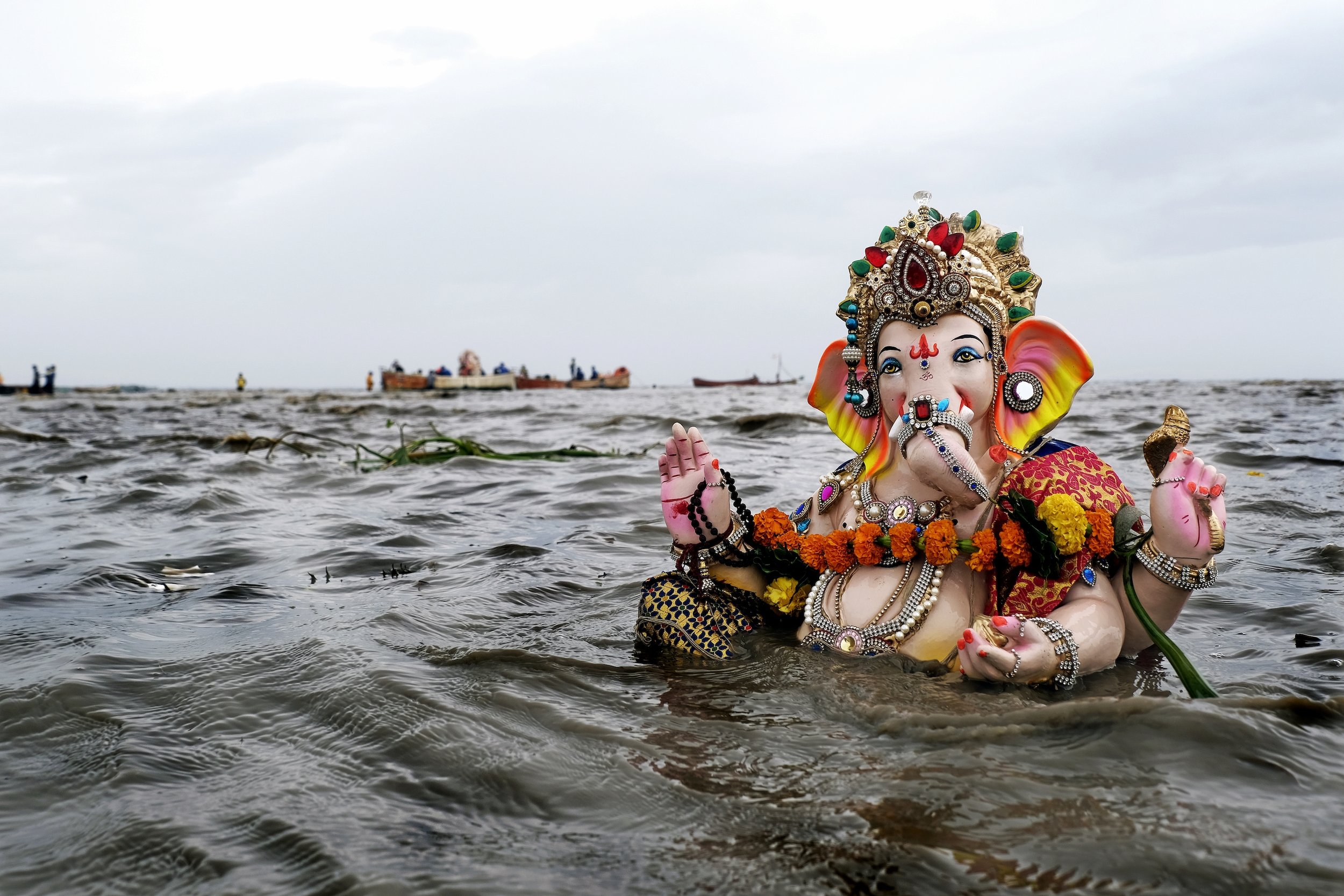
Ganesh Chaturthi is a Hindu festival celebrating the arrival of Lord Ganesh to earth from Kailash Parvat with his mother Goddess Parvati/Gauri. It is a 10-day festival.


It is said that Goddess Parvati created Ganesha out of dirt off her body. Mother Parvati once asked this little boy (Ganpati) to stand by the door while she was bathing and not let anyone inside until she finished. Soon after, Lord Shankar arrived at the same place and tried to enter the restricted area where the little boy stood.


Furthermore, Lord Shankar’s (Husband of Godess Parvati) path was barred by the boy, which angered the former and resulted in him beheading the latter’s head. On knowing the incident, Mata Parvati was enraged and soon ordered Lord Shankar to bring back the boy to life. So, Lord Shiva immediately sent his Ganas to bring back the head of the first creature they would find on their way. However, the Ganas found the elephant head, which was then fixed to the child’s body. And this is how Lord Ganesha was brought back to life and was celebrated as the revival of his elephant head form.


Ganesh Chaturthi preparations commence from almost a month before the festival. The celebrations last for around ten days. On the first day a clay idol of Lord Ganesha is installed in homes. Homes are decorated with flowers. Temples witness the visit of large number of devotees. Poojas are performed. Localities organize and arrange for pandals and install large idols of Lord Ganesha to celebrate the festival with friends and family. On the final day of the celebrations, the idol of Lord Ganesha is taken on the streets. People exhibit their enthusiasm and joy in the form of dancing and singing on the streets along with the idol. The idol is finally immersed in the river or sea.


The ritual is done to signify the birth cycle of Lord Ganesha; just as he was created from clay/Earth, his symbolic statue is as well. The idol is immersed in water so that Ganesha may return to his home after his 'stay' at the devotees' home or temple where the Ganesha Chaturthi rituals are conducted. This is the time when Lord Ganesha is seen off with heavy hearts.  It is believed that when the idol of the Ganesha is taken out for immersion, it also takes away with it the various obstacles of the house and these obstacles are destroyed along with the visarjan.


Ganesh statues are worshiped for 10 days and then it is immersed in water. It is liking sending a family member away from us and that makes people emotional.

View fullsize TEJAL MEWAR - GANESH FESTIVAL (2).jpg
View fullsize TEJAL MEWAR - GANESH FESTIVAL (5).jpg
View fullsize TEJAL MEWAR - GANESH FESTIVAL (3).jpg
View fullsize TEJAL MEWAR - GANESH FESTIVAL (14).jpg
View fullsize 297589312_3351561165172964_6395003721998781721_n.jpeg
View fullsize TEJAL MEWAR - GANESH FESTIVAL (13).jpg
View fullsize TEJAL MEWAR - GANESH FESTIVAL (8) copia.jpg
View fullsize 296834075_1098462347739287_1948118943006342430_n.jpg
View fullsize TEJAL MEWAR - GANESH FESTIVAL (12).jpg
View fullsize TEJAL MEWAR - GANESH FESTIVAL (10).jpg
View fullsize 292401773_1482420602169205_3544443765201504220_n.jpg
View fullsize TEJAL MEWAR - GANESH FESTIVAL (9).jpg


My name is Tejal Mewar. I am primarily a textile merchandiser engaged into international sales of fabrics, living in Gujarat, India. I started photography as a hobby in 2014. I am a self-taught photographer. Observing good photographs on various photography related forums and publications has helped me a lot develop my own style. Every day I am learning something new.

I like capturing candid moments on streets of the people and their life. For me, anything I find unique or amazing for my vision can make me stop and click.

Photography has brought quite a lot of changes in my life. My attitude towards life has changed. It has brought lot of positivity in my life. My self-confidence has increased a lot. I have become more patient. And more over I have also realized that, all the people in this world are good, only they have different points of view.

I really love photography. It is keeping me happy from inside and taking me away from every worry of my life. It takes me somewhere that I have never been to. It helps me preserve these beautiful moments of life. All I want to say is: Camera is a wondrous tool that you may freeze beautiful moments of life with. And I am so glad I learned this.

instagram
Monday 08.15.22
Posted by Progressive-Street
 

THE STARS ARE HIS BONES

by Debiprasad Mukherjee and Gabriel Rosenstock

THE STARS ARE HIS BONES

by Debiprasad Mukherjee and Gabriel Rosenstock

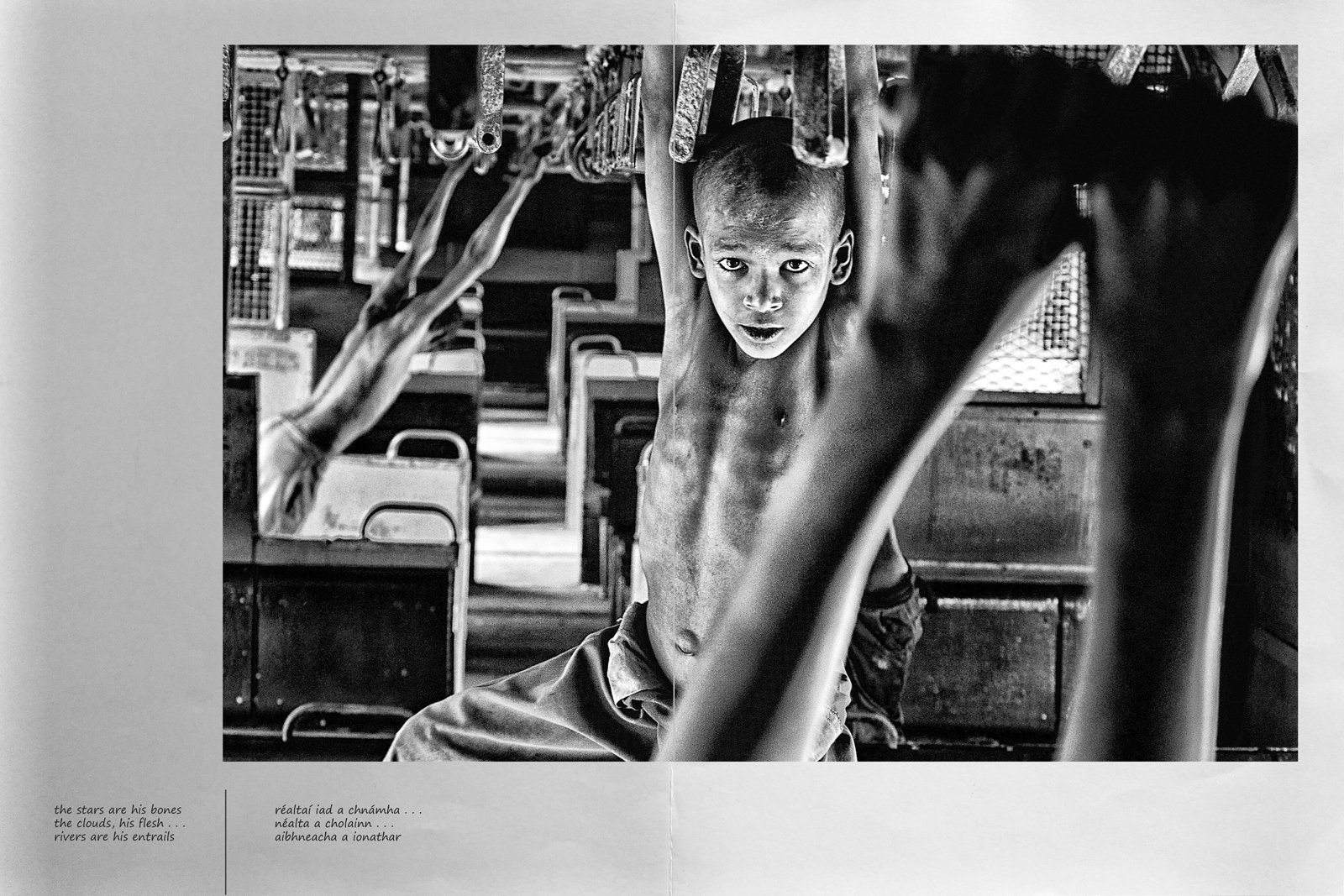
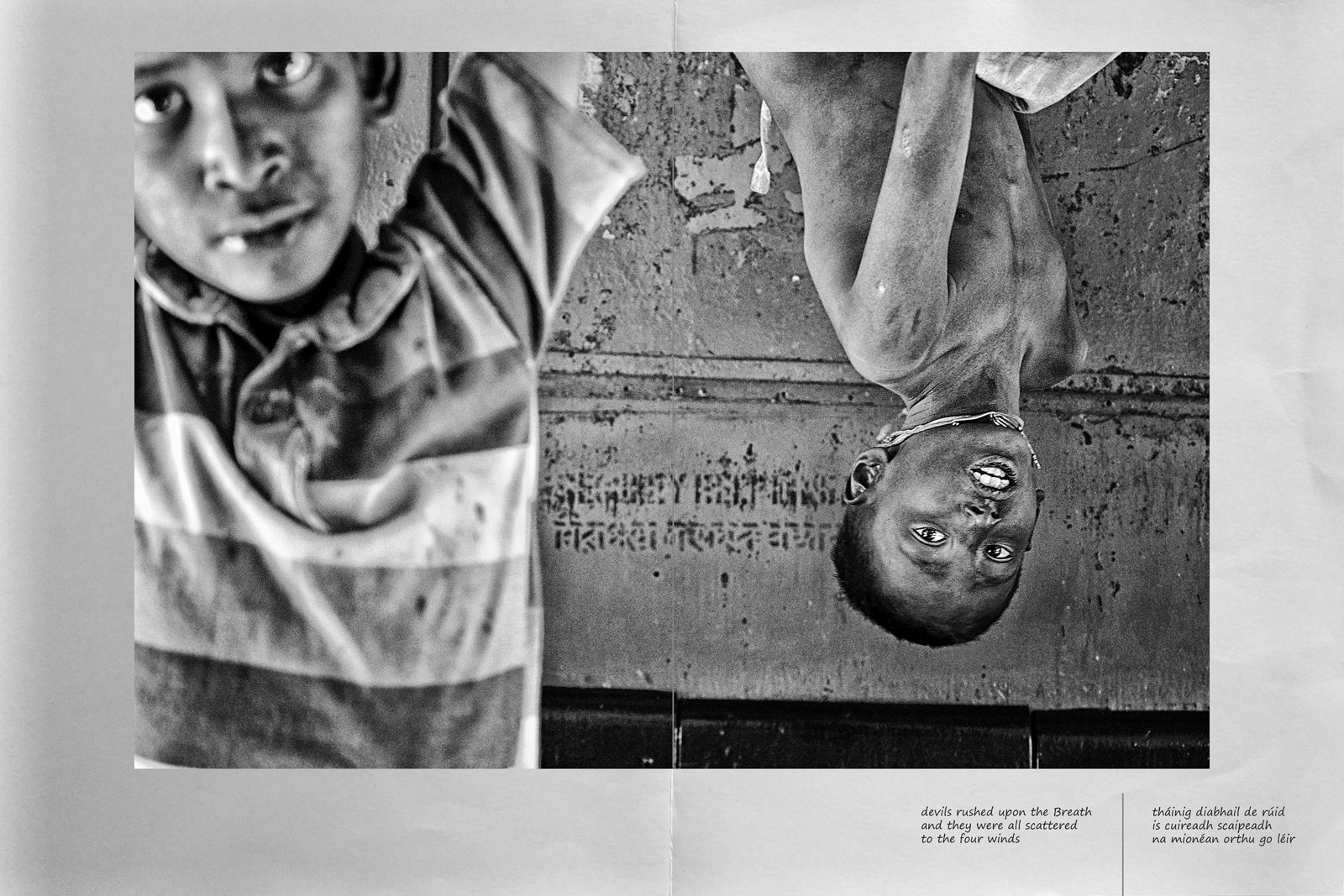
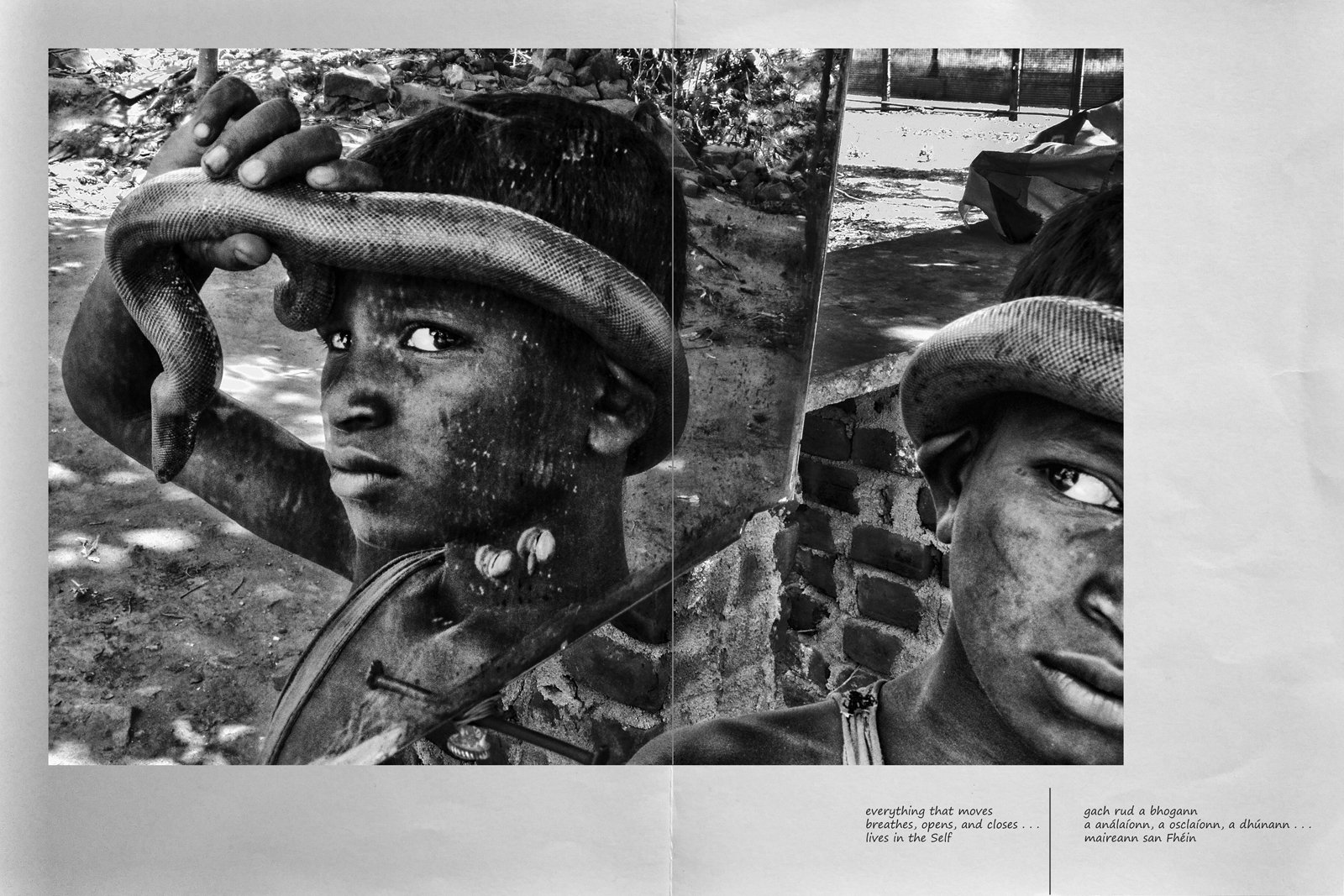
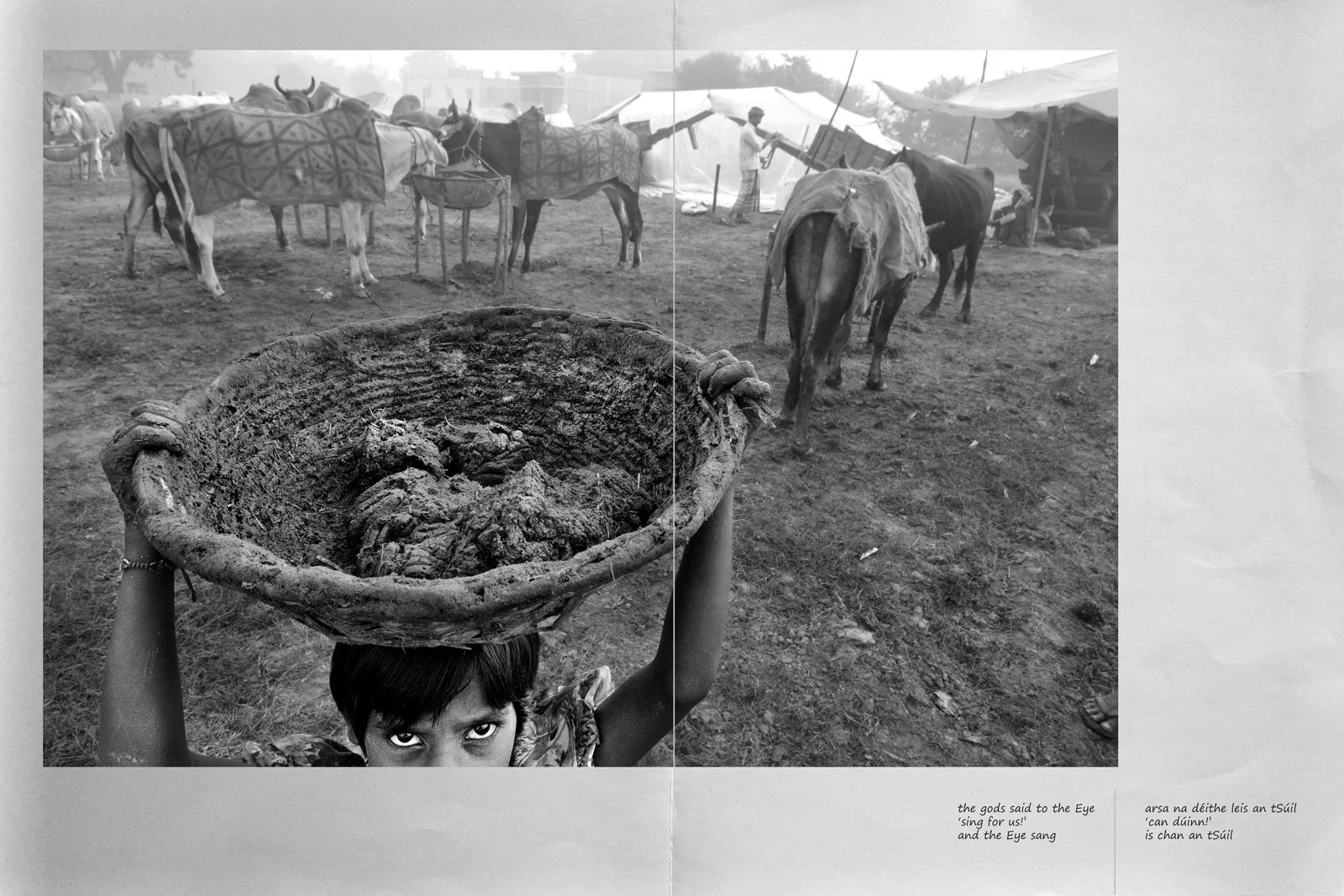
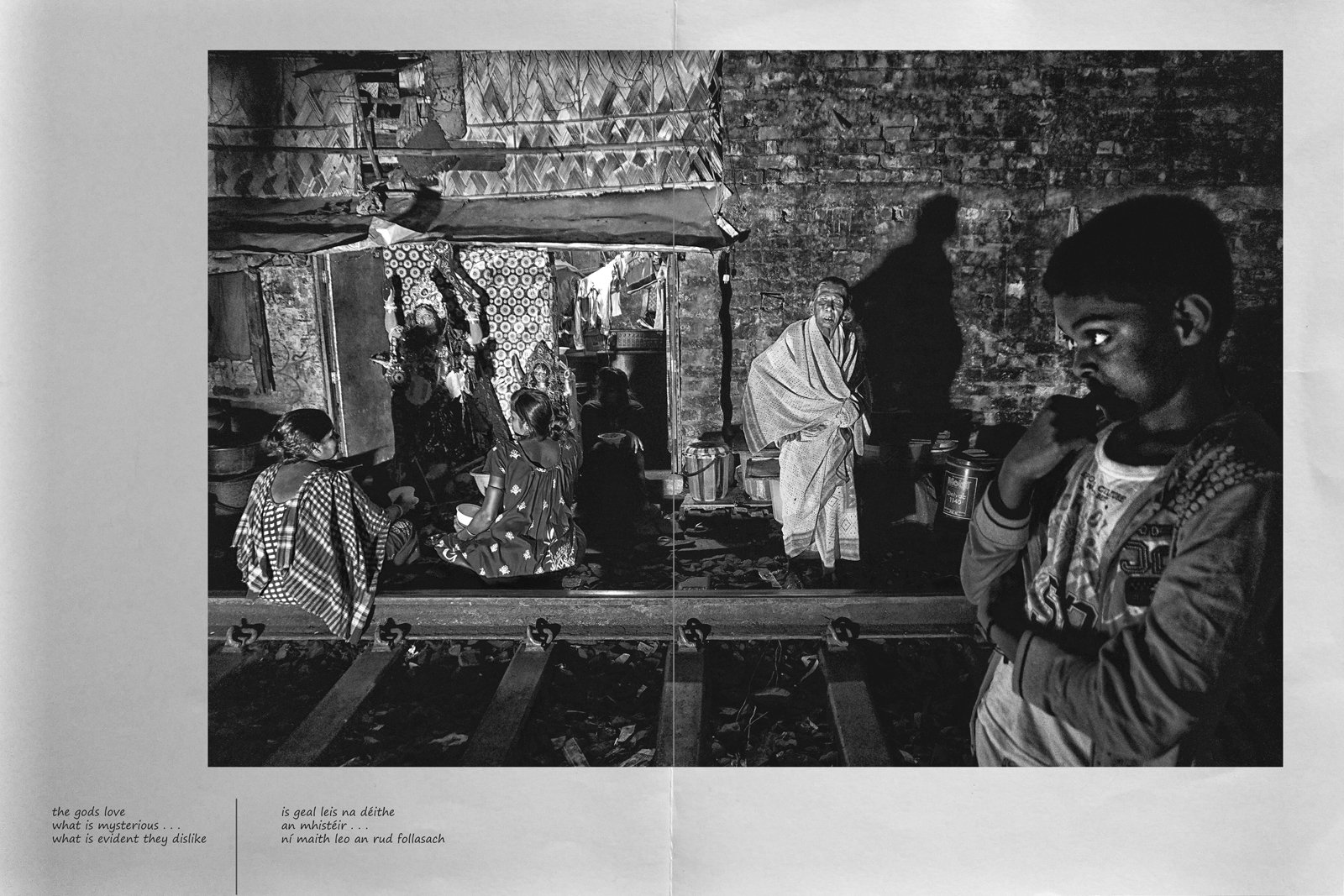
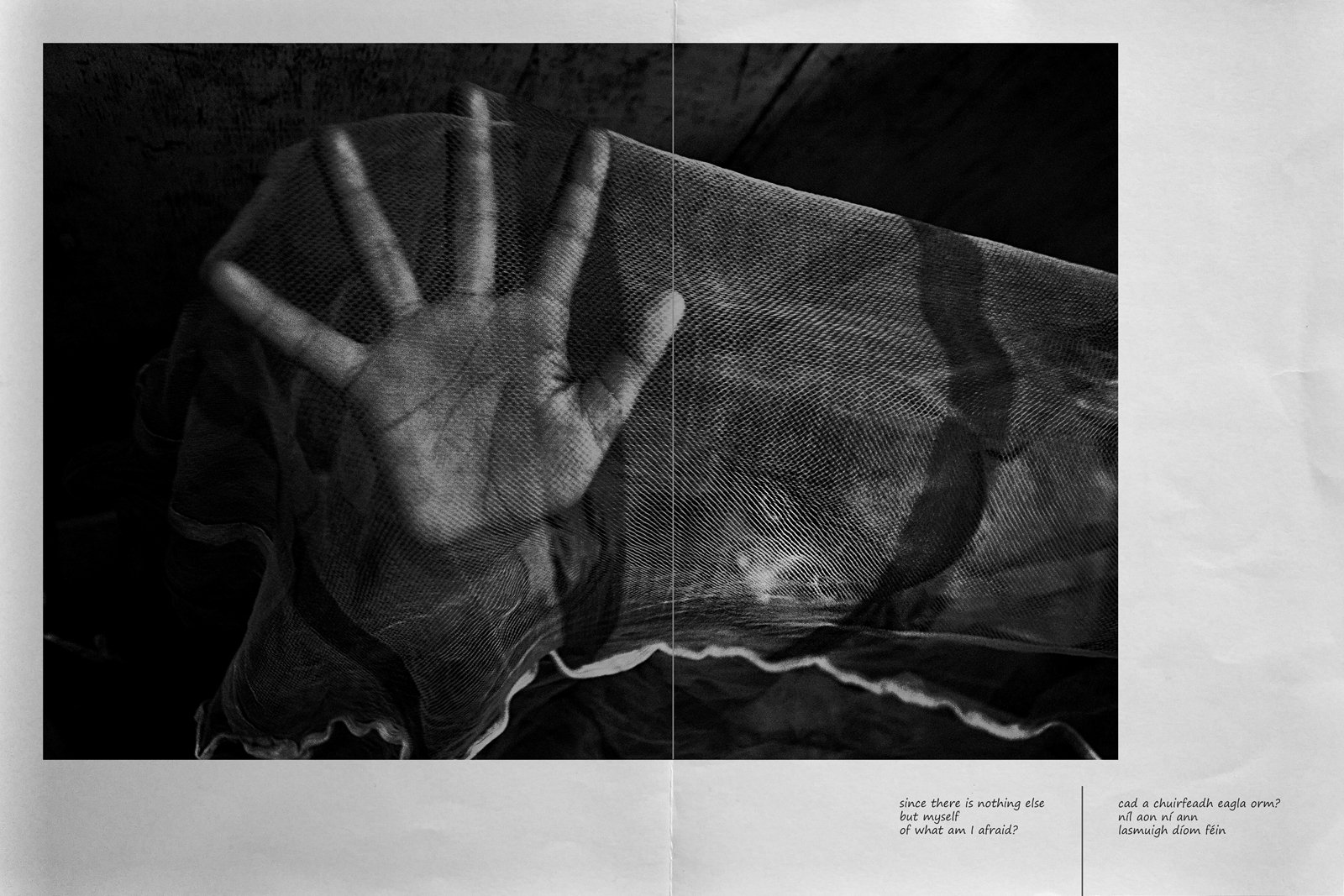
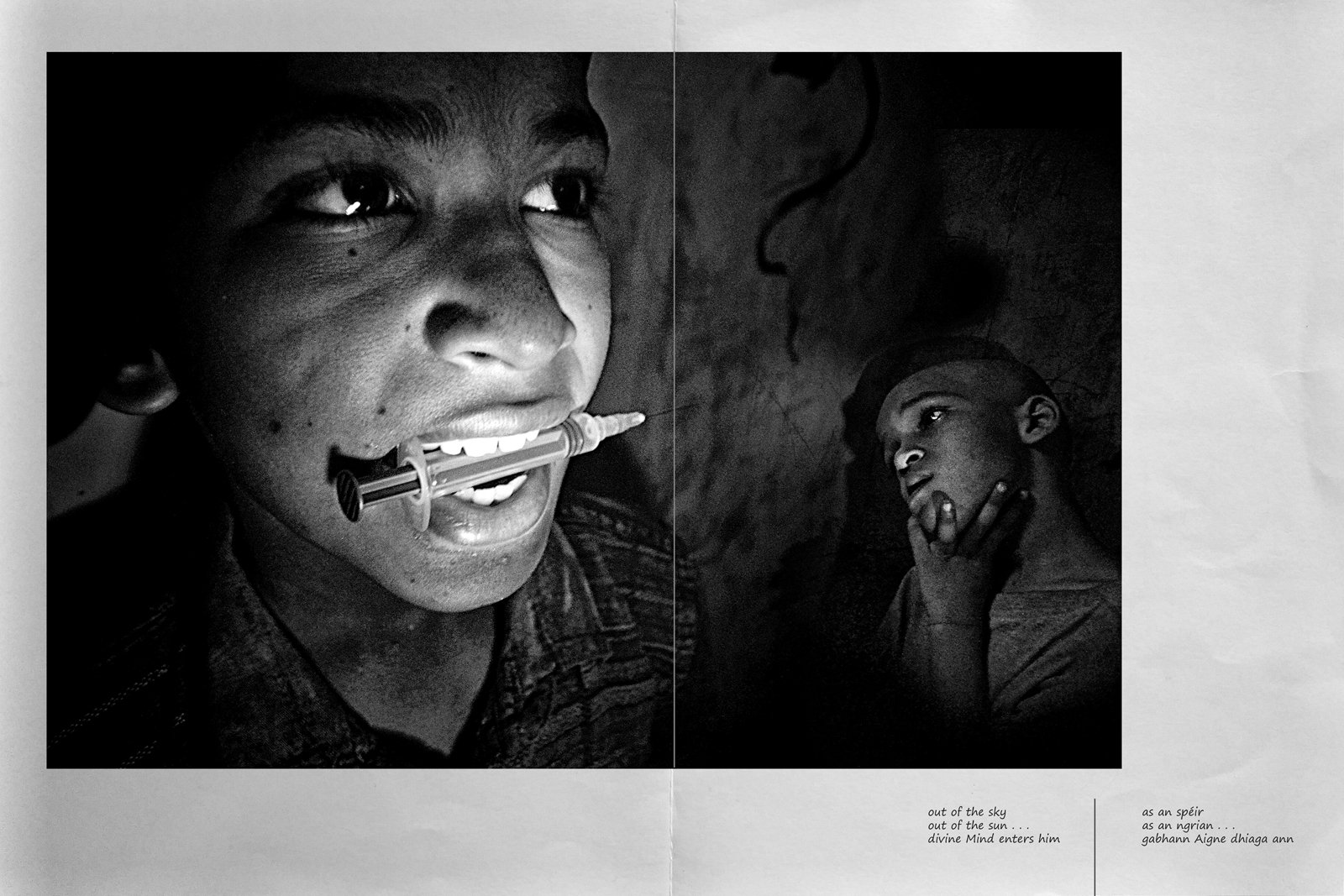
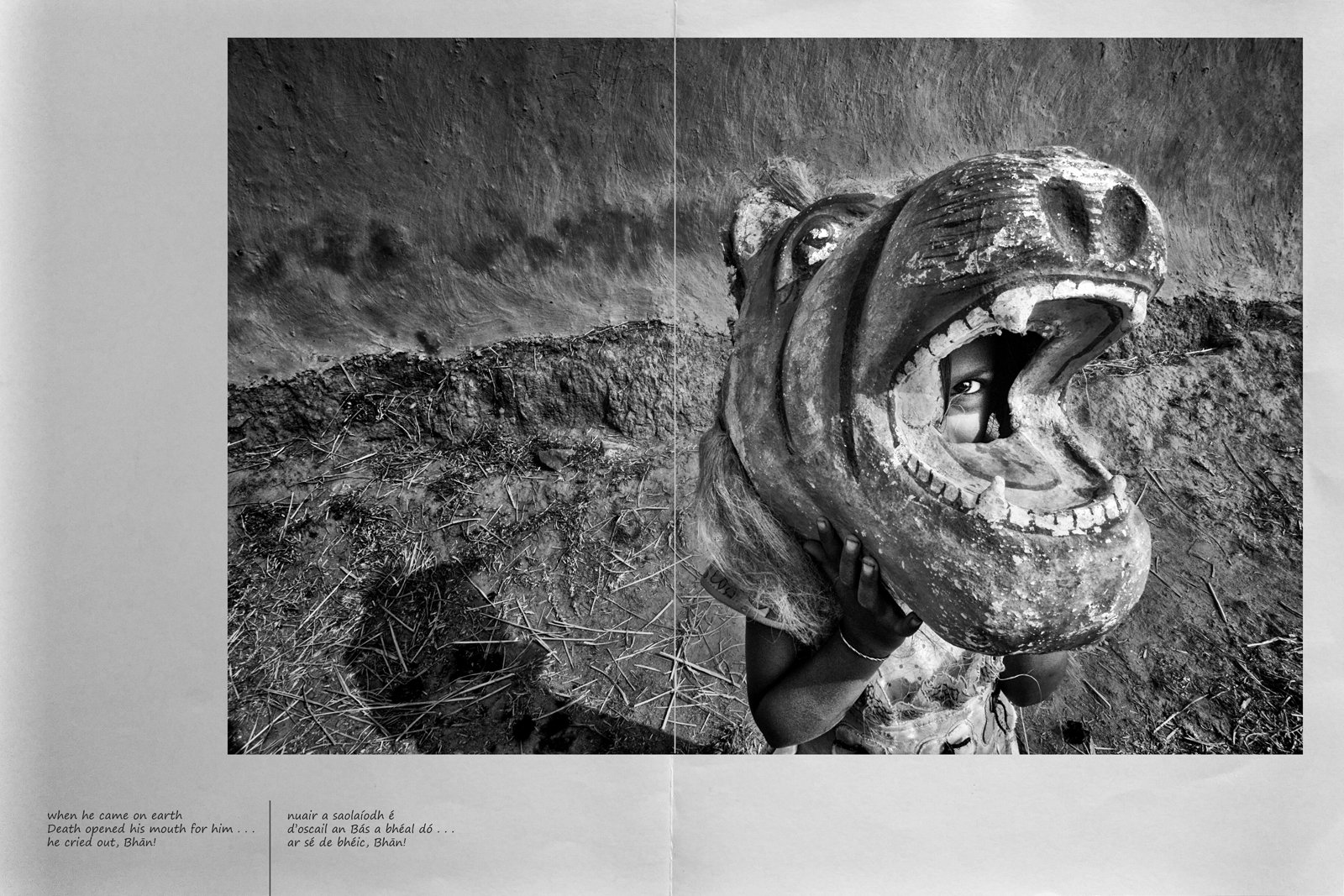
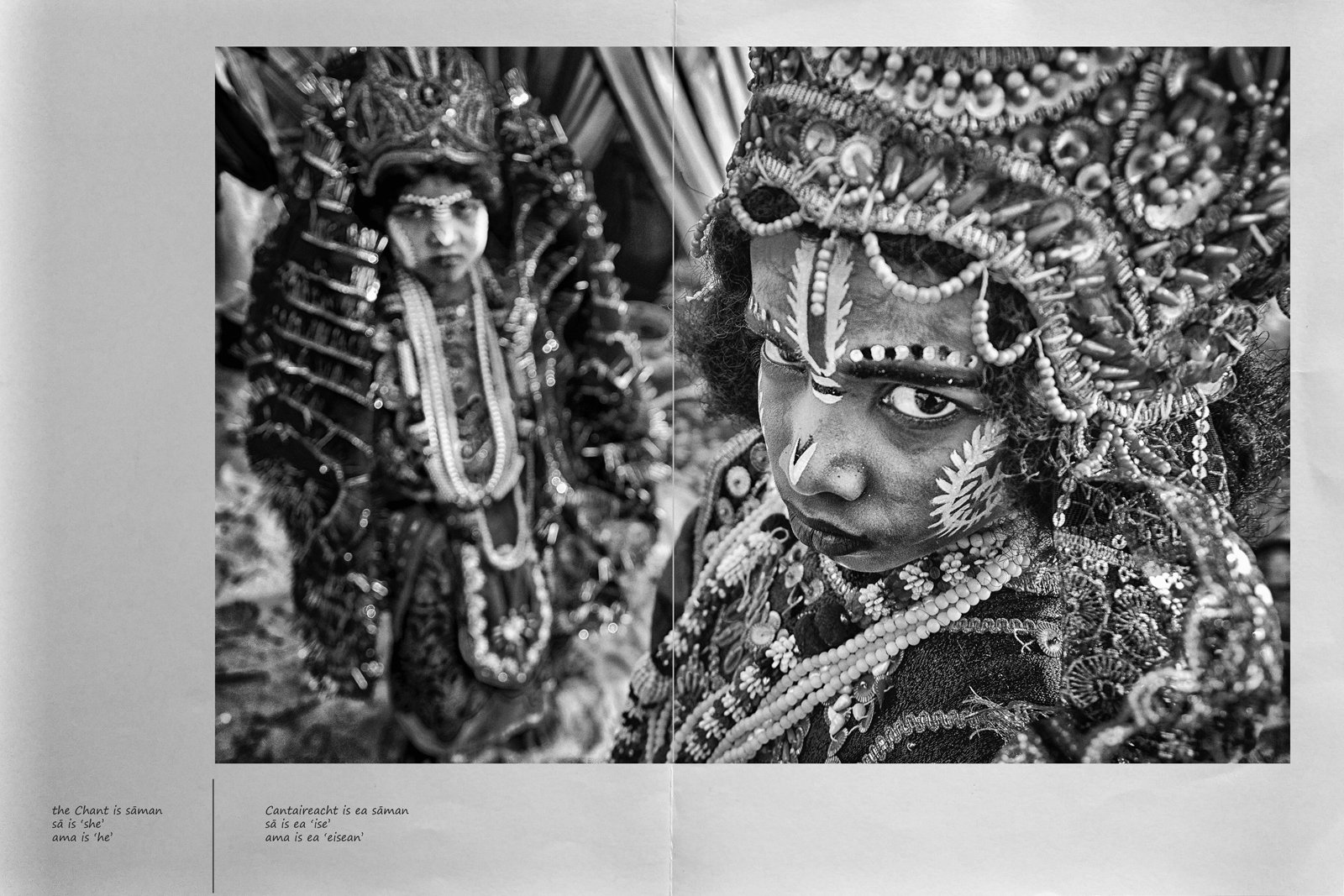
THE STARS ARE HIS BONES is a hybrid East-West Project which juxtaposes a wide variety of black and white images of people and places in India with 'found haiku', extrapolated from an early translation of the Upanishads, considered widely to be one of the world's great fountains of wisdom.

Bilingual poet and haiku master Gabriel Rosenstock, author of Haiku Enlightenment and co-editor of The Awakened One: Buddha-themed Haiku from Around the World, both volumes published by Poetry Chaikhana, says, 'Haiku became popular in the West as a literary and spiritual phenomenon during the heyday of the Beat Generation and in particular the haiku of Jack Kerouac, J W Hackett, Richard Wright and Allen Ginsberg, many of whom Rosenstock has translated into Irish.' Not all modern haikuists derive their inspiration from the Beats. Today, haiku is a world phenomenon; not only is it still hugely popular in Japan, it has found deep roots all over the world, including India and Ireland.

THE STARS ARE HIS BONES offers itself to audiences as a unique experience in which image and text can be contemplated separately and together. In a world that is still troubled by political and religious tensions, this work suggests an alternative transcendental vision of the shared Self, beyond borders, beyond class and all ethnic, political and religious differences. Far from being fuzzy or ethereal, the images and 'found haiku' in THE STARS ARE HIS BONES yield their flesh-and-blood reality, their here and now clarity, to those who linger in their aura.


The Stars Are His Bones is the result of their creative, spontaneous and joyous collaboration, carefully honed and polished over a three-year period. Not a coffee-table book to dip into for visual and poetic delight, but a new 'edition' of an ancient text which, miraculously, allows us to dip into the Self.

Gabriel says: "Annie Besant, a legendary supporter of both Irish and Indian self-rule, had an insight into this ancient wisdom:  'According to the Vedantic view the Self is one, omnipresent, all-permeating, the one reality . . . The Self is everywhere conscious, the Self is everywhere existent, the Self is everywhere blissful . . .' " (An Introduction to Yoga, 1908).

The Stars Are His Bones is not a proselytising project, either as a book, concept or exhibition. Nevertheless, both photographer and author recognise that their work is inspired by the One inexhaustible Self – the core teachings of the Upanishads – and that their combined creative energies have produced something that surprised themselves, initially, and continues to surprise them. For this is a story – like the Self – which ­has no beginning, no end.

 
The Stars Are His Bones (1).jpg
The Stars Are His Bones (2).jpg
The Stars Are His Bones (3).jpg
The Stars Are His Bones (4).jpg
The Stars Are His Bones (5).jpg
The Stars Are His Bones (6).jpg
The Stars Are His Bones (7).jpg
The Stars Are His Bones (8).jpg
The Stars Are His Bones (9).jpg
The Stars Are His Bones (10).jpg
 

"THE STARS ARE HIS BONES" - an atmospheric photo-haiku monograph infused with the wisdom of Upanishadic extracts, configured as 'found haiku'. Text conceived and arranged by Gabriel Rosenstock, Ireland, in Irish and English, complemented by photography by Debiprasad Mukherjee, Kolkata, India.

Book Published By: Cross-Cultural Communications. NY.USA.

ISBN: 978-0-89304-708-5

Debiprasad Mukherjee is an independent documentary photographer based out of Kolkata, India. He strongly believes that as a documentary photographer, it is his responsibility to showcase the social changes and its impact on human race and he is committed to leverage photography as the most powerful tool to capture the social changes & behaviors across the globe over the years. He was the first Convener of Kolkata International Photography Festival 2019 & played role of Global Carbon Ambassador at World Climate Summit Spain 2019. Debiprasad has visited 15+ countries for photo documentary & photojournalism, published his works on 30+ magazines/articles, exhibited photographic works at 35+ exhibitions, got awarded from 40+ countries.

Website: www.debiprasadmukherjee.com

Instagram: https://www.instagram.com/debiprasad.mukherjee/

Email: debiprasad.mukherjee@gmail.com


Gabriel Rosenstock was born in postcolonial Ireland. He is a bilingual poet, tankaist, haikuist, translator, short story writer, novelist, playwright, essayist and, to borrow a phrase from Hugh MacDiarmid, 'a champion of forlorn causes'. Previous collaborative work with Debiprasad Mukherjee has appeared in The Irish Times, The Culturium and Margutte. Rosenstock is a member of Aosdána (The Irish academy of Arts & Letters), a Lineage Holder of Celtic Buddhism and a recipient of the Tamgha-i-Khidmat medal for services to literature. He has edited and contributed to books of haiku in Irish, English, Scots and Japanese. He is a prolific translator into Irish of international poetry, plays & songs.

https://www.rosenstockandrosenstock.com/

https://en.wikipedia.org/wiki/Gabriel_Rosenstock

Wednesday 08.10.22
Posted by Progressive-Street
 

Carnwath Agricultural Show 2022

Carnwath Agricultural Show 2022

by Cameron Scott

Carnwath is a small village in rural South Lanarkshire, Scotland, about 10 minutes’ drive from where I live. The lands of Carnwath were granted to Lord John Somerville in 1508 by King James IV of Scotland, and this part of the country is comprised of rolling green uplands where agriculture is the dominant industry, a million miles away from the hustle of Glasgow and Edinburgh where my street photography usually takes place, but in actuality only 30 minutes’ drive to both.

Each year, in common with many rural communities an annual show takes place which consists of livestock competitions, craft fayres, a funfair, dog and pet shows, and not forgetting home baking and a beer tent. The show also hosts what is believed to be the oldest foot race in Britain (some say the world!) – The Red Hose Race. A modest cash prize attracts runners from afar, but only those from the immediate surrounding parishes are eligible to compete for the coveted Red Hose. The hose on this occasion are of the lower leg covering variety, in other words the winner takes home a pair of long red socks.

In years gone by events such as this have been the happy hunting grounds of many British documentary photographers. I have been in attendance many times in the past, always finding something of interest to point the camera at. Back then I was more interested in competition photography, so I was looking for that single shot, the killer that would see another salon acceptance and possibly a prize. But times change as have I, and this year, being the first full edition post pandemic, I decided to approach one particular event within the show from a documentary perspective – the Sheep Champion of Champions.

The sheep pens and competition rings sit at the bottom end of the upward sloping show field. Various breeds such as Texel, Border Leicester, Bluefaced Leicester and Blackface are judged in classes, these including individual males and females (known as Tups and Yows in the local Scots dialect), pairs and family groups. After being herded into the judging pen the contestants are allowed to wander around while the Judge, dressed in timeless countryside tweeds, watches their movement with a keen eye. Onlookers, mostly those in the business going by the weather-beaten complexions, take notes and pass comments amongst themselves.

After the contestants have been herded around the judging pen, the next part of the process involves them being arranged in a straight line for closer inspection, and this is where the fun begins. Unlike the competitors who are assembling further up the field for the dog show, obedience does not come naturally to these animals. In fact, it does not come at all. Having once rescued a stranded sheep from a steep mountainside, I know from first-hand experience just how powerful and stubborn they are. Each sheep has a handler whose purpose it is to ensure that they hold the line. This can become a wrestling match, a sheep rodeo, or a strange bout of WWF – man against mutton. After much struggling an uneasy compromise is reached, and the hands-on judging can begin. This involves a lot of poking, prodding and more grappling, all while the animals become ever more restless and the truce increases in fragility. Occasionally an inspiring bid for freedom is successful and the line has to be regained. Eventually a winner is selected, indicated by a gesture from the judge using his crook and a nod in the winning entrant’s direction. Ribbons change hands, more notes are taken, and the handlers get a well-earned short rest before the whole process to select another Champion starts again.

 
View fullsize 1.jpg
View fullsize 2.jpg
View fullsize 3.jpg
View fullsize 4.jpg
View fullsize 5.jpg
View fullsize 6.jpg
View fullsize 7.jpg
View fullsize 8.jpg
View fullsize 9.jpg
View fullsize 10.jpg
View fullsize 11.jpg
View fullsize 13.jpg
 
 
website
Tuesday 08.09.22
Posted by Progressive-Street
 

Searching For My Very Own Rue Mouffetard

by Thomas Hackenberg

Searching For My Very Own Rue Mouffetard

by Thomas Hackenberg

“What a strange title?!”, you might be asking yourself… Here’s the story to it:

I got my first serious camera as a present from my parents for my 18th birthday and bought myself a photo compendium entitled “THE JOY OF PHOTOGRAPHY”, which was published by Kodak, if my memory serves me correctly. I poured over the pages and there it was – I can still feel my amazement when I first discovered this photograph; it's as if it were yesterday:

The magical B/W masterpiece by Henri Cartier-Bresson, a photograph that many of you are sure to be familiar with. The black-and-white picture of a small boy, carrying home two huge bottles of wine with an indescribable expression of pride and joy on his face, entitled Rue Mouffetard, Paris, 1954. When I saw this picture, I was thunderstruck: How on earth could a photographer be there, see and catch such an intimate, candid moment? What he called The Decisive Moment. With the equipment available at that time!

This picture of the little boy virtually burned itself into my brain from that day on. I have never forgotten it since; it has provided me with a kind of internally memorized guardrail and a compass to give direction to my own photographic passion.

I have entitled my series “Searching For My Very Own Rue Mouffetard”, because that is the most fitting title I could possibly think of. It describes my quest to make good street pictures which resonate with and speak to the viewer. Henri Cartier-Bresson’s masterpiece is always in my head. This was THE picture for me, my personal game changer! Take pictures of people in the street – this was going to be what I wanted to do!

“Searching For My Very Own Rue Mouffetard” is an open, continuing series of single street pictures which have one thing in common: they show my photographic search for the elusive ideal which is so hard to define and to find – examples of my quest to catch ambient peculiarities and quirkiness in everyday life.

Braunschweig, Germany, 2020
Vienna, Austria, 2019
Vienna, Austria, 2019.
Luxembourg City, 2022
Braunschweig, Germany, 2021
Braunschweig, Germany, 2018
Braunschweig, Germany, 2021
Hannover, Germany, 2020
Luxembourg City, 2022
Hannover, Germany, 2020
Braunschweig, Germany, 2021
Frankurt-Main, Germany, 2021
Luxembourg City, 2022
Salzburg, Austria, 2022
Luxembourg City, 2022
Vienna, Austria, 2019
Salzburg, Austria, 2022
Luxembourg City, 2022
Westerland, Germany, 2019
Amrum Island, Germany, 2020
Braunschweig, Germany, 2021
Collioure, France, 2014
Braunschweig, Germany, 2018
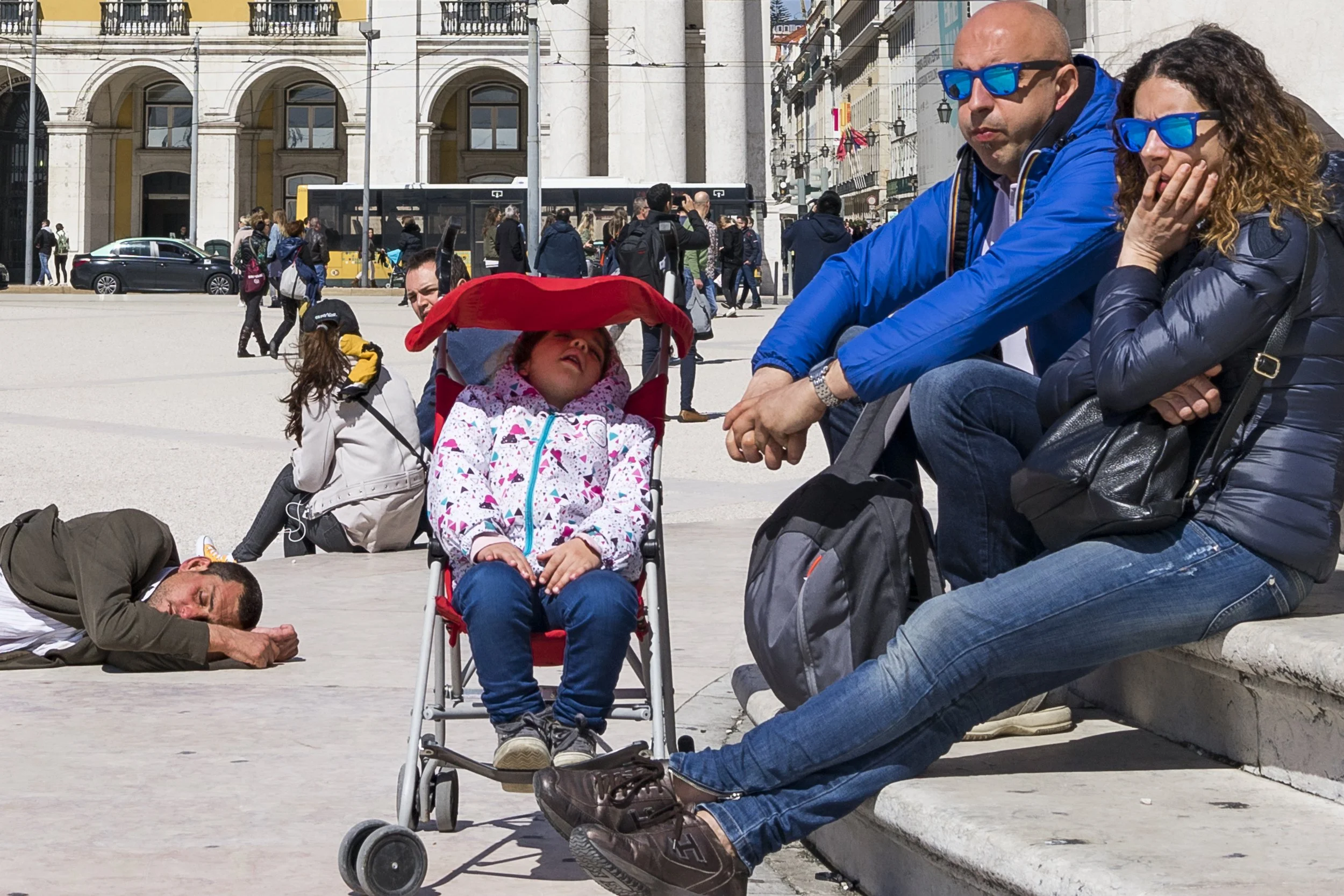
 Lisbon, Portugal, 2018
Lisbon, Portugal, 2018
Braunschweig, Germany, 2020
San Francisco, USA, 1987
San Gimignano, Italy, 1991
Braunschweig, Germany, 2020 Vienna, Austria, 2019 Vienna, Austria, 2019. Luxembourg City, 2022 Braunschweig, Germany, 2021 Braunschweig, Germany, 2018 Braunschweig, Germany, 2021 Hannover, Germany, 2020 Luxembourg City, 2022 Hannover, Germany, 2020 Braunschweig, Germany, 2021 Frankurt-Main, Germany, 2021 Luxembourg City, 2022 Luxembourg City, 2022 Salzburg, Austria, 2022 Luxembourg City, 2022 Luxembourg City, 2022 Vienna, Austria, 2019 Salzburg, Austria, 2022 Salzburg, Austria, 2022 Luxembourg City, 2022 Westerland, Germany, 2019 Amrum Island, Germany, 2020 Braunschweig, Germany, 2021 Collioure, France, 2014 Braunschweig, Germany, 2018  Lisbon, Portugal, 2018 Braunschweig, Germany, 2020 San Francisco, USA, 1987 San Gimignano, Italy, 1991
 

"For me, a good street photo must be made candidly, captivate me at first glance and make me want to take that second look. It must raise more questions than provide answers. I like photos that tell a story in a single image, and I particularly like quirky pictures and visual puns in everyday life. When I am out on the streets, I like chasing for the offbeat, on a quest to find some extravaganza in the ordinary, some fun element, some beautifully layered scene, some fleeting moment. Any interesting scene that hits my eye, observed images from the great theatre of street life that might only exist for a split second and then it’s gone forever. Triggered by a colour, a human gesture, an interplay of foreground and background. I love these special moments, so rare and so elusive, when all things fall into place and a good picture emerges. It’s the pleasure and anticipation of making a good street picture that drives me. The flow when I am completely in the moment and fully open and susceptible to life on the street. Standing on a corner, letting life flow towards me, observing and pressing the shutter at the right moment. After all, it’s all about curiosity. It’s all about finding out what life has in store for me on any given day – I'm eager to see what’s around the next corner."

 
website
Instagram

Thomas Hackenberg was born in 1963 and lives in the German city of Braunschweig.

His work has been widely published, received finalist awards and prizes at international festivals such as at the Gothenburg, Istanbul, Italian, London, Miami, and Paris Street Photography Festivals, and was exhibited in several group shows.

Thursday 08.04.22
Posted by Progressive-Street
 

"Il-Gostra" is a traditional Maltese Game

Martin Agius

"Il-Gostra" is a traditional Maltese Game

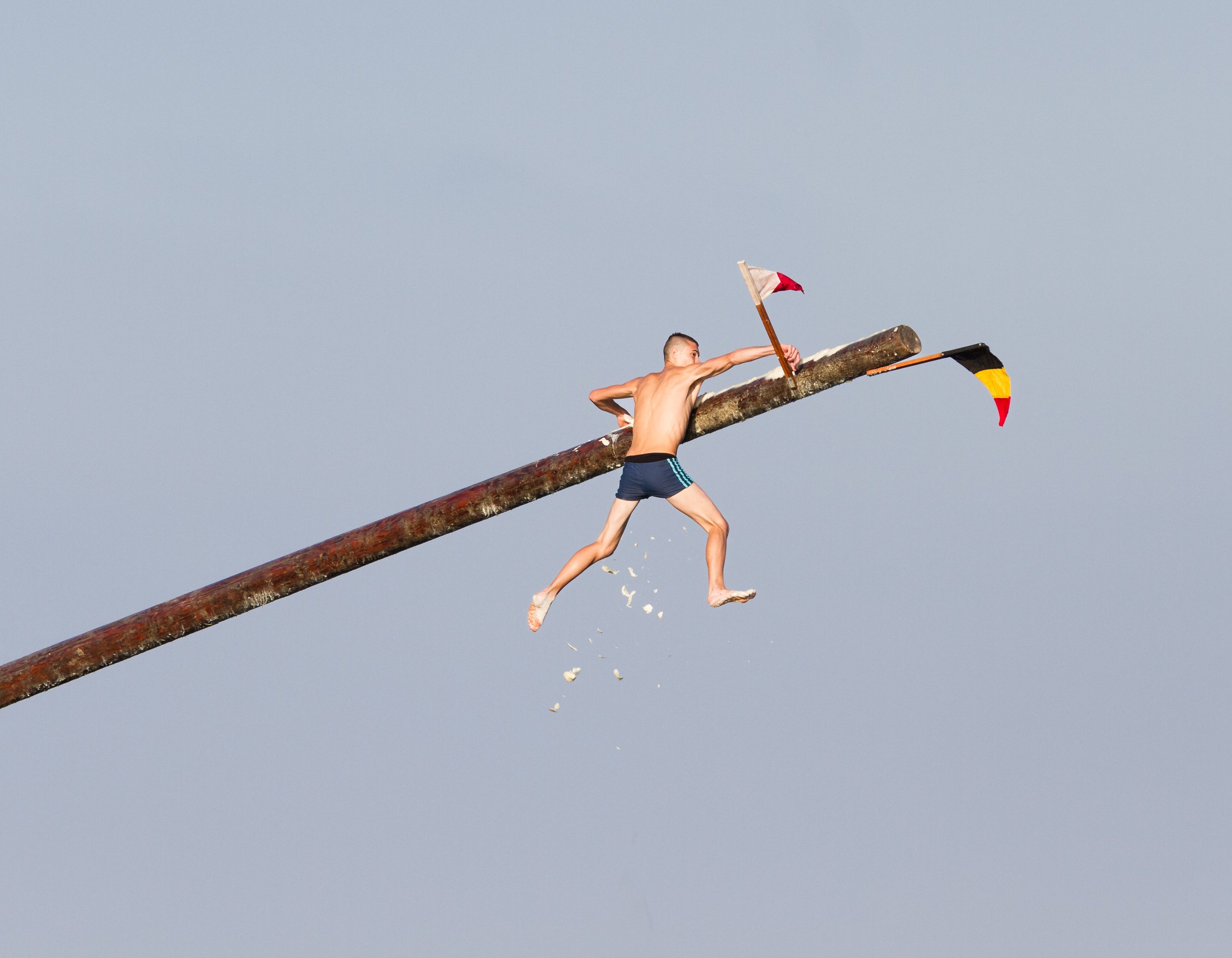
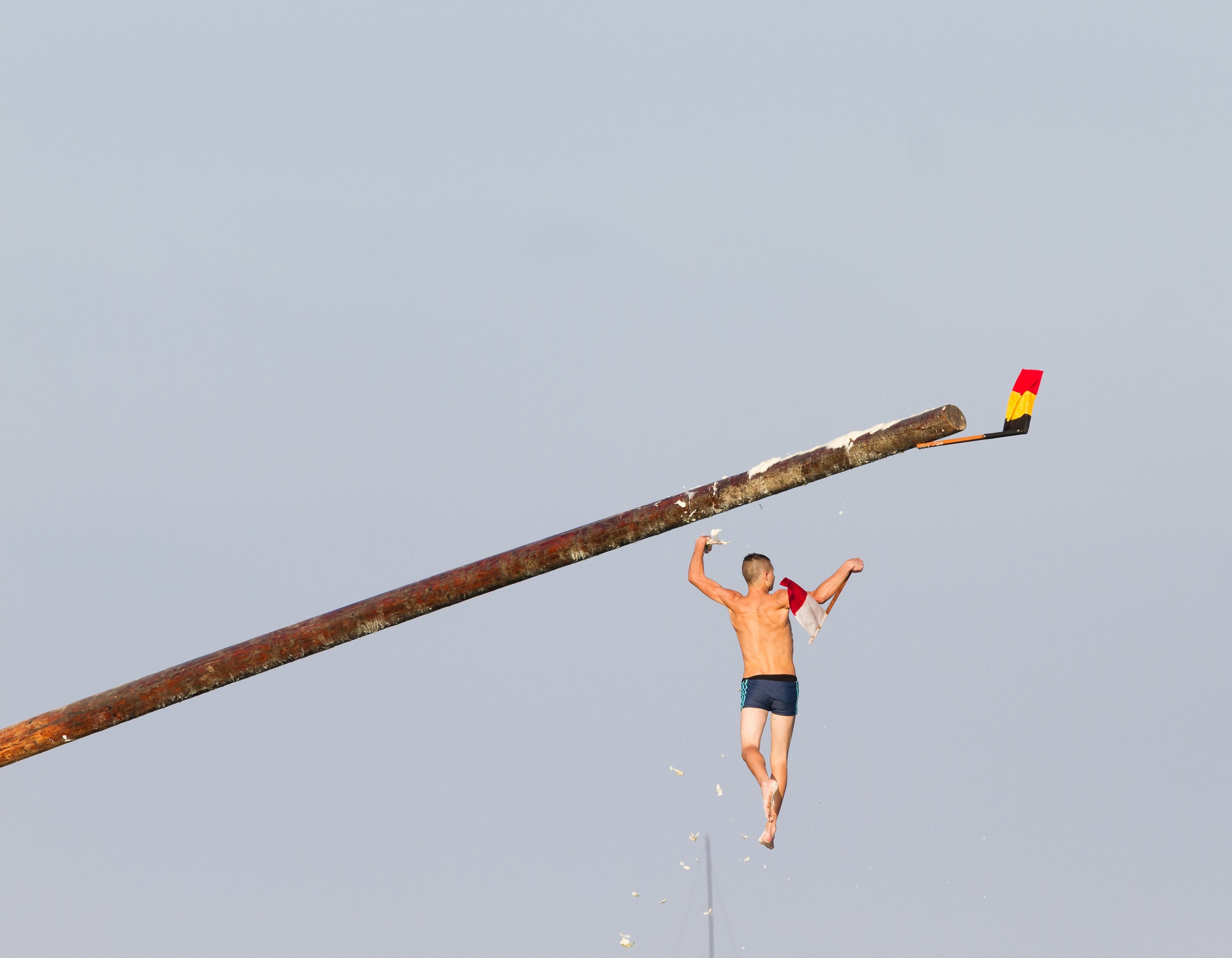
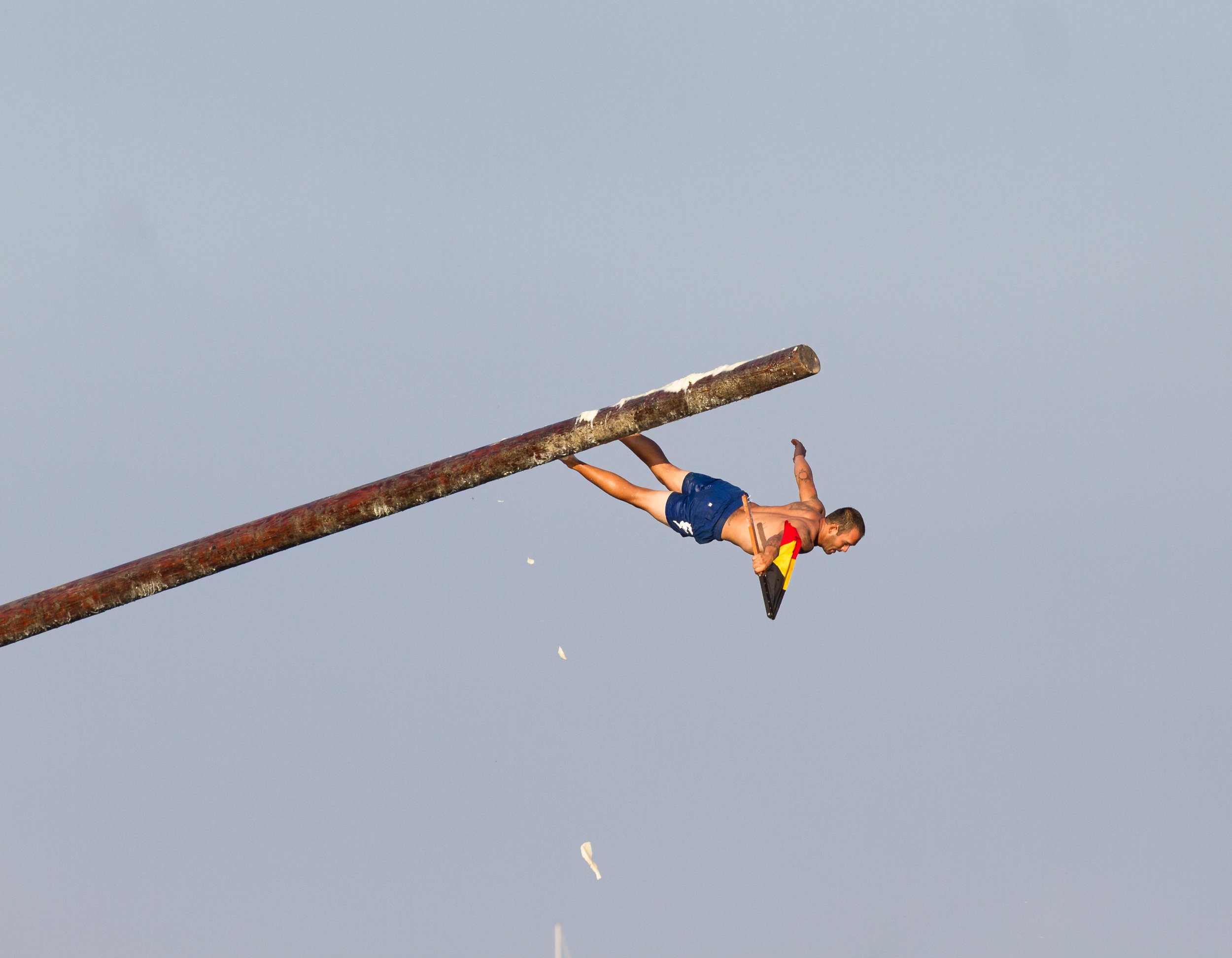
One of Malta's oldest sports, the "Gostra," involves contestants trying to climb a greasy pole to retrieve a flag before falling into the water below. The game is played during the feasts of St Joseph in Msida and St Julian in St Julians.

A sizable wooden pole (between 10 and 16 metres in length) would be raised over the sea in numerous seaside villages around the Maltese Islands. It was then hauled to the harbour while mounted atop a coal barge. The huge pole sticking out over the water would be dripping with grease and pig fat.

The object of the game is to take one of the three flags at the end of the pole, which are a blue and white flag for St. Mary, a yellow and white flag for the Vatican, and the Belgian tricolour, which is said to be dedicated to St. Julian.

Many people return home with a few bumps, but only a few people bring home medals and awards! However, you risk injury just like in other sports.

The game is played during the feasts of St Joseph in Msida and St Julian in St Julians.

View fullsize Gostra 01.jpg
View fullsize Gostra 04.jpg
View fullsize Gostra 10.jpg
View fullsize Gostra 11.jpg
View fullsize Gostra 12.jpg
View fullsize Gostra 13.jpg
View fullsize Gostra 14.jpg
View fullsize Gostra 15.jpg
View fullsize Gostra 02.jpg
View fullsize Gostra 03.jpg
Gostra 07.jpg
Gostra 08.jpg
Gostra 09.jpg
Gostra 07.jpg Gostra 08.jpg Gostra 09.jpg
 
 
Martin Agius
Monday 08.01.22
Posted by Progressive-Street
 

GOMIRA DANCE by Nilanjan Ray

GOMIRA DANCE

by Nilanjan Ray

Gomira dance is a rural dance form mainly practised in the Dinajpur district of West Bengal. The dance is usually performed by the villagers to please the gods to usher in the ‘good forces’ and ward off the ‘evil forces’. Very obviously, this dance form is a part of varying traditions and the rich cultural history of Bengal.

Gomira dance is actually a masked dance form. The word Gomira has been derived from the colloquial form of the word “Gram-Chandi” or the female deity who is the protective force of the village. The exact origin of the dance form is not traceable and is lost in the realms of time. Another section believes that the word “Gomira” has been derived from the word ‘Gamar’, the wood that is mainly used to make the masks. The Gomira masks or “Mukha” are thus inexorably linked with the Gomira dance festival.

The Gomira dance is mainly celebrated during the Bengali months of Baisakh-Jaishtya and Asarh corresponding to the English months between mid-April to mid-July. This is the harvest season for the villages. The dance is also performed during the period of harvesting of mangoes when the puja of Amat-Kali is celebrated.  This is usually during the period of Jaishtya.

The dance has been evolved into mainly two forms – the Gomira form and the Ram-Vanvas Form. The Gomira form is the traditional form with the characters of Bura-Buri (Old man- Old woman), Smasan Kali, Masan Kali, Dakini Bishwal, SigniBishwal, Bagh (Tiger), Nar-Rakshas and Narsingha Avatar. The Ram-Vanvas form depicts the Van Kanda of Ramayana.

Traditionally, the dance starts with the entry of two characters Buro-Buri, who are actually said to be the human forms of Shiva and Parvati. After their performance, other masked dancers enter their arena to perform. According to the Gomira tradition, these gods took human shape and descended on earth so that they may bless the humans and help them to fight the forces of evil and establish a righteous way of life.

 
View fullsize gom_001.jpg
View fullsize gom_005.jpg
View fullsize gom_010.jpg
View fullsize gom_012.jpg
View fullsize gom_013.jpg
View fullsize gom_014.jpg
View fullsize gom_018.jpg
View fullsize gom_021.jpg
View fullsize gom_022.jpg
View fullsize gom_023.jpg
 
nilanjan ray

NILANJAN RAY (b. 1959) has a handful of exposed stock on “HUMAN INTEREST” and keeps stock of other people’s money in a Bank since it is his profession. 

Has received wide appreciation Internationally as well as Nationally.  Has received Merit Prize from National Geographic, USA & National Award from Photo Division, Govt. of India.

Solo Photography Exhibition on ‘VARANASI - AN ETERNAL CITY’ organized by OXFORD BOOKSTORE, Kolkata, NATIONAL CENTRE FOR PERFORMING ARTS, (NCPA), Mumbai and INDIA INTERNATIONAL CENTRE (IIC), New Delhi.

Solo Photography Exhibition on “FAITH – A QUAINT EMOTIONS” was organized by INDIA INTERNATIONAL CENTER, NEW DELHI from 29th Novemvber,2016 to 9th December,2016.

 Other than above, my photographs are selected for exhibition at British Council, UNICEF, ACADEMY OF FINE ARTS, Calcutta, LALIT KALA ACADEMY, New Delhi etc. Photographs are also selected for a Book” Framed City” – published at Indian Art Festival, New Delhi. Photographs are also selected for a Book “INDIA- 5 Senses “by Roli Books. Photographs & Articles are published regularly in leading daily Newspapers and Magazines.

Received letter of appreciation from Maitre Henri Cartier-Bresson. Paris.


Saturday 07.30.22
Posted by Progressive-Street
 

Following Honey Hunters in the Himalayas in Nepal

LIMOR ZADOK

Following Honey Hunters in the Himalayas in Nepal

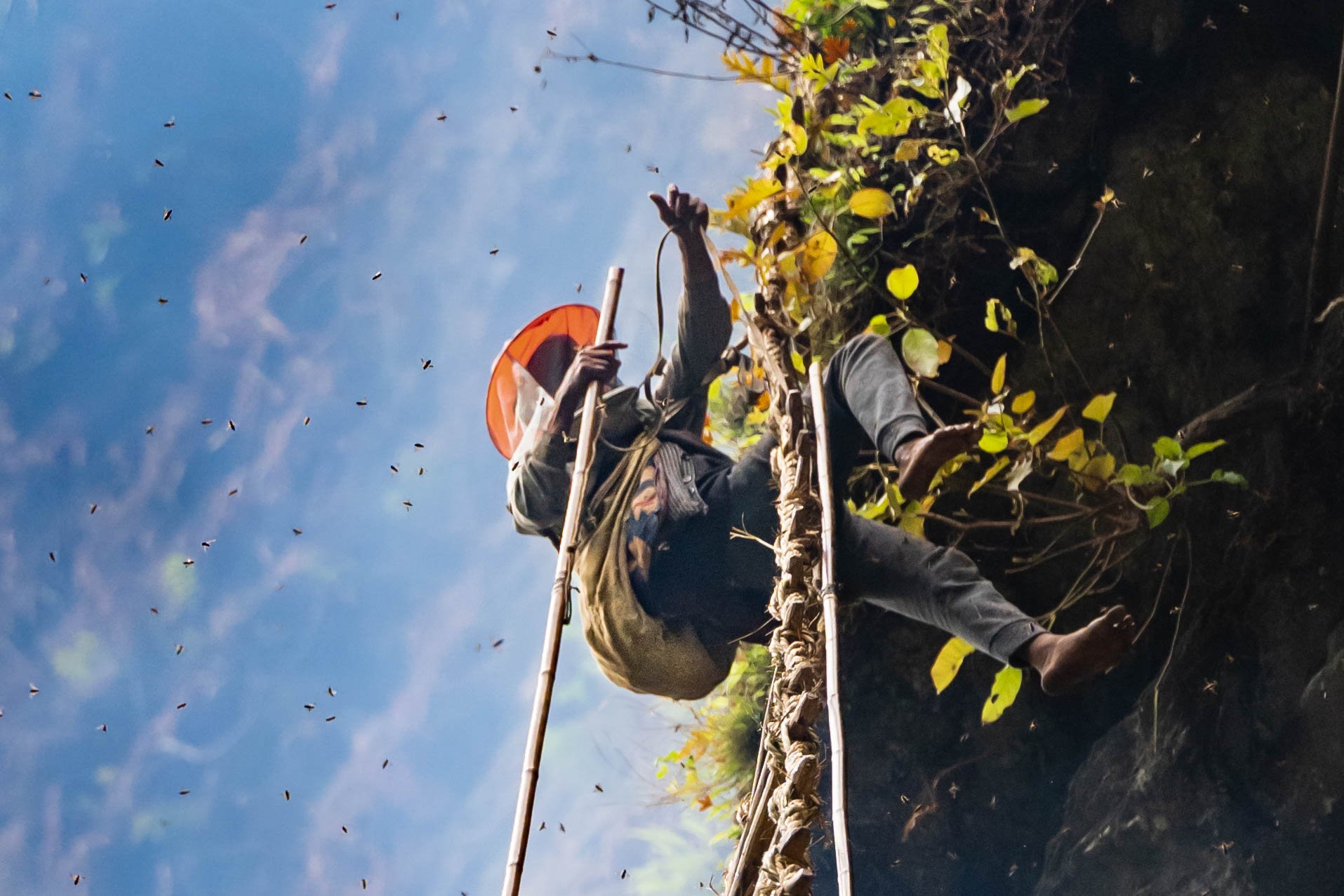
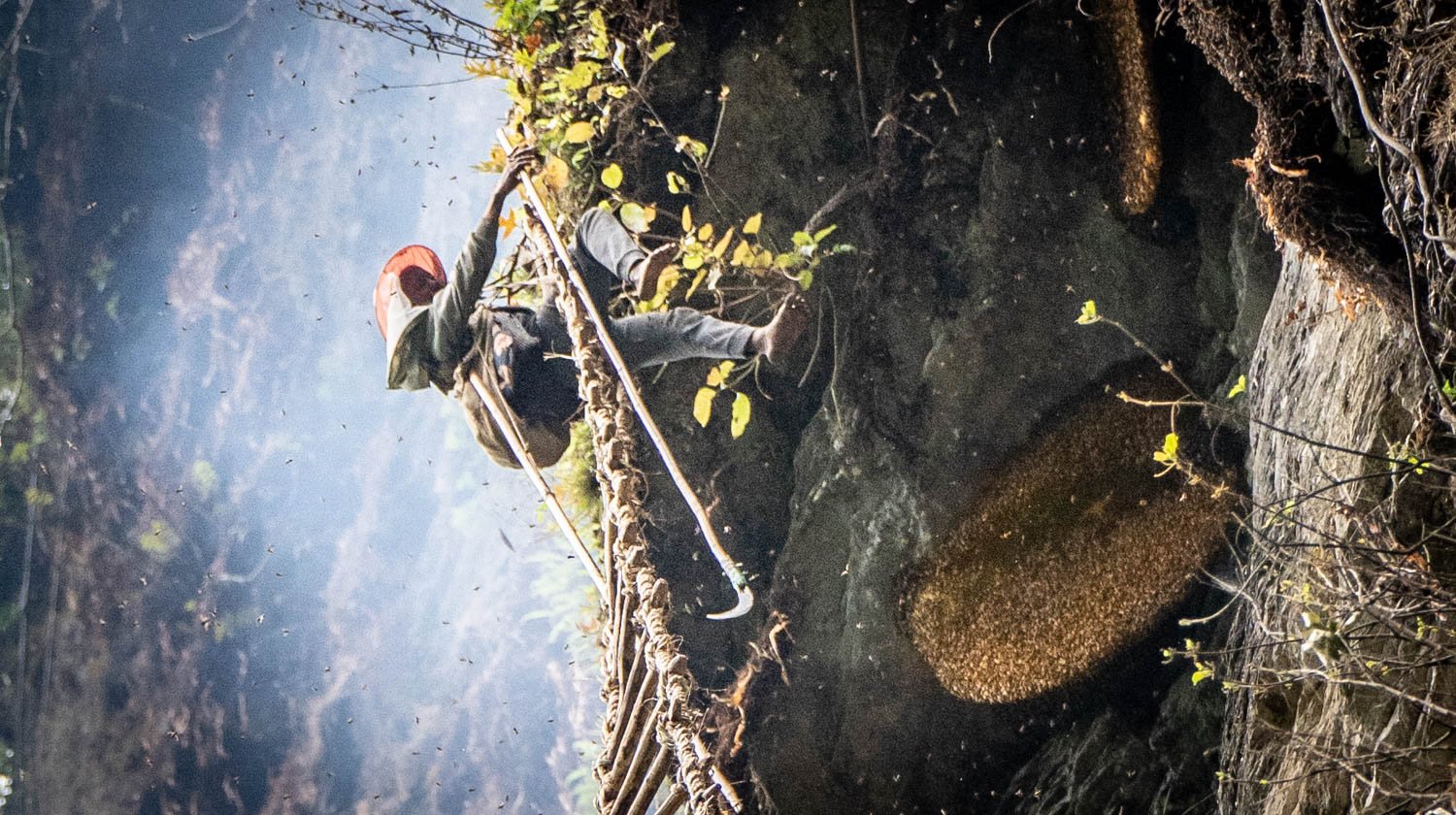
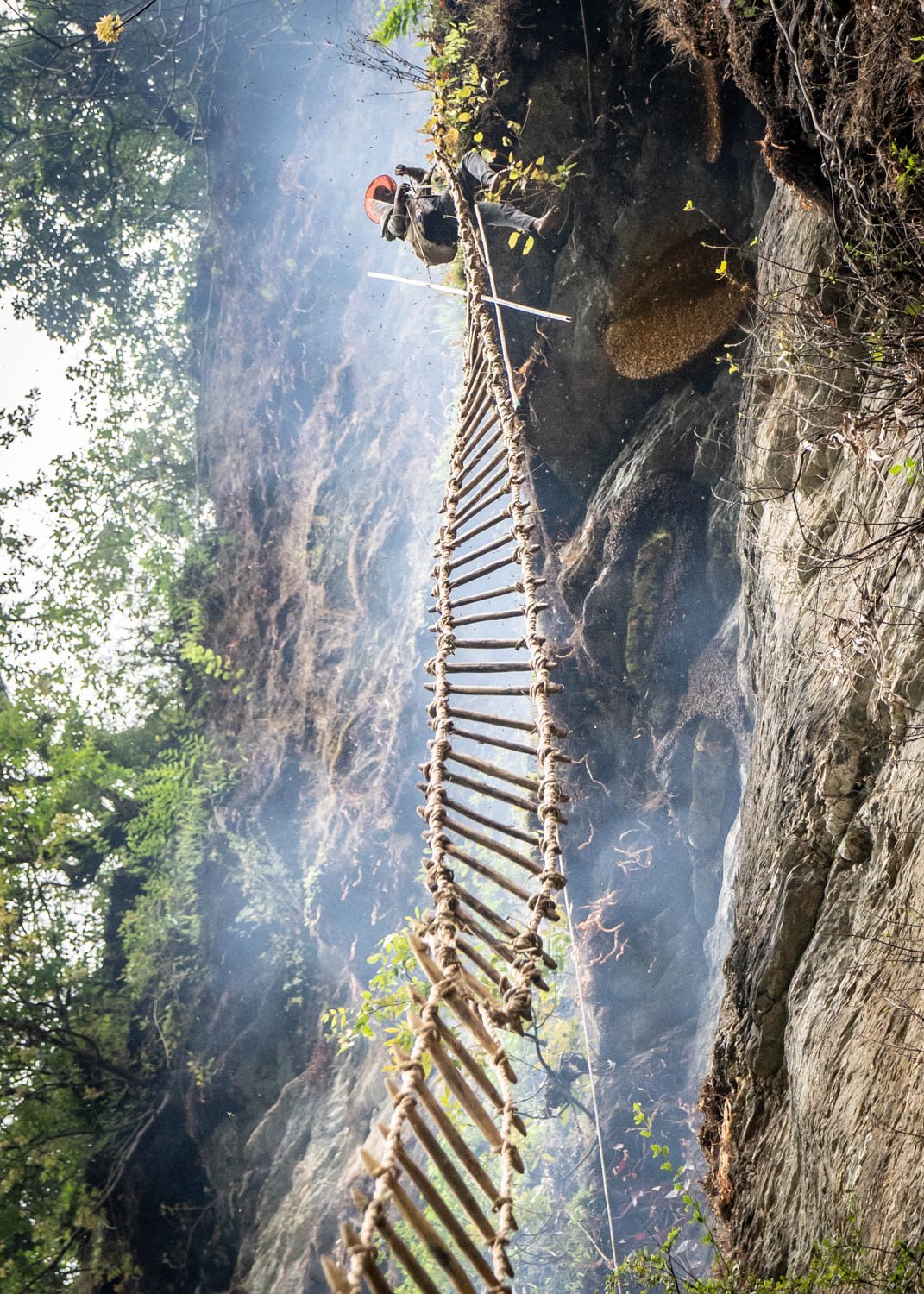
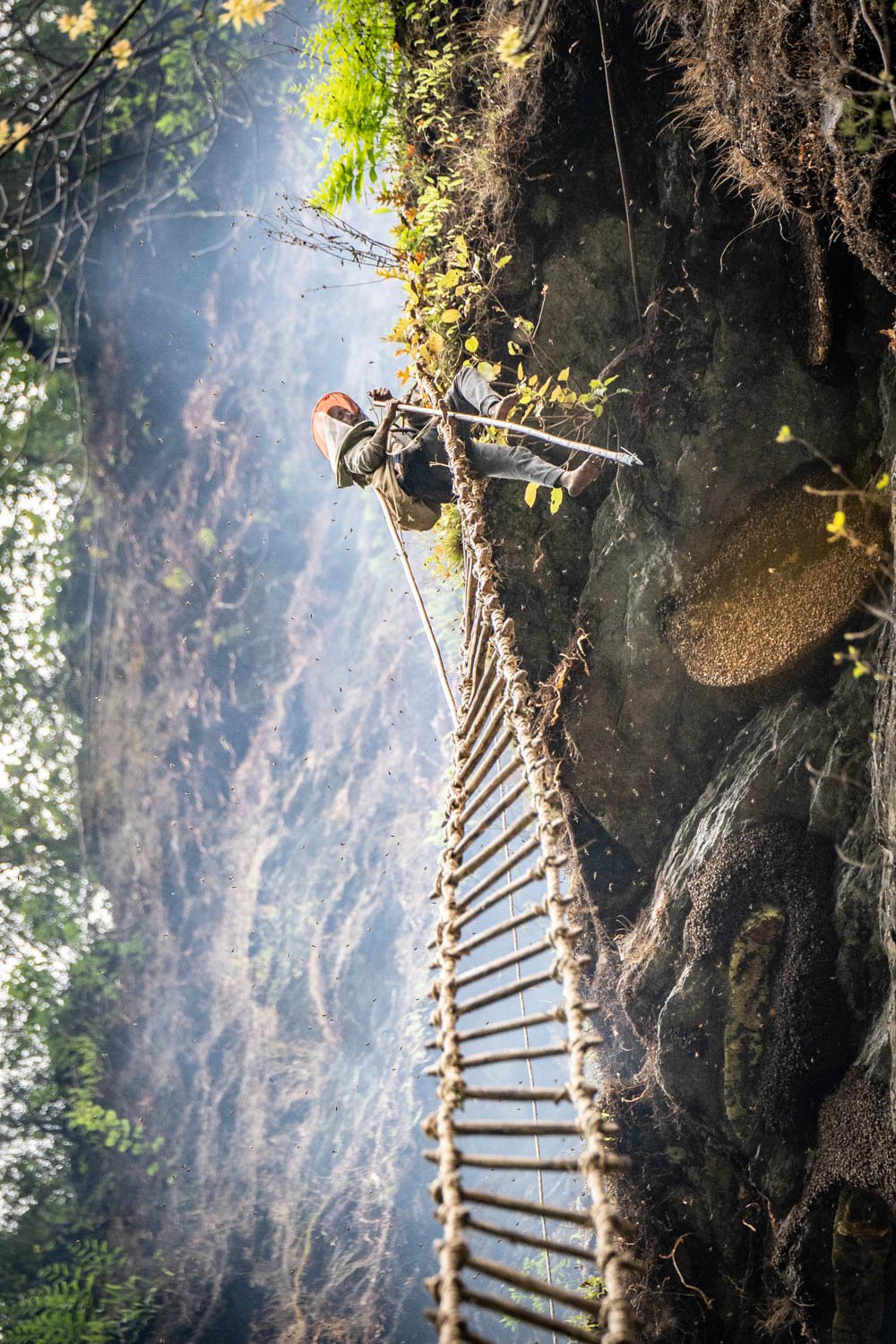
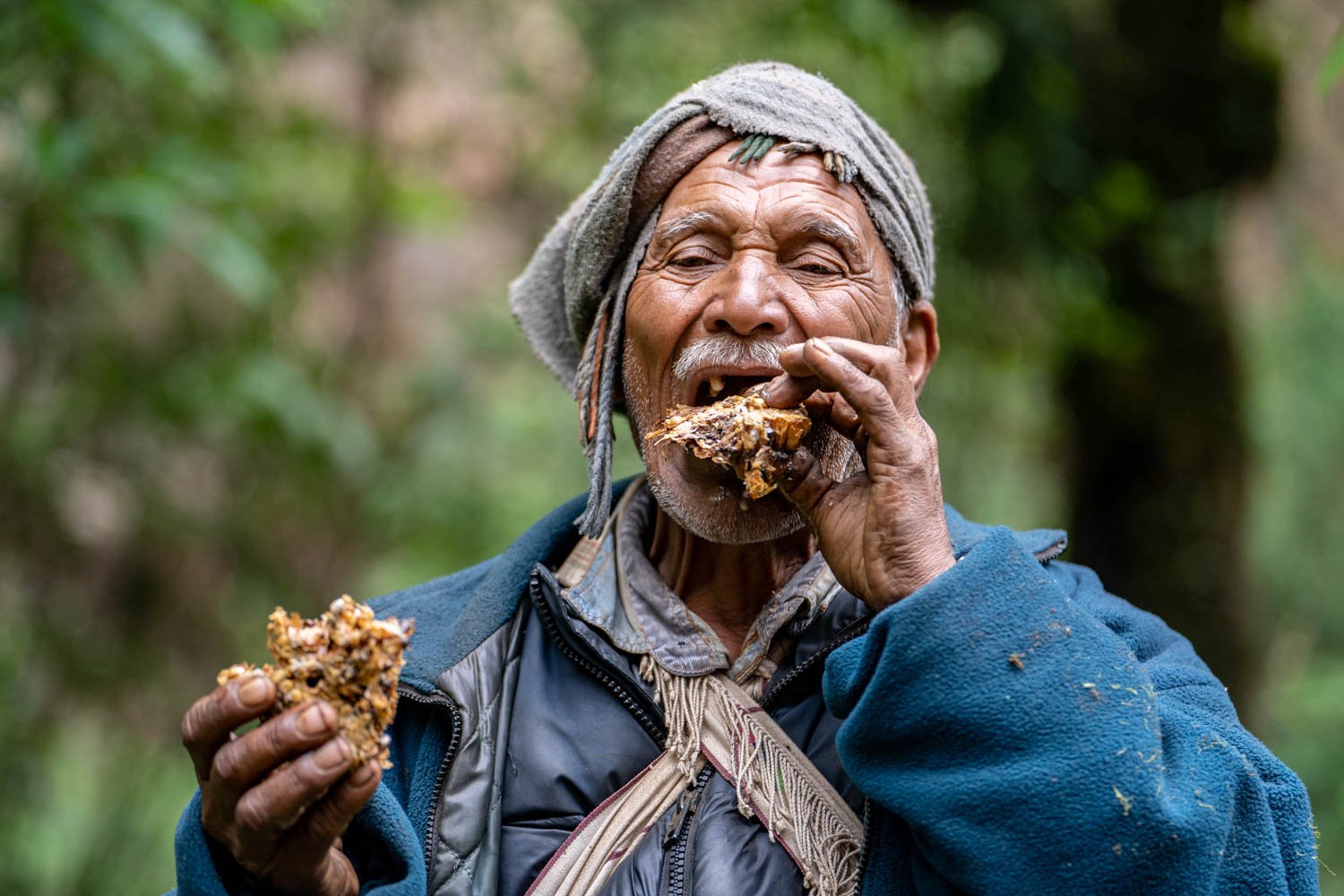
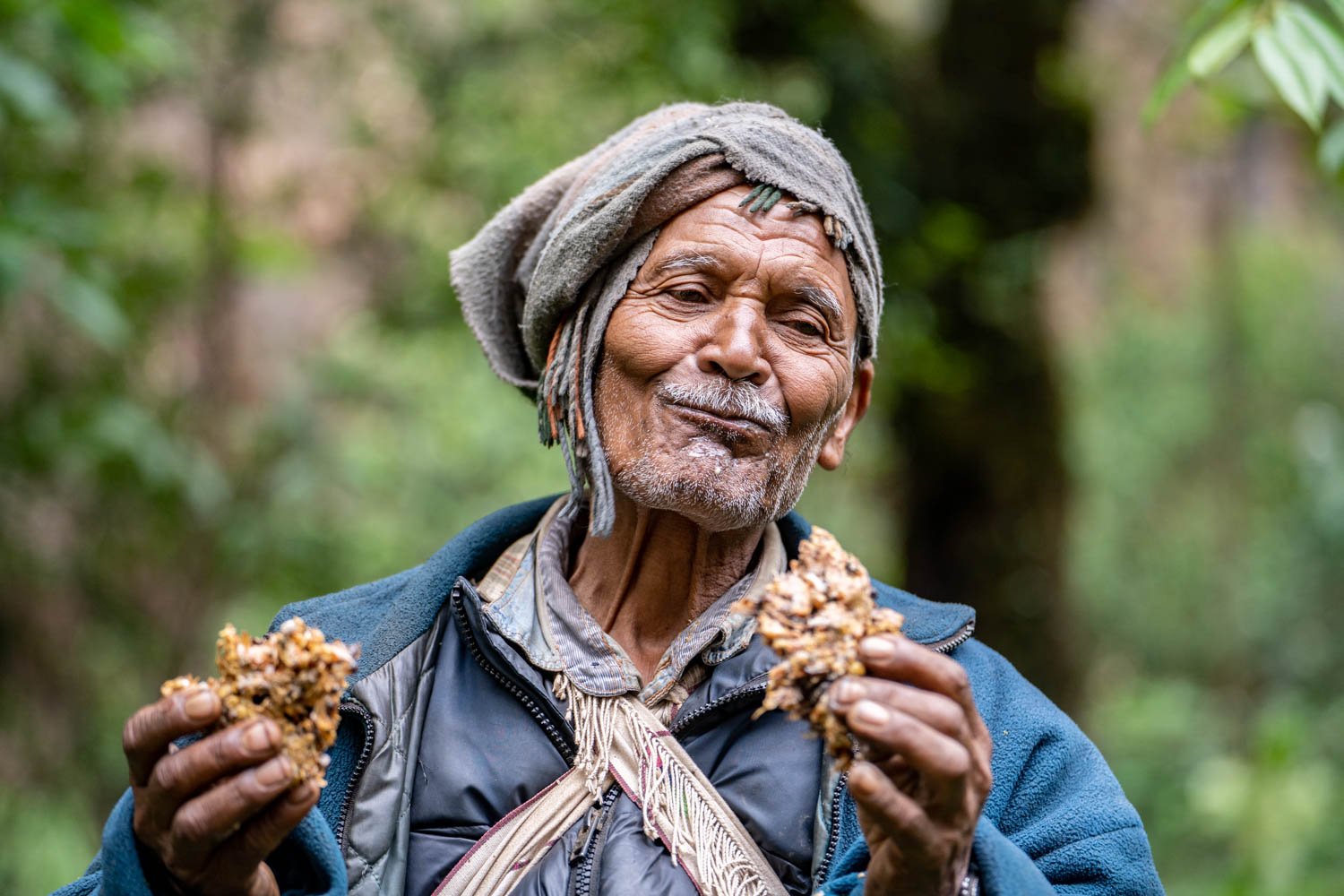
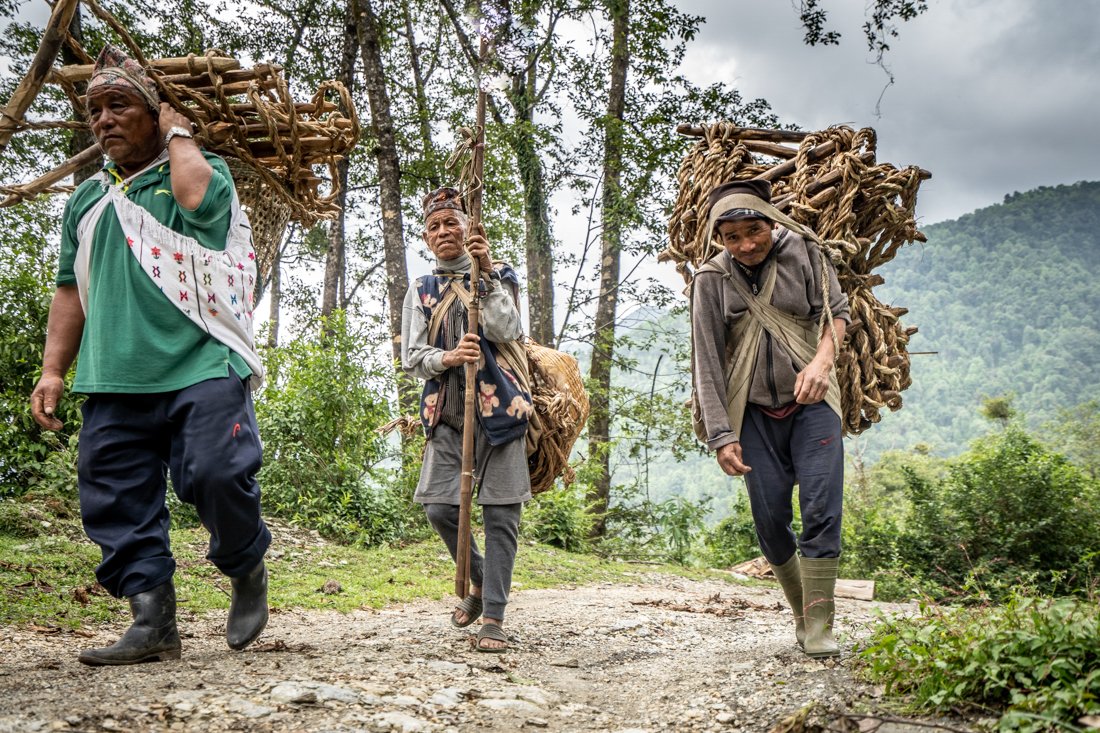
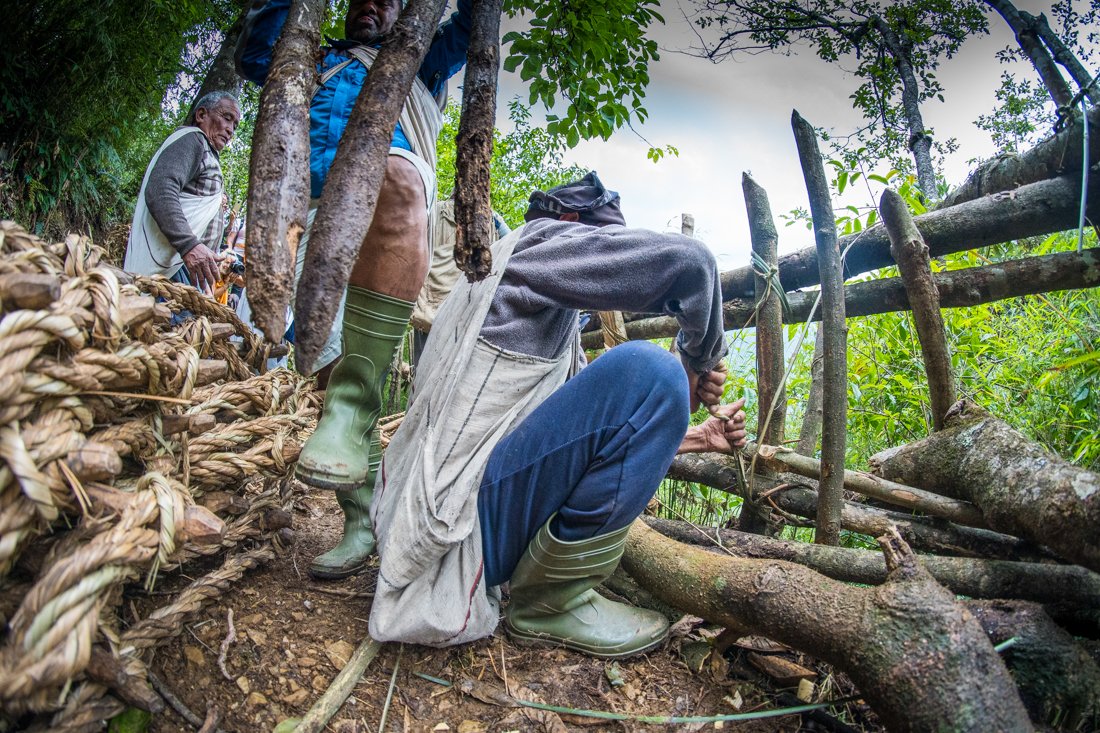
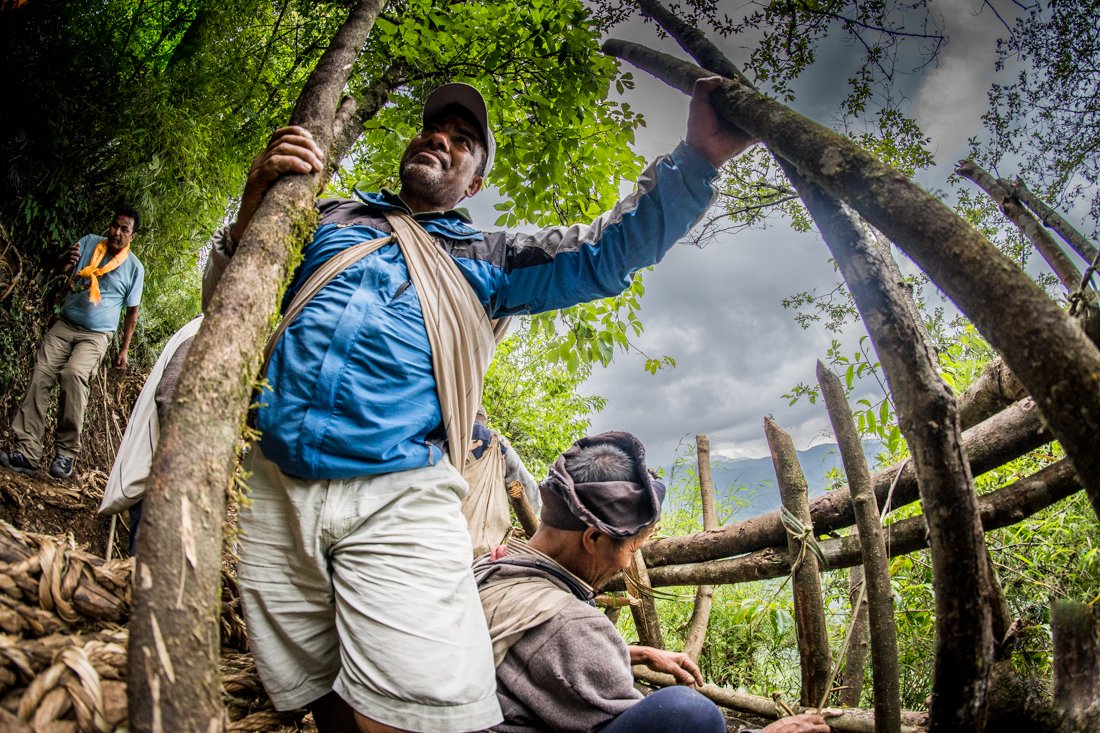
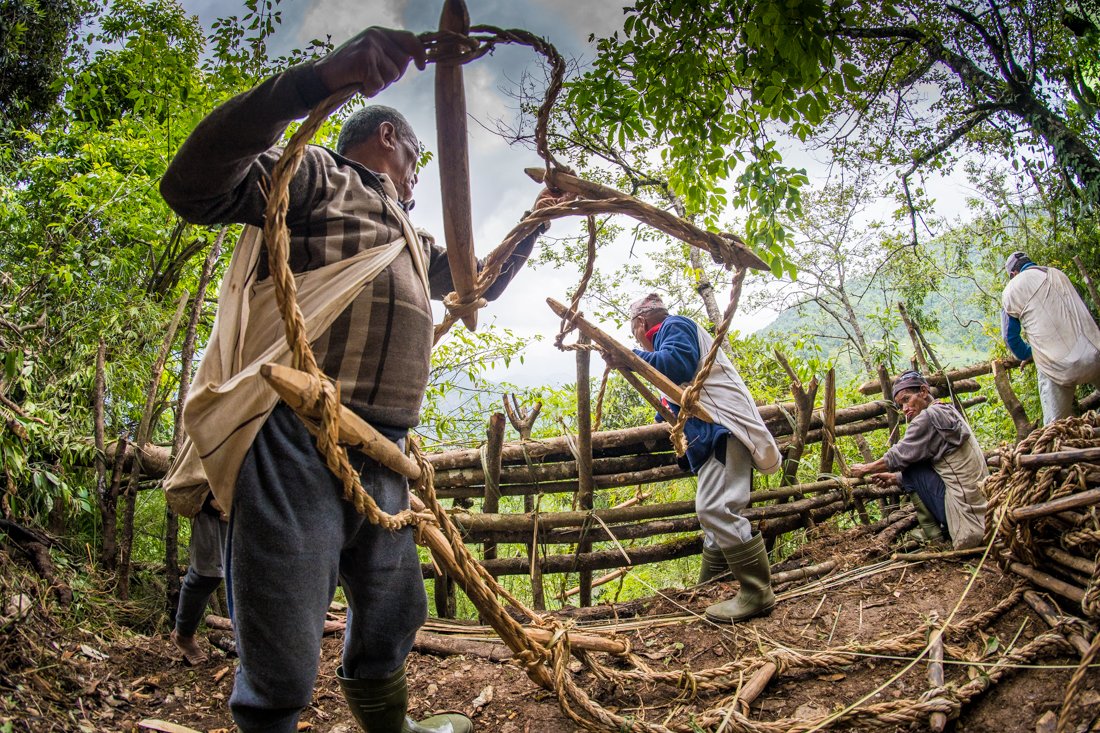
For more than 2,000 years, the men of the Gorong and Magar tribes have been dangling themselves with the help of bamboo ladders and ropes, among the largest bee clouds in the world on the cliffs of the Himalayas.

Epicurean bees are four times larger than a normal bee, about the size of a thumb. Their sting stings and hits you. We snatched a few of these, on our journey following the honey hunters in Nepal. There amidst a tumultuous and exciting occurrence of the dreaded bees, the work of honey-spreading continues to take place.

Honey production is considered one of the oldest professions in the world. Only twice a year, in early November and May, do the men of the tribe engaged in dangerous hard labour on hundreds of feet of cliffs. The elders of the tribe remember that in days gone by, the livelihood of the villagers depended on their craft. We accompanied the 71-year-old Naok, who has been doing this for fifty years in a row. He learned the trade from his grandfather and became one of the most sought after and famous honeymooners in the area. "Our young people in the village are turning their backs on us," Naok said, "they are leaving the village. Looking for easier work in the cities. Breaking our lineage and family tradition."

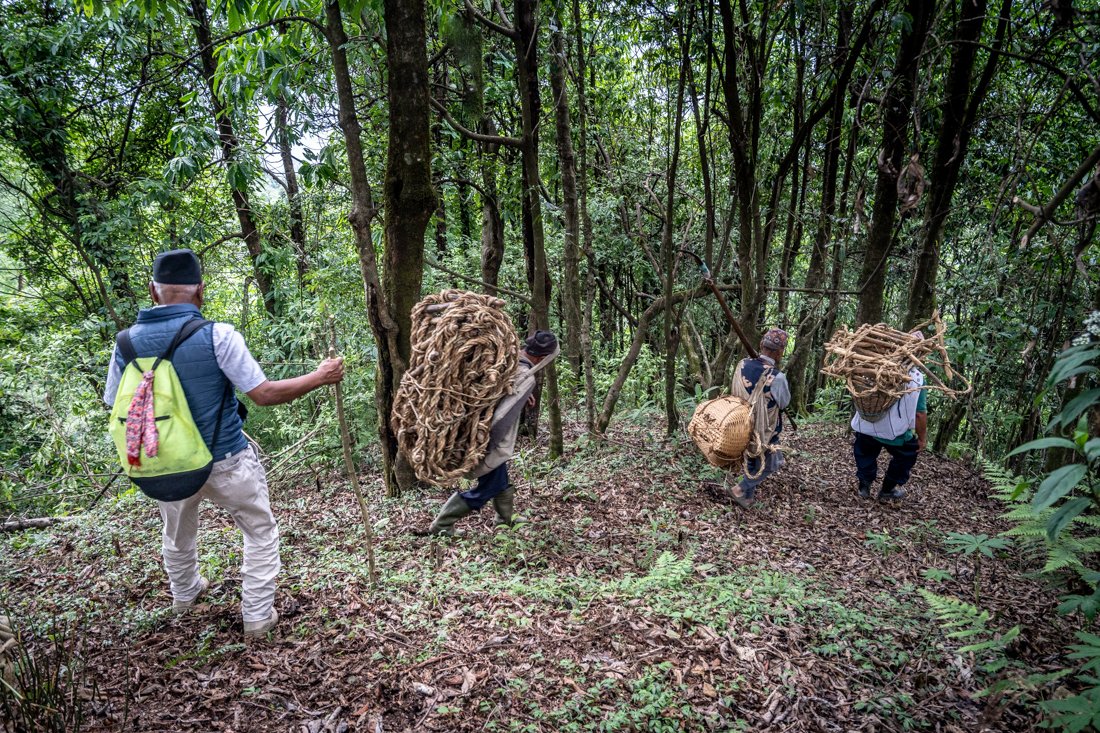
Effortlessly and with a wave of his hand, Naok loaded a key basket on his back, into which he inserted a ladder of seventy meters. Another ladder was loaded on the back of his friend. With his feet light as if hovering in the air he began to tread down a path saturated with puddles, from the torrential rain that had fallen that night.

We followed him to the thicket of the forest, where the road disappeared in favour of muddy surfing on the leaves of fallen leaves. But maybe we should start from the beginning. It was such a morning that we wore tailored clothes for the domestic flight (from Kathmandu to Pokhara), as part of a photo trip to Nepal, which I guided with my travel partners. We buried our hiking boots in a suitcase, wrapped ourselves in multi-layered clothing and additional layers were packed in a backpack.

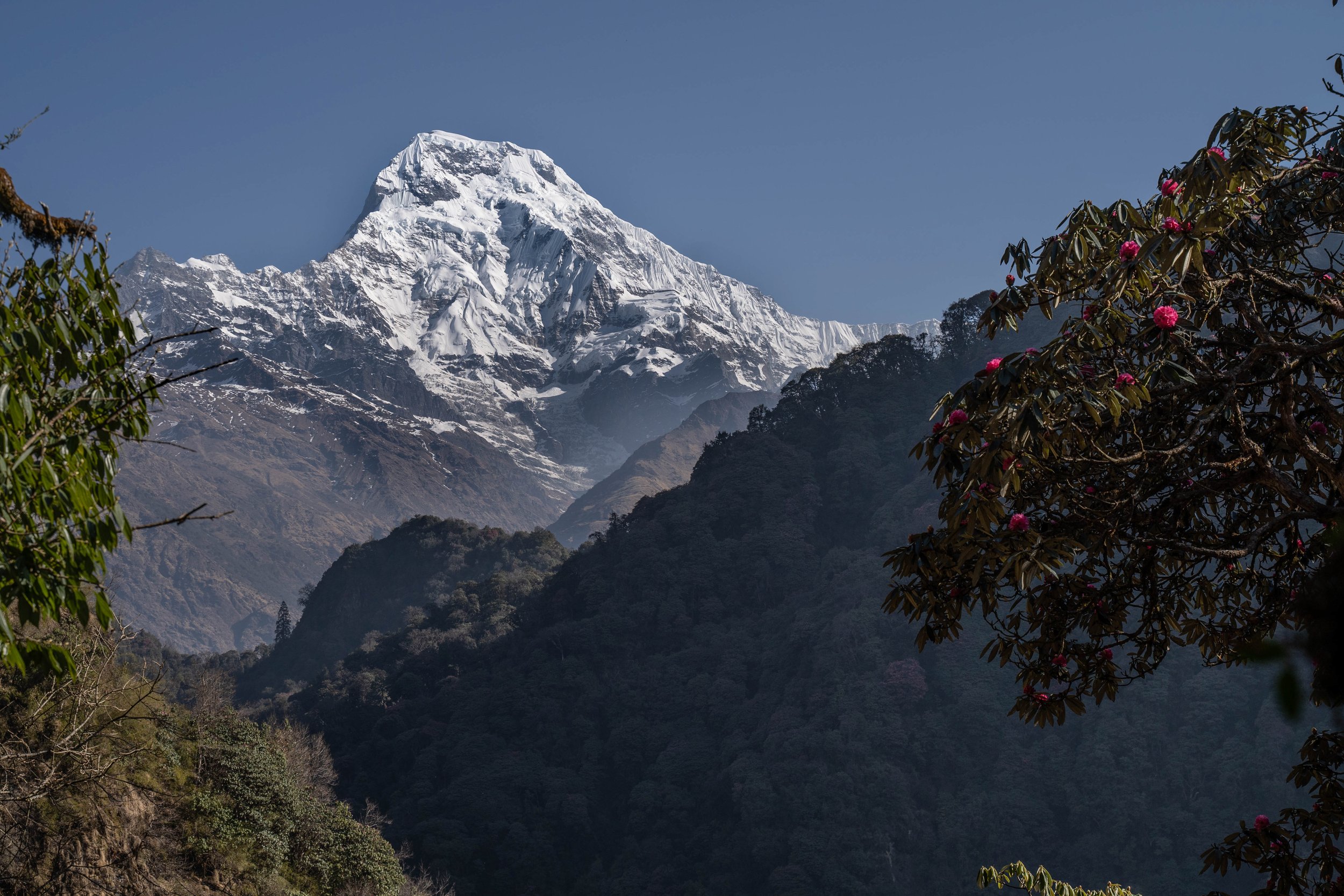
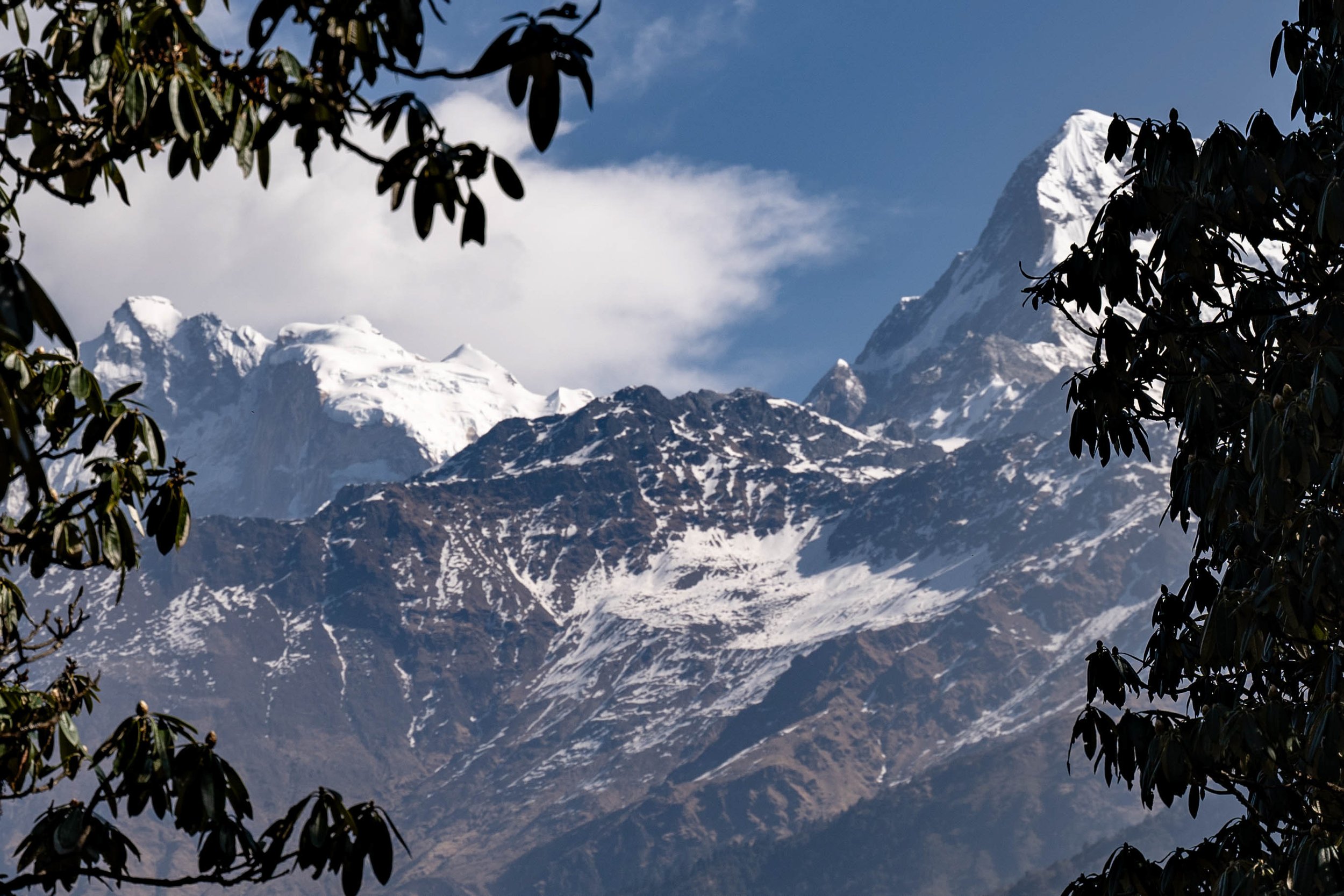
A day when they intended to get away from the tourist route and climb in jeeps to the cold cliffs of the southern slopes of the Anforna ridge, home to the Gurong tribe.

We did not expect that even that day, we would find ourselves surfing in a steep and muddy jungle, breathless and sweaty climbers in the heat and humidity that stuck to our bodies the festive suits and some broken leaves and branches. Nor did we assume that he had to tear dozens of leeches off his feet and bleed.

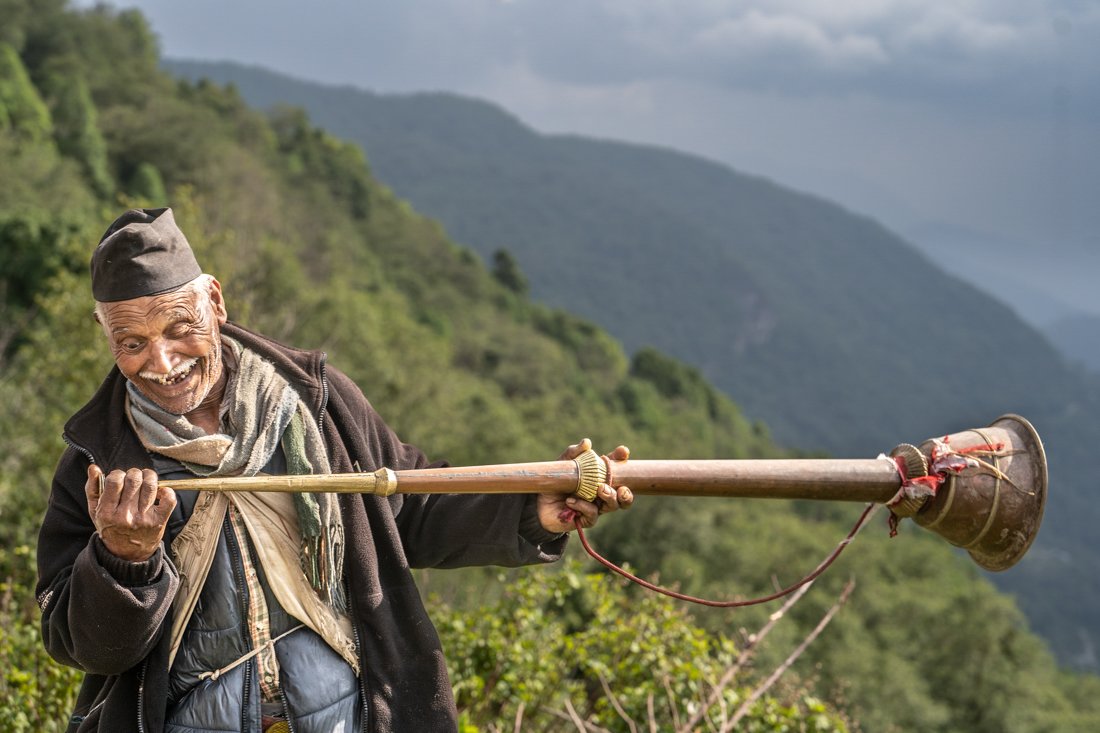
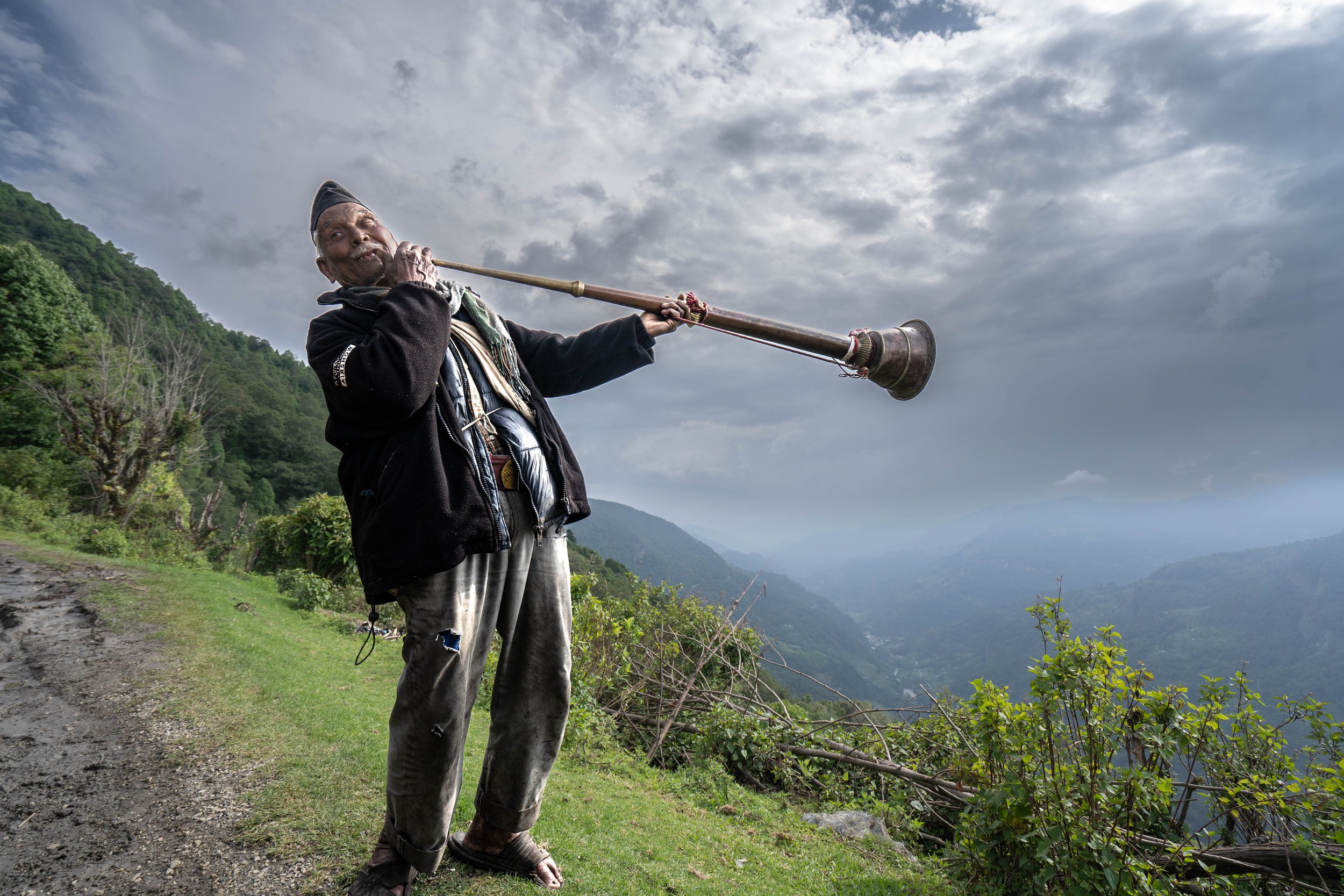
On a challenging jeep route - between rocks, potholes and mud, we climbed through thick jungles to an altitude of over 2200 meters. On the mother of the road, the villagers appeared with Tibetan trumpets with long noses and drums. We met Naok, the smiling old-fashioned smiling Roda Honey.

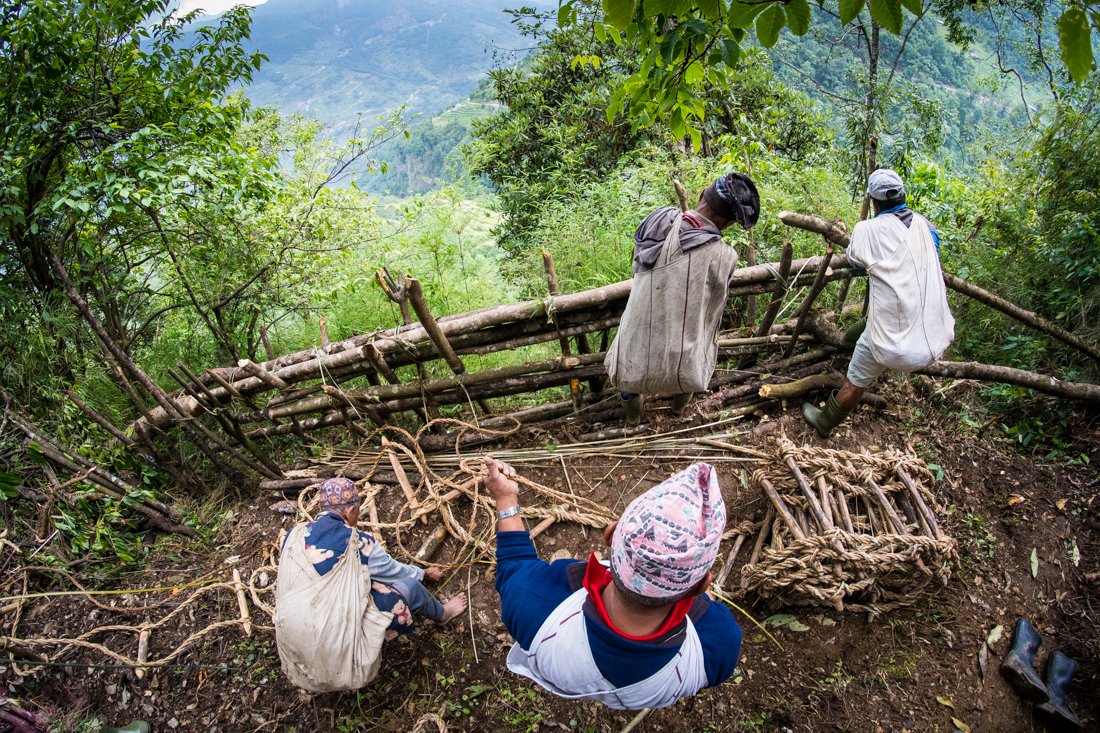
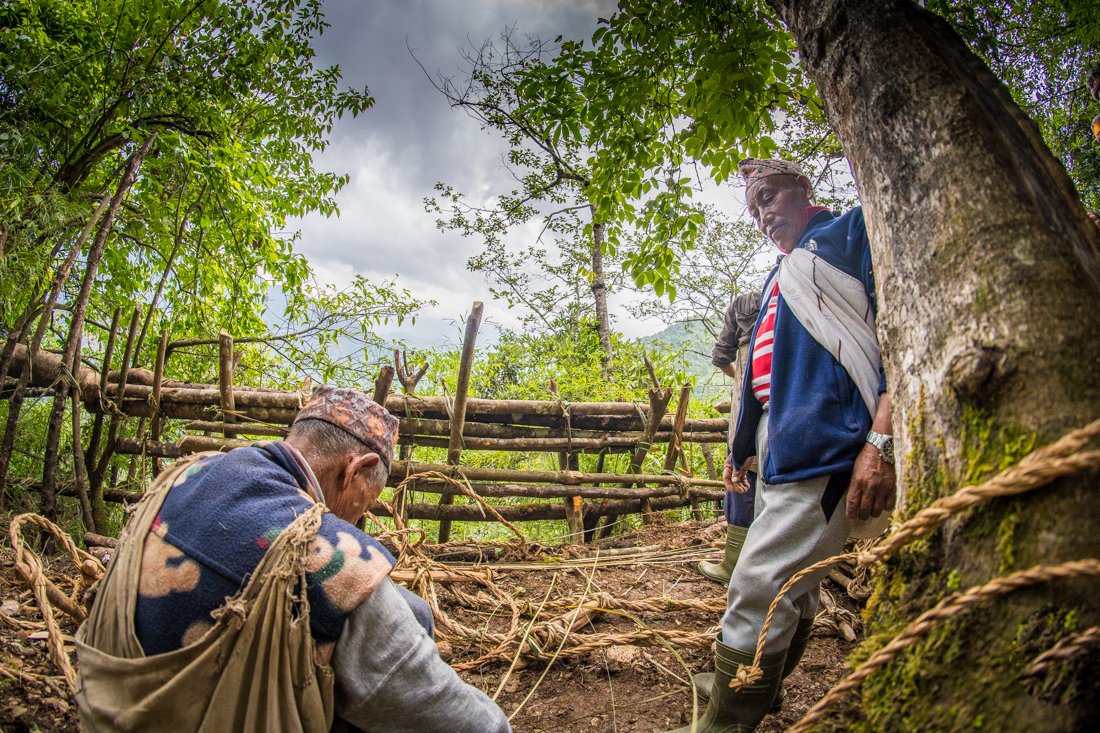
Within minutes we realized he was about to head out into the jungle, to a rock bunk on a cliff to install an outpost from which he would dangle the next day, the rope ladder for the honey spread. As we and without being able to get organized and replace the "high heels" and mumbles, we began the pursuit of him. First on a dirt road and later on a steep descent deep into the jungle. We slid on our asses, on a slide of leaves and mud in the heart of a 100-foot-long cliff. The walking sticks we brought especially for the event were left locked in a suitcase. We supported each other and improvised sticks that the tribesmen had prepared for us within minutes.

The next day on our journey following the honey hunters, actually started at night. A loud carnival of insects woke us to the local tea saturated with raw ginger, lemon and honey.

We set off. First in jeeps and later again on foot in the thick of the jungle. Beekeeper hats were distributed to all of us and we will discover in the first few minutes that luck has subsided.

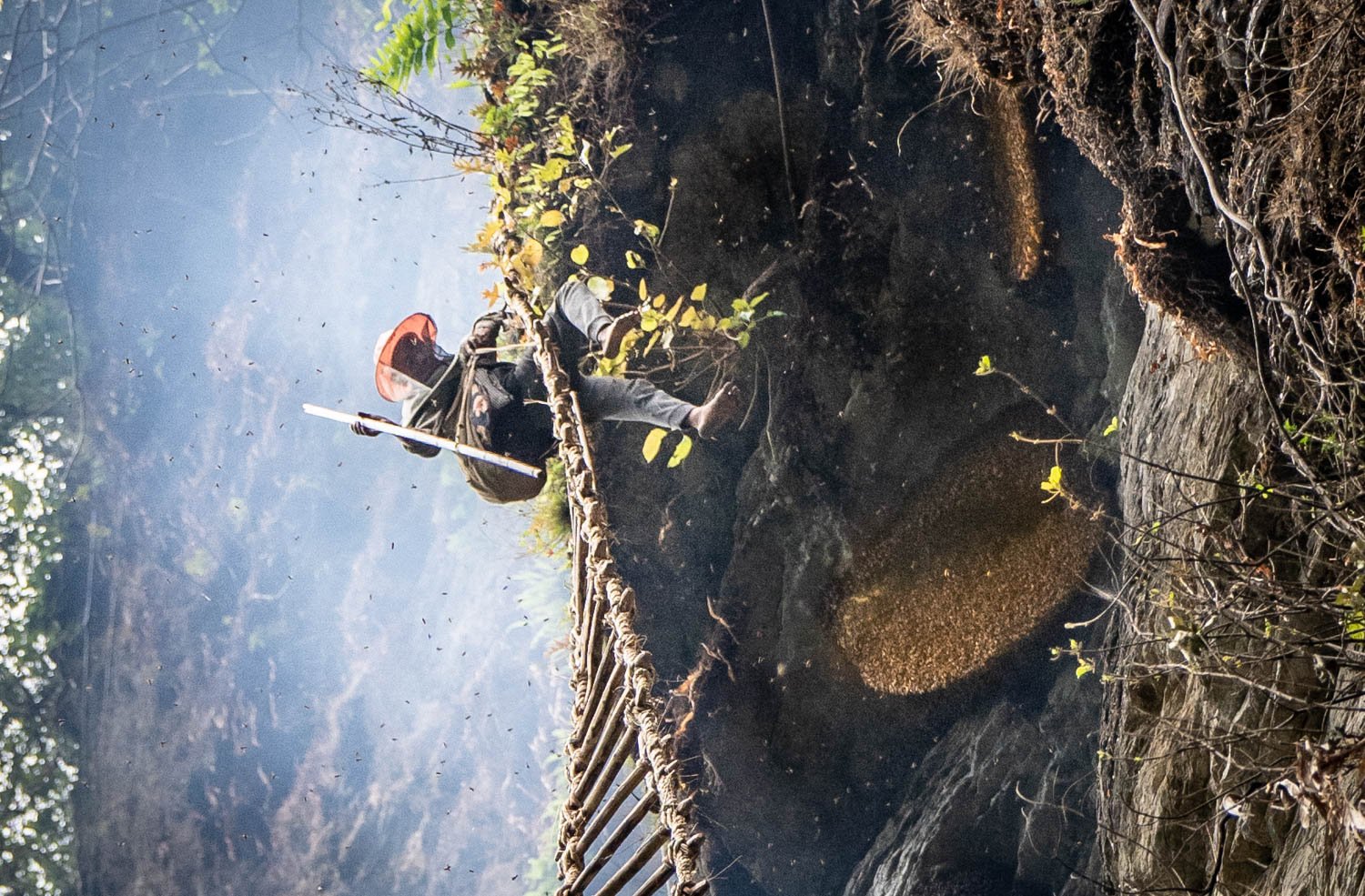
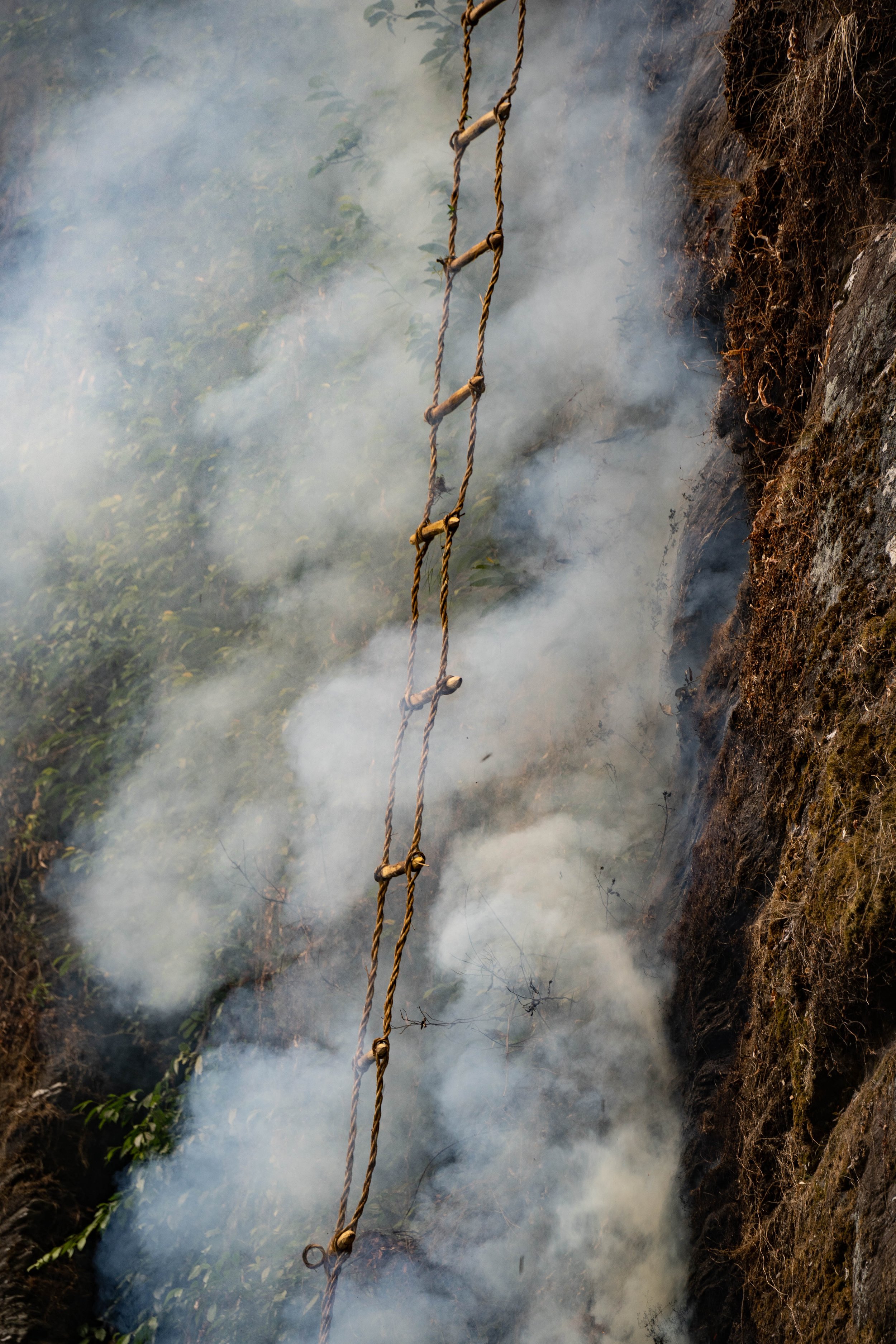
In order to get rid of the bees from the honey diseases and allow Naok, the honey rod, to reach them, the people of the tribe lit a "smoking fire", especially from fresh bamboo leaves at the foot of the cliff and next to us. The smoke removes the bees from the honey diseases and stalks them.

The honeycombs, which look like huge "shelf mushrooms" clinging to the rock, have emptied one of the bees and their brown colour has turned bright yellow. Spectacular spectacle.

The following moments became an emotional roller coaster ride and the spectacular spectacle became a terrifying spectacle. The fleeing bees landed on us.

Clouds of giant bees. We found that bees are most attracted to hair and even more to my blond curly hair. The reticulated hats saved us.

Through the smoke billowing across the cliff, we discovered Naok on the ladder. Next to it hung a huge straw basket. One that can contain a honeycomb that reaches sizes of about two meters.

Naok held a sickle attached at the end to a long bamboo stick. With his help, he repeatedly struck the connection between the honeycomb and the rock. He shortened the challah one after the other for long hours, in a thick cloud of bees. He chained the honeycombs to his friends down the cliff and they brought them closer to us and started squeezing the honey out of them.

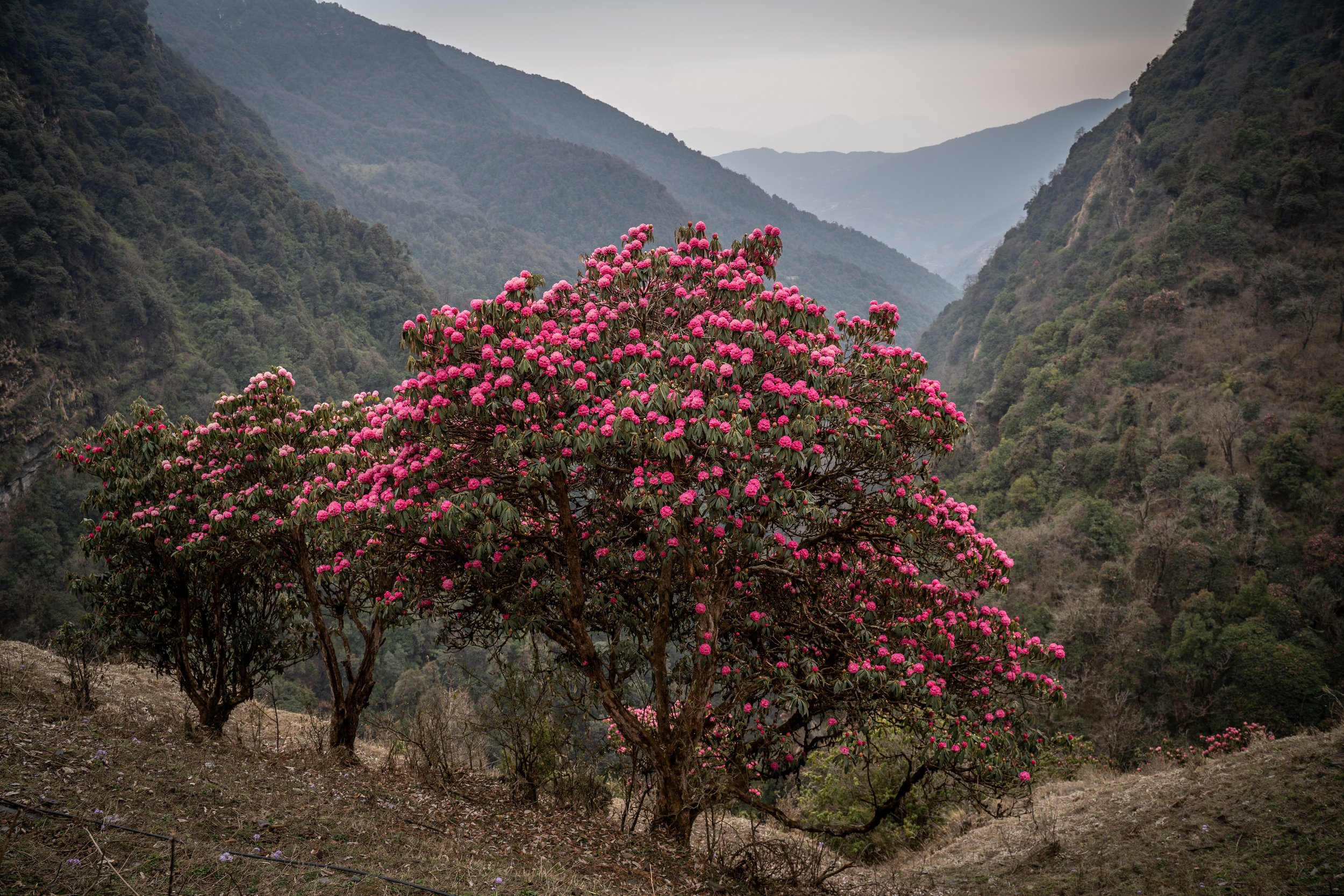
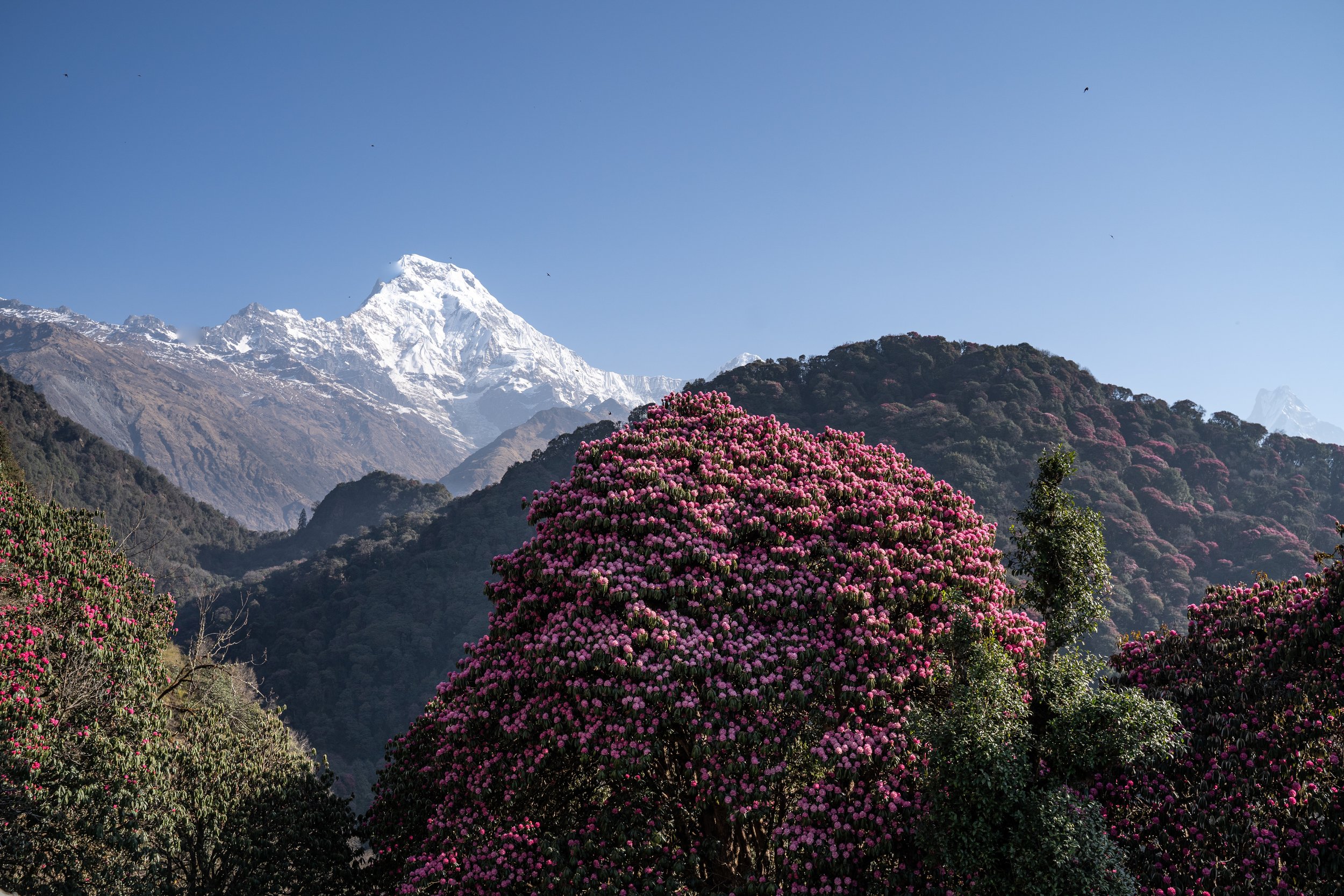
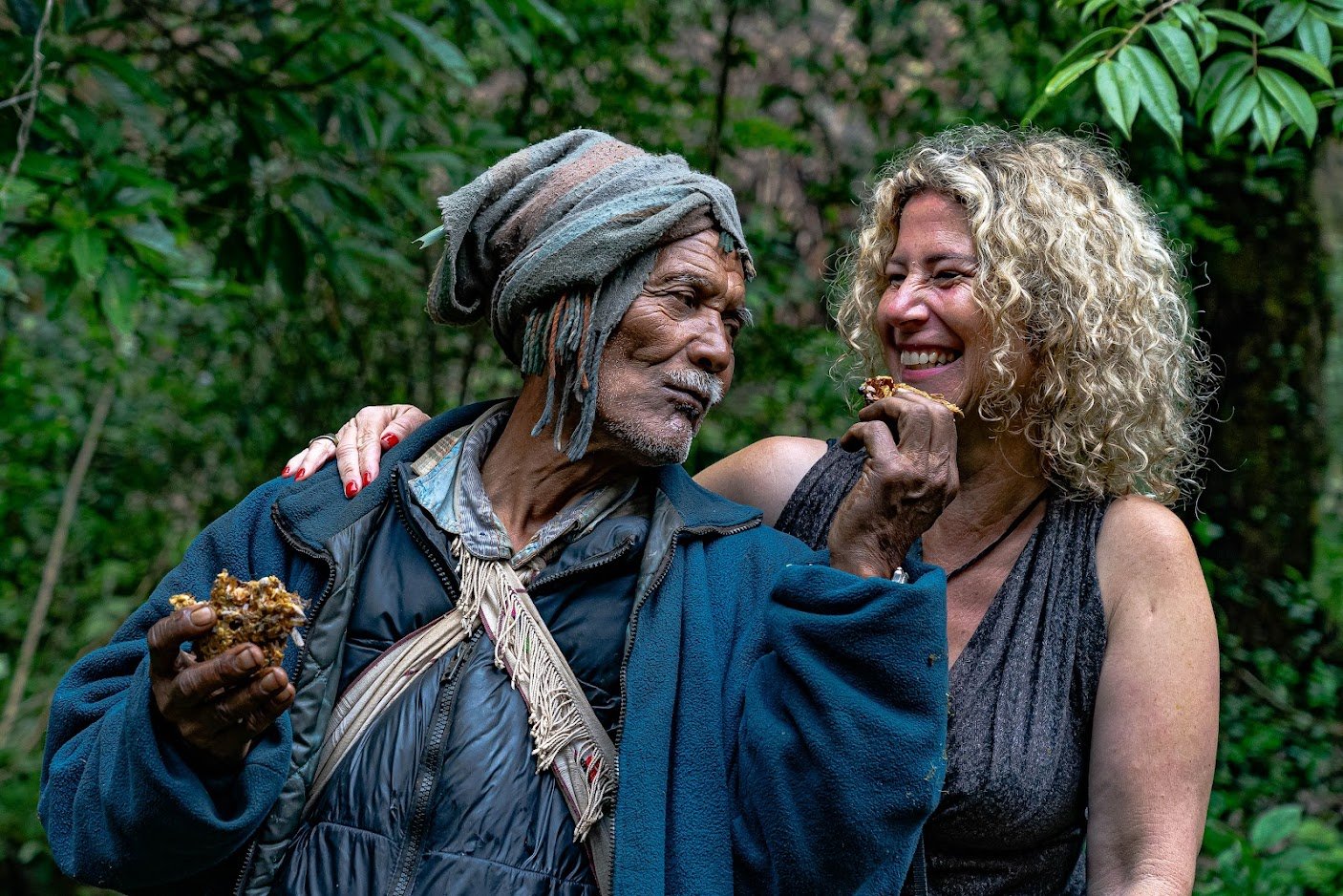
This is a different and special honey - "crazy honey". A small amount of it (2-3 teaspoons) causes hallucinations and a larger amount can cause death. The honey is produced by the epic bees for the boryosa, from the flowers of the rhododendron trees that wrap in a furry and colourful cover on the slopes of the Himalayas. Their flower roses, which bloom in red, pink and white, are very poisonous. From the honey, the villagers produce various medicines. Honey costs a fortune. Six times the price of regular Nepali honey. Gorong people have used honey for centuries as a cough syrup and antiseptic. The wax finds its way to workshops in the alleys of Kathmandu, where it is used for casting bronze statues of gods and goddesses.

We dared and nibbled at him a little. From that moment on, life became honey and everyone who was by our side became a human being. At the end of many hours of wandering, Naok came down to us with a proud look on his stung face. This time he was stung only twice on the forehead and cheek once. Bees managed to penetrate his net hat and stung him to the waist. His hands, too, were dotted with bites. "Today I am no longer excited about it," Naok told us, "but I still remember the first time I went down the cliff. I got 17 bites at once."

Naok invited us to his house. It was important to him that we get to know his wife. Maybe we'll make her happy. His wife, he said, "is deeply ill. A patient. She gave birth to three sons and they left the village in search of another job in distant towns. We did not see them for a long time." He pulled out a bag full of pills and medicine.

In a dim house made of mud, without electricity and running water. By the light of a window and a candle, his wife sat on a low stool. She opened their home to us, pulled out a temporary smile and sank back into her seriousness. There was no chair or table in it, only a bed, an oven and a number of wooden shelves. Sacks of rice and corn were hung from the ceiling so that rats and vermin would not harm them. The second floor to which a wooden ladder led, served as a storage and accommodation place.

The house is surrounded by small green terraces, where the couple grows corn, cereals and vegetables for a living. They erected on the terraces a small wooden hut that serves them as toilets, from which the needs for fertilizing the crops are routed. A bamboo corral for the Jamos was also set up there. On a calendar hanging on the mud wall on the doorstep of the house, Naok's crowded schedule appeared in the honey spread.

He will return to his house in the evening. He would take two pink balls out of the bag and serve his wife with a cup of hot tea, made from ginger and lemon and sweetened with only one teaspoon of the "crazy honey", to make sure the dreams that befell his wife would make her happy, at least on her nights.

_DSC0587.jpg
_DSC0595.jpg
_DSC0600.jpg
_DSC0587.jpg _DSC0595.jpg _DSC0600.jpg
_DSC0596-2.jpg
_DSC0601.jpg
_DSC0086.jpg
_DSC0596-2.jpg _DSC0601.jpg _DSC0086.jpg
_DSC0678.jpg
_DSC0684.jpg
_DSC0678.jpg _DSC0684.jpg
View fullsize _DSC0958.jpg
View fullsize _DSC0764.jpg
View fullsize _DSC0941.jpg
View fullsize _DSC0965-2.jpg
View fullsize _DSC0997.jpg
View fullsize _DSC0998.jpg
View fullsize _DSC9465.jpg
View fullsize _DSC9470.jpg
View fullsize _DSC9484.jpg
View fullsize _DSC9485.jpg
View fullsize _DSC9506.jpg
View fullsize _DSC0976.jpg
View fullsize _DSC0950.jpg
View fullsize _DSC0966.jpg
_DSC9559.jpg
_DSC9572.jpg
_DSC9576.jpg
_DSC9559.jpg _DSC9572.jpg _DSC9576.jpg
_DSC9634.jpg
_DSC9641.jpg
_DSC9655.jpg
_DSC9675.jpg
_DSC9698.jpg
_DSC9734-2.jpg
_DSC9747-2.jpg
_DSC9756-2.jpg
_DSC9758-2.jpg
_DSC9774-5.jpg
 
 
DSC07496.jpg
DSC07517.jpg
DSC07531.jpg
DSC07400.jpg
 

At the age of 50, I received a gift of life - I fell in love with the world of photography.

My specialization in psychic life as a “Lacanian psychoanalyst” and the study of my cultures as a world tour guide, as experiences over the years as two parallel lifelines that often contradicted each other. Travelling around the world forced me to close the clinic for episodes.

And on the other hand, sitting in the clinic without going out into space was inadequate. Photography moved me because in its spaces I finally found an integration to these two loves and pursuits in my life.


The humanistic ethos is at the center of my work. I focus on street photography, documentary photography and cultural photography.

Going out again and again into the unknown and surprised by what was recorded in me through the camera, a process and adventure similar to what happens to me in the clinic together with the patient. I discovered that for me photography is a multi-layered journey between the human psyche and interpersonal relationships, and the study of historical and geographical cultures. I am curious about the story behind the subject and its cultural context and create a connection and closeness with it.

 During the corona period and the closures, a project I initiated in photography entered the vacuum. I set up with another partner, a venture that connects cultural research and geography. We created workshops in the Bedouin communities in the Judean Desert, meetings with the Sufis and Circassians in the Galilee and in the Druze villages In the Golan Heights and the Galilee. When the sky reopened, we set out to guide abroad as well, with an emphasis on Southeast Asia.

 
Sunday 07.24.22
Posted by Progressive-Street
 

"Brilli": An Old-Fashioned Outdoor Game

"Brilli"

by Martin Agius

Today, only a few men in the town of Gharb, Gozo, still play "brilli”. On Sundays and public holidays in Gozo, this unusual game of ancient skitters is played! Only a few guys still play "brilli" in the village of Gharb, Gozo. In Gozo, this distinctive, age-old skitter game is played on Sundays and holidays.

The history of the game "Brilli" predates the arrival of the Knights of St. John. Due to the fact that brilli is played with skittles and a ball, it somewhat resembles bowling. However, bowling is typically played indoors with a hefty bowling ball and 10 skittles. Brilli is a light-weight outdoor game involving a grapefruit-sized wooden ball and nine wooden skittles.

The players are required to abide by a number of rules. The skittles are first placed in a diamond-shaped arrangement of squares. To knock the pins down and accrue points is the game's objective. Obtaining precisely 24 points is the goal. A player is eliminated from the game immediately till the next round if they go above this limit. Noting that several pins have various names and values is also crucial. Is-Sultan, in the center, is the highest-scoring one with 9 points. Known as is-secondi skittles, corner skittles are worth six points. The final one is known as qarmuc, and it only counts for one point.

You have two attempts with the ball when it's your turn. The first throw comes from a predetermined location, while the second throw originates from the spot where the ball landed after the first throw. It's a little more fascinating because the first throw is scored differently than the others. The initial toss is double-counted. However, the player only receives 2 points for each pin if more than one type of pin is knocked down on the first throw (is-sultan, is-secondi, and qarmuc).

If you wish to explore the game further and learn more about it, there are additional regulations to adhere to. If I understood it well, you can reach the skittles with your hand if the ball lands close enough to them. As you can see from the photographs up there, it does occur very frequently. While the other player is reaching for the necessary skittle, one player assists in keeping the ball in position.

Every Sunday morning, this regular group of gamers gets together to play for a few hours. The game is played with money, which adds a little bit of intrigue. The game's winner receives €020 from each losing player. Additionally, before each game begins, the guys meet together and "draw straws" by haphazardly displaying a number between one and five on their hands.

 
View fullsize Martin Agius_Brilli 01.jpg
View fullsize Martin Agius_Brilli 02.jpg
View fullsize Martin Agius_Brilli 03.jpg
View fullsize Martin Agius_Brilli 04.jpg
View fullsize Martin Agius_Brilli 05.jpg
View fullsize Martin Agius_Brilli 06.jpg
View fullsize Martin Agius_Brilli 07.jpg
View fullsize Martin Agius_Brilli 08.jpg
 
 
View fullsize Martin Agius_Brilli 10.jpg
View fullsize Martin Agius_Brilli 11.jpg
View fullsize Martin Agius_Brilli 12.jpg
View fullsize Martin Agius_Brilli 13.jpg
View fullsize Martin Agius_Brilli 14.jpg
View fullsize Martin Agius_Brilli 15.jpg


Martin Agius

Photo by Foto-ish Charles Calleja

Sunday 07.24.22
Posted by Progressive-Street
 

Moi-chhara cattle race festival.

Moi-chhara cattle race festival

by Kuntal Biswas 

Moi chhara cattle race festival by Kuntal Biswas 

16th July,2022

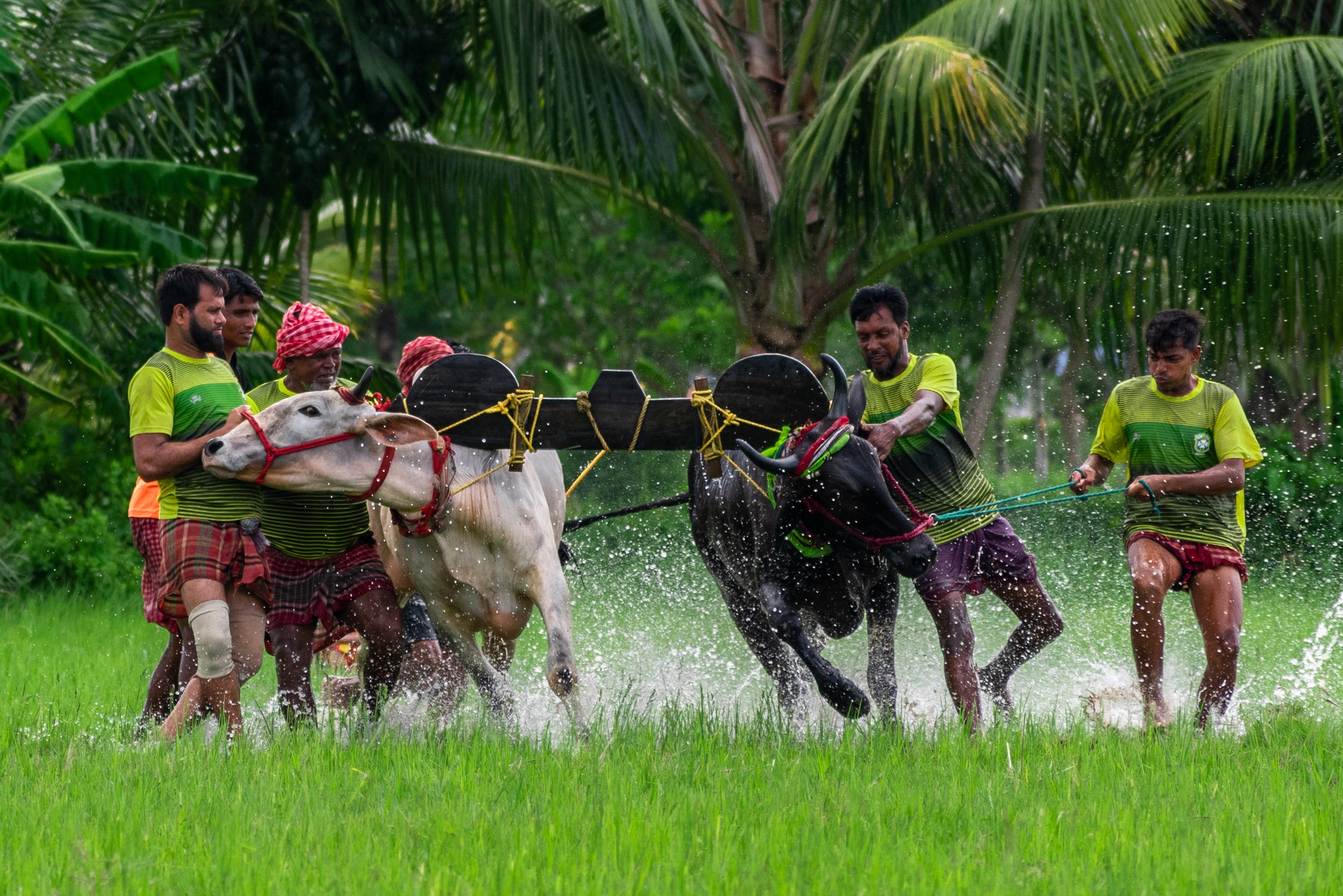
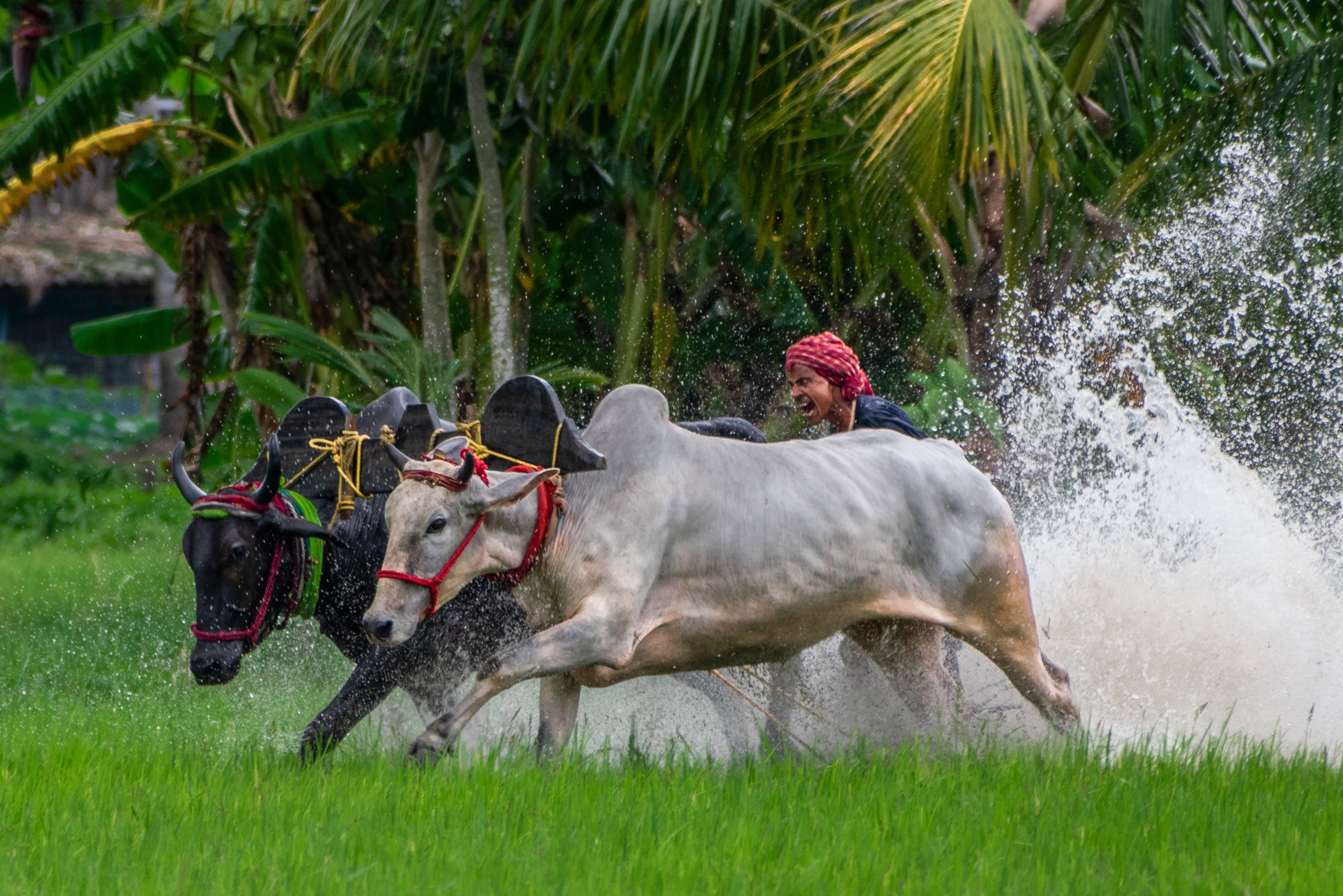
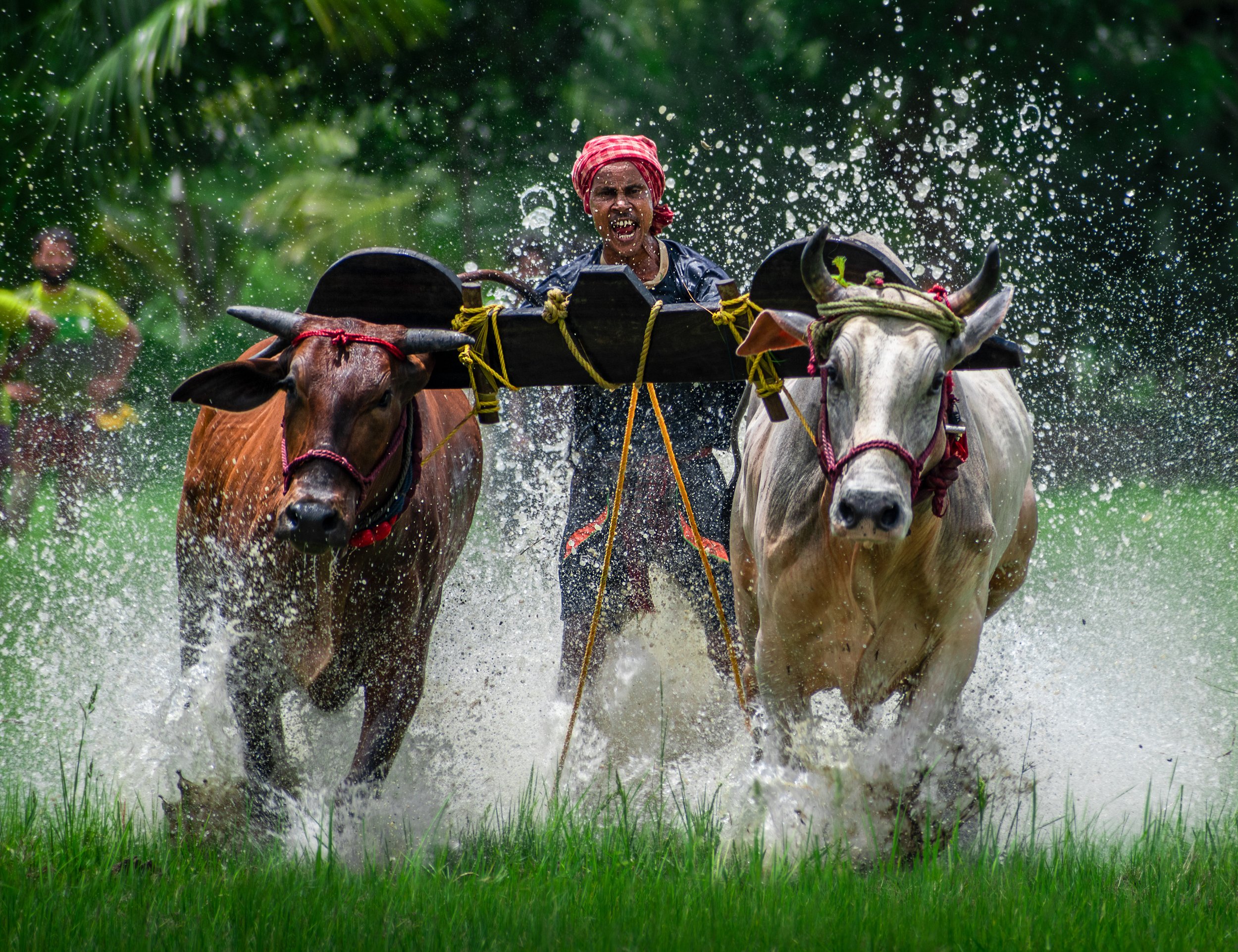
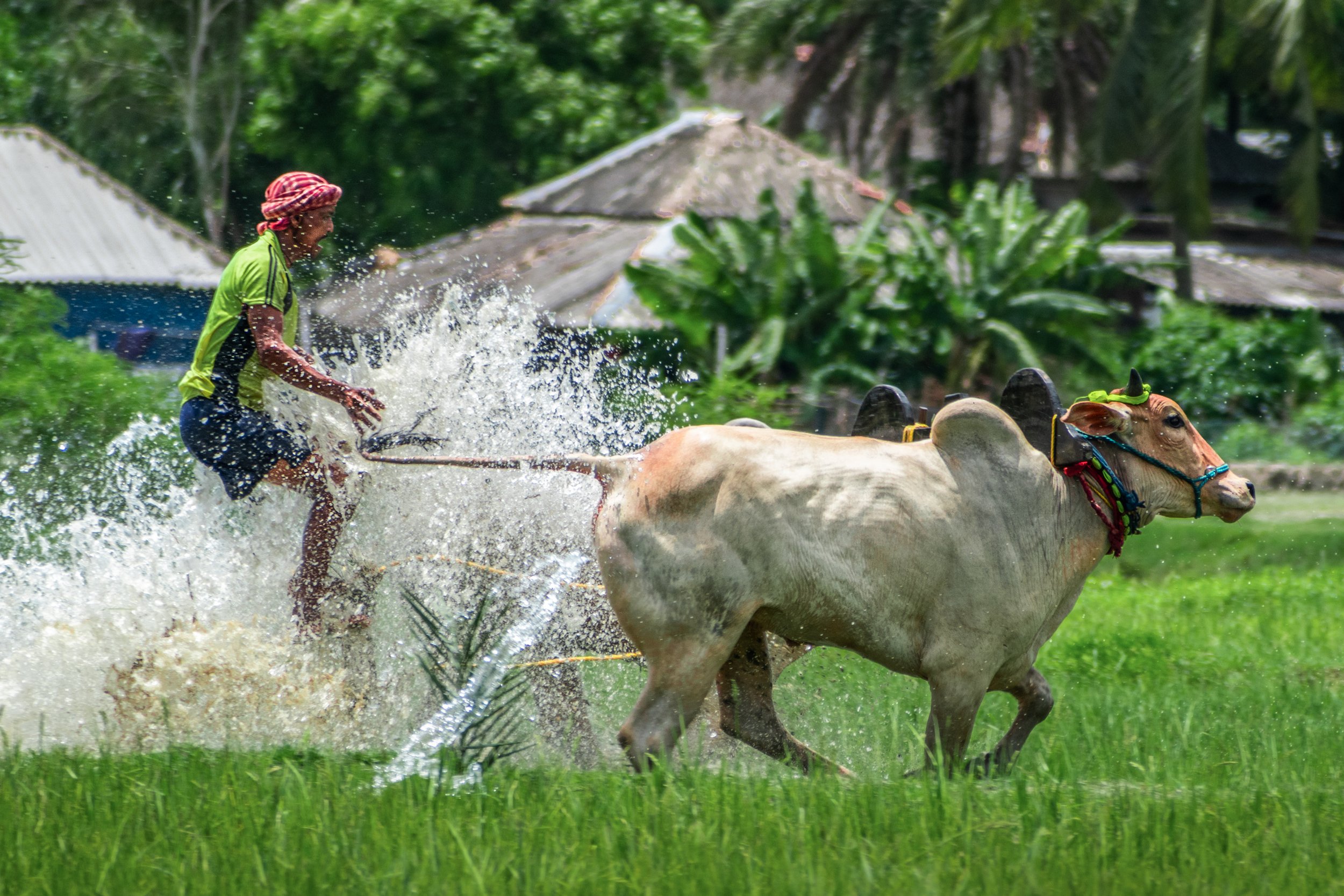
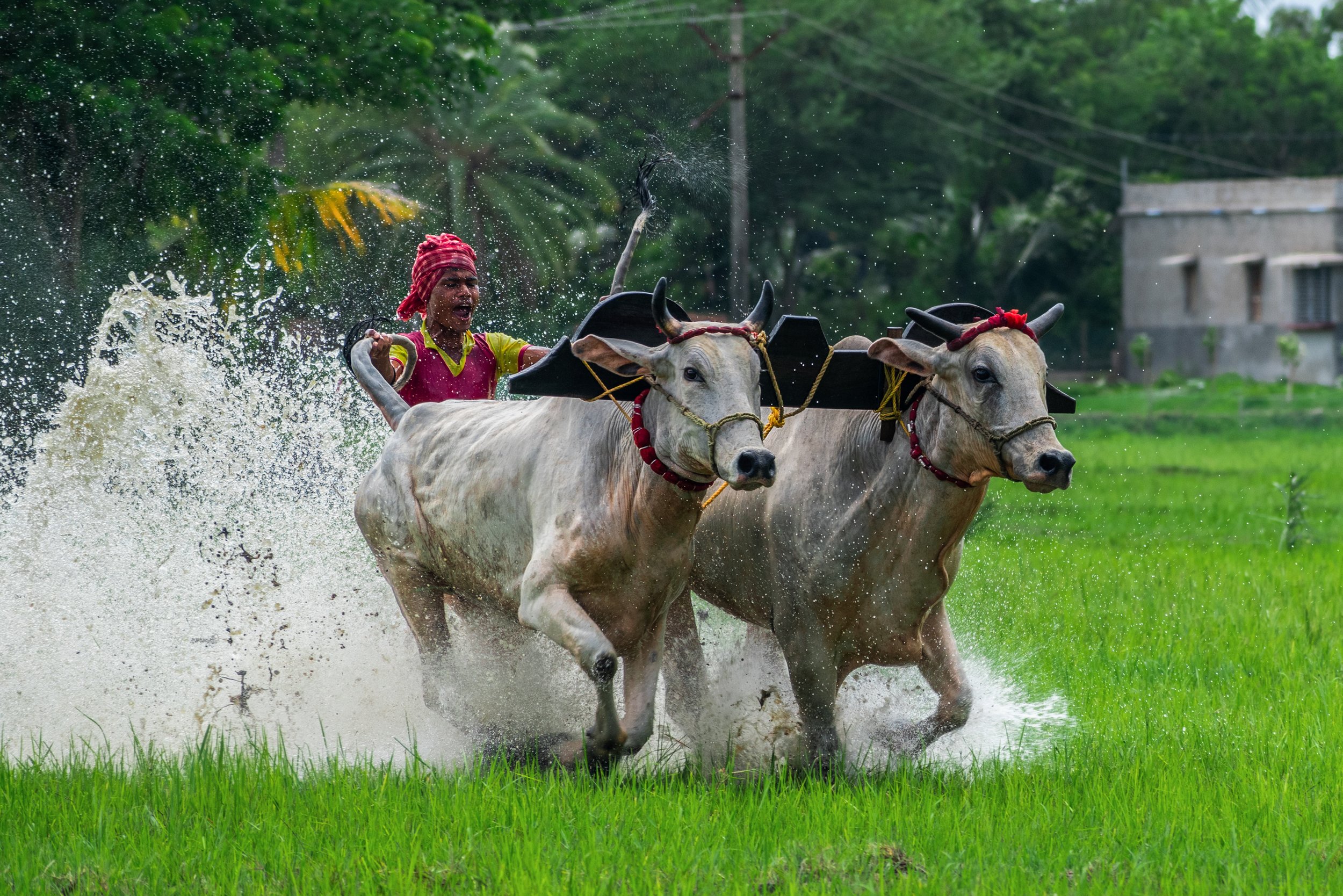
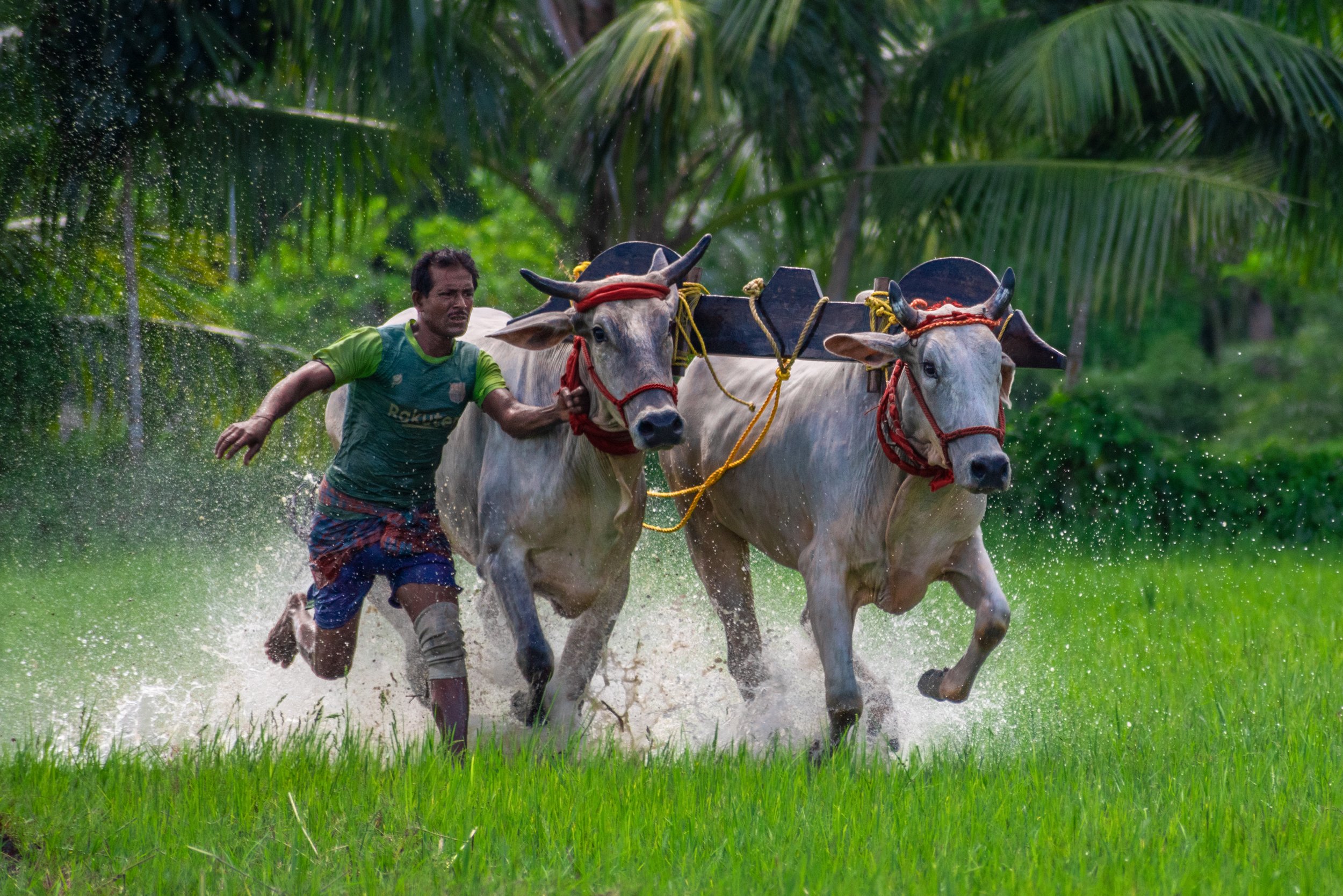
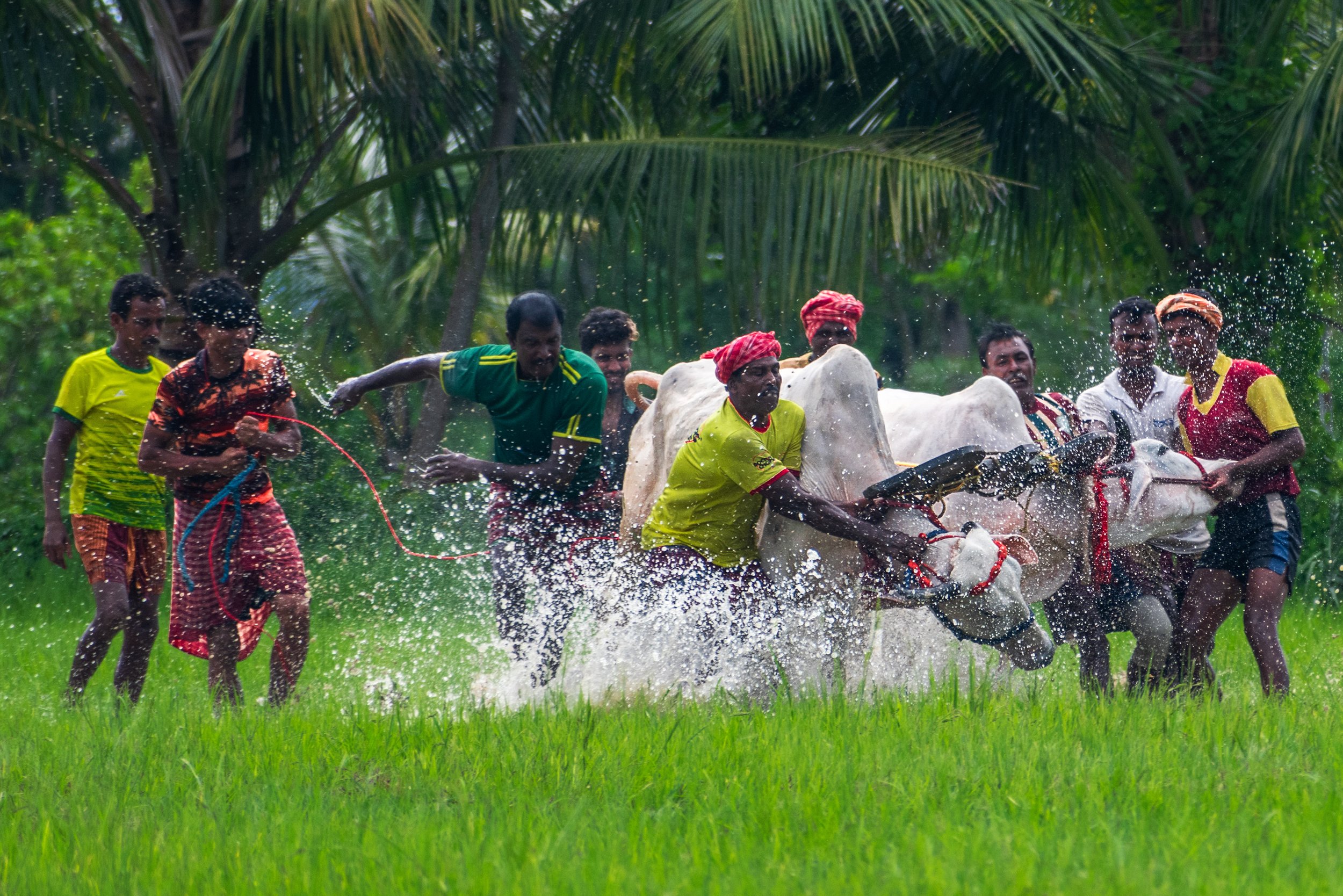
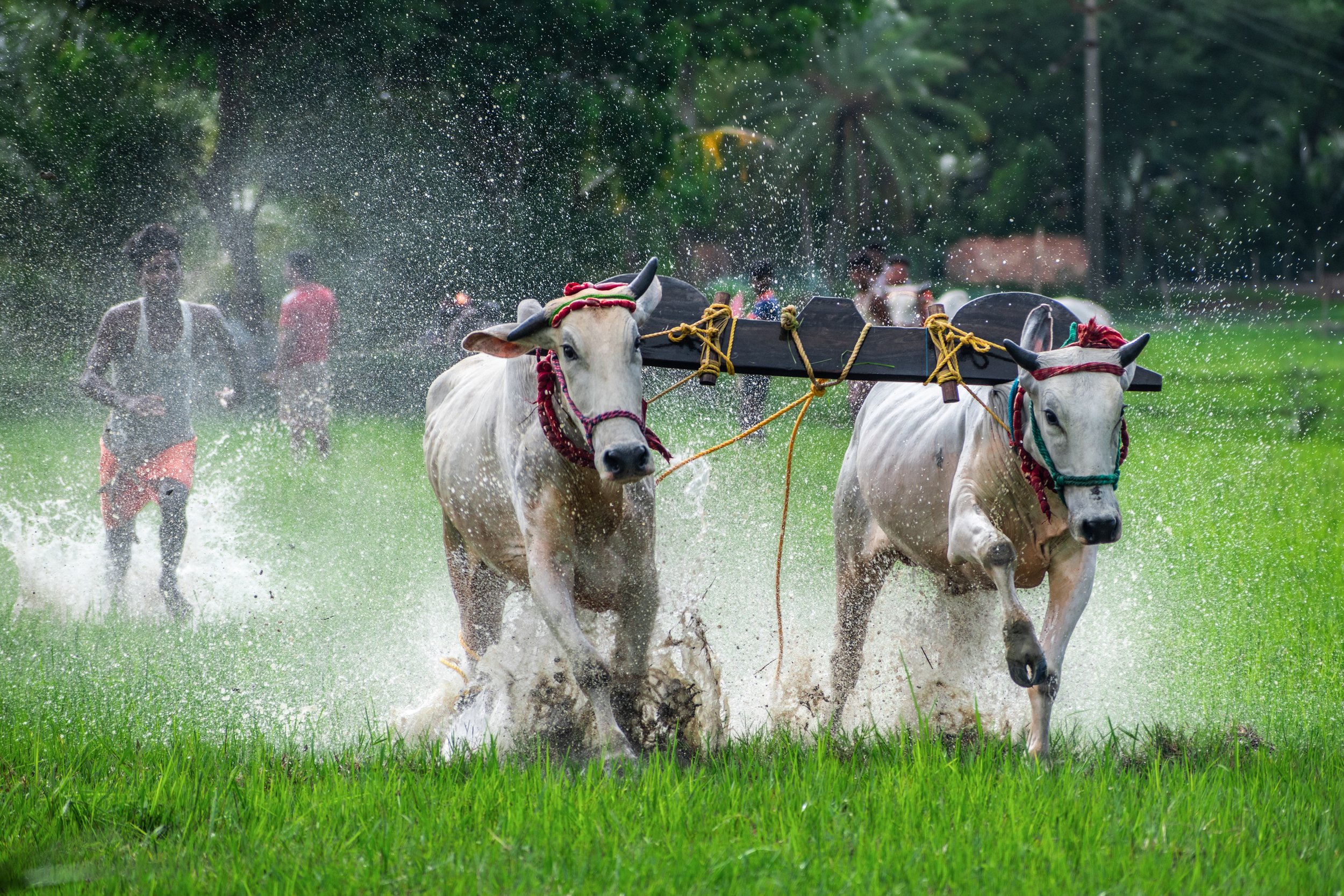
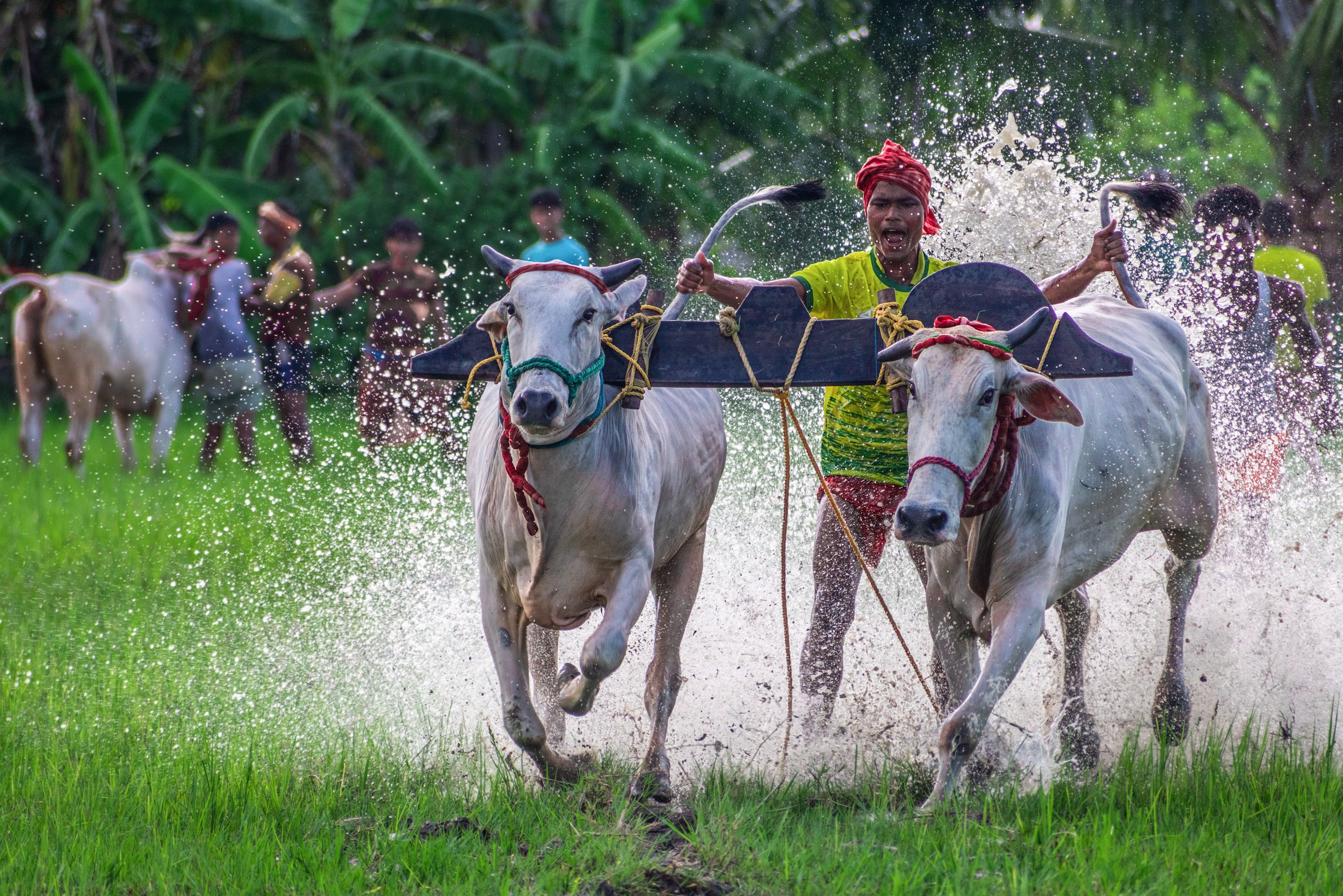
Every year, Herobhanga, 80 kilometres from Kolkata in South 24 Pargana district of West Bengal, organises a cattle race, locally called Moi-Chhara.

The race usually occurs in mid-June or early July, when farmers begin cultivation.

Once again this year farmers in a relatively unknown south Bengal village are busy organising a cattle race to celebrate the arrival of the monsoon.

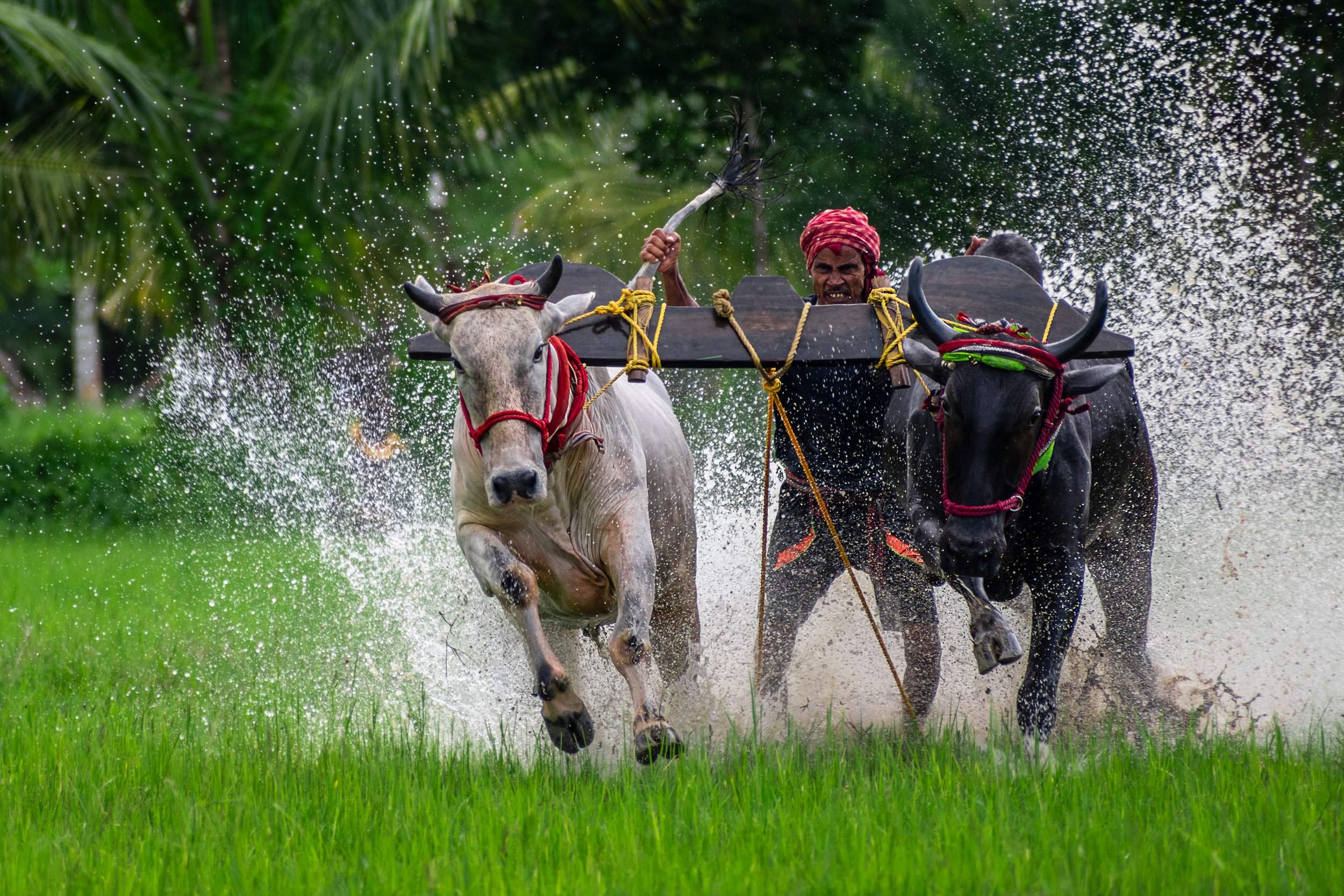
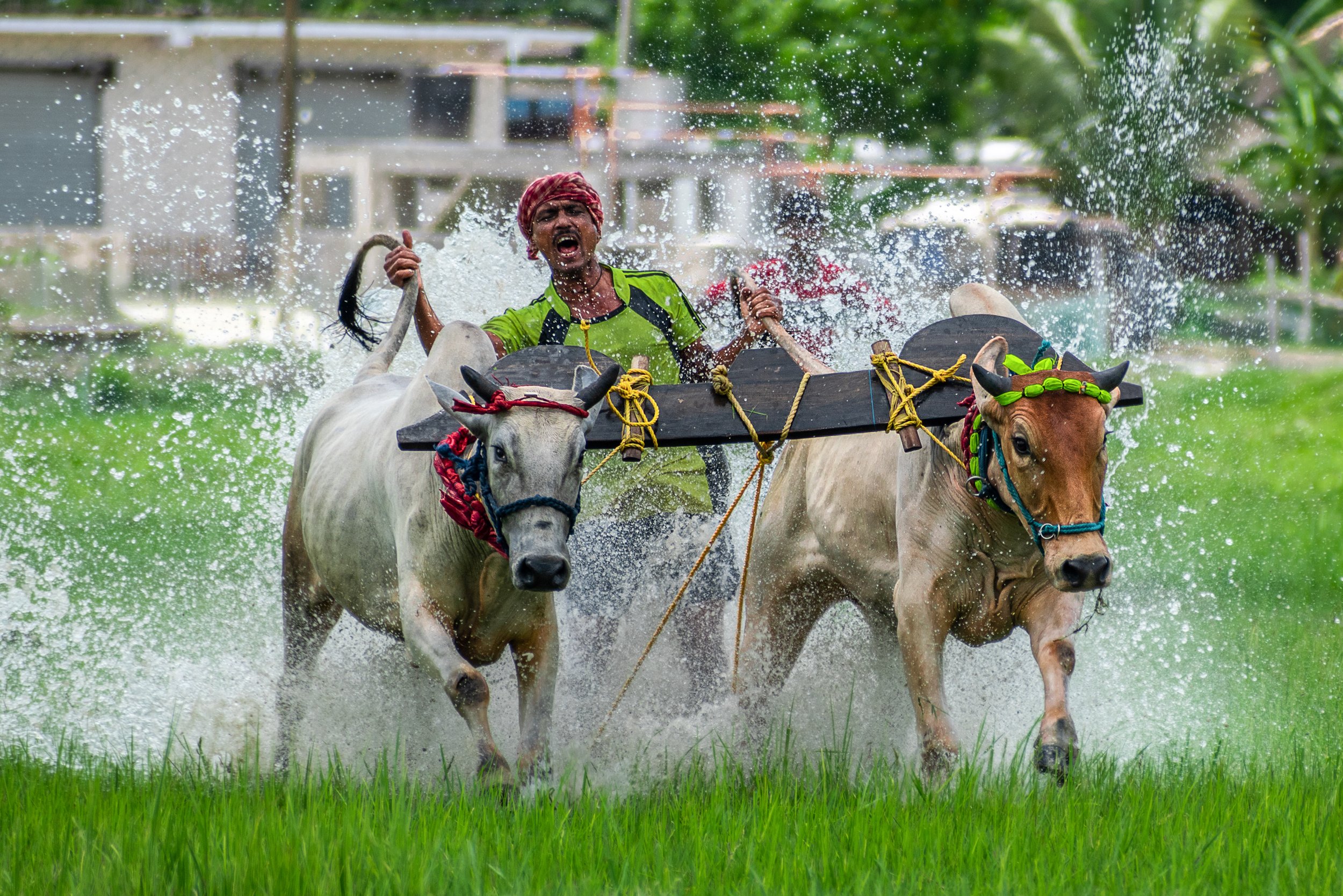
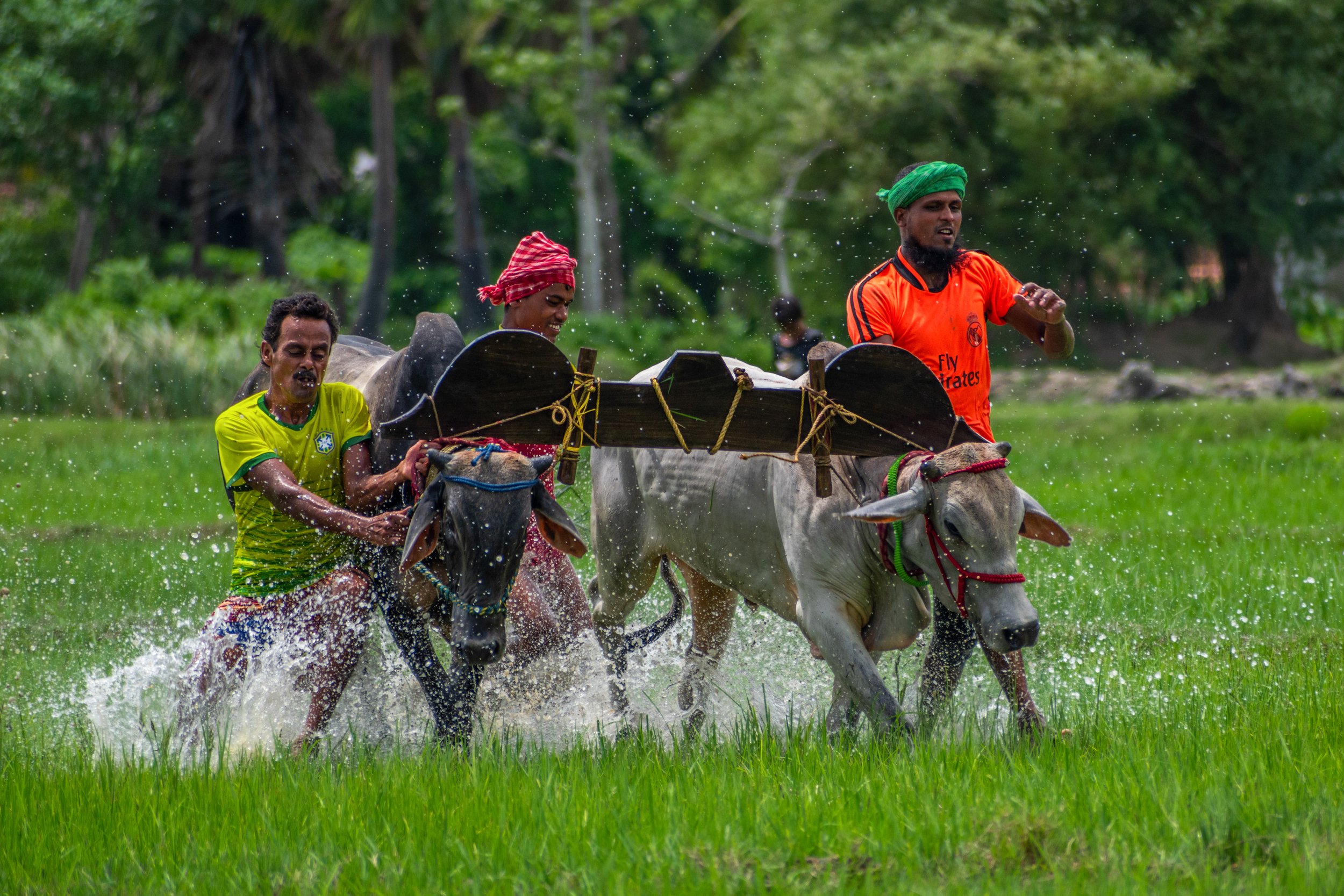
The ‘game’ involves pairs of bulls racing against each other. There are red flags at the start and finish points. The bull that comes first wins. The competitors must follow the rules that the organising committee have to follow.

Usually, farmers who own the bulls become jockeys. The bovine is tied together by a piece of wood called Joyal, which helps them run simultaneously. Meanwhile, the jockey stands on another piece of wood called Moi.

The jockey is responsible for maintaining the speed of the bull. And those who have more experience have a better chance of finishing first.

The participants don’t just come from Herobhanga – many come from the three nearby blocks in Canning.

However, the race has also been criticised for being cruel to animals.

moichara1 (1).jpg
moichara2.jpg
moichara6.jpg
moichara8 (1).jpg
moichara9.jpg
moichara10 (1).jpg
moichara11.jpg
moichara12 (1).jpg
moichara13 (1).jpg
moichara15 (1).jpg
moichara16 (1).jpg
moichara18 (1).jpg
 
 
Instagram
Friday 07.22.22
Posted by Progressive-Street
 

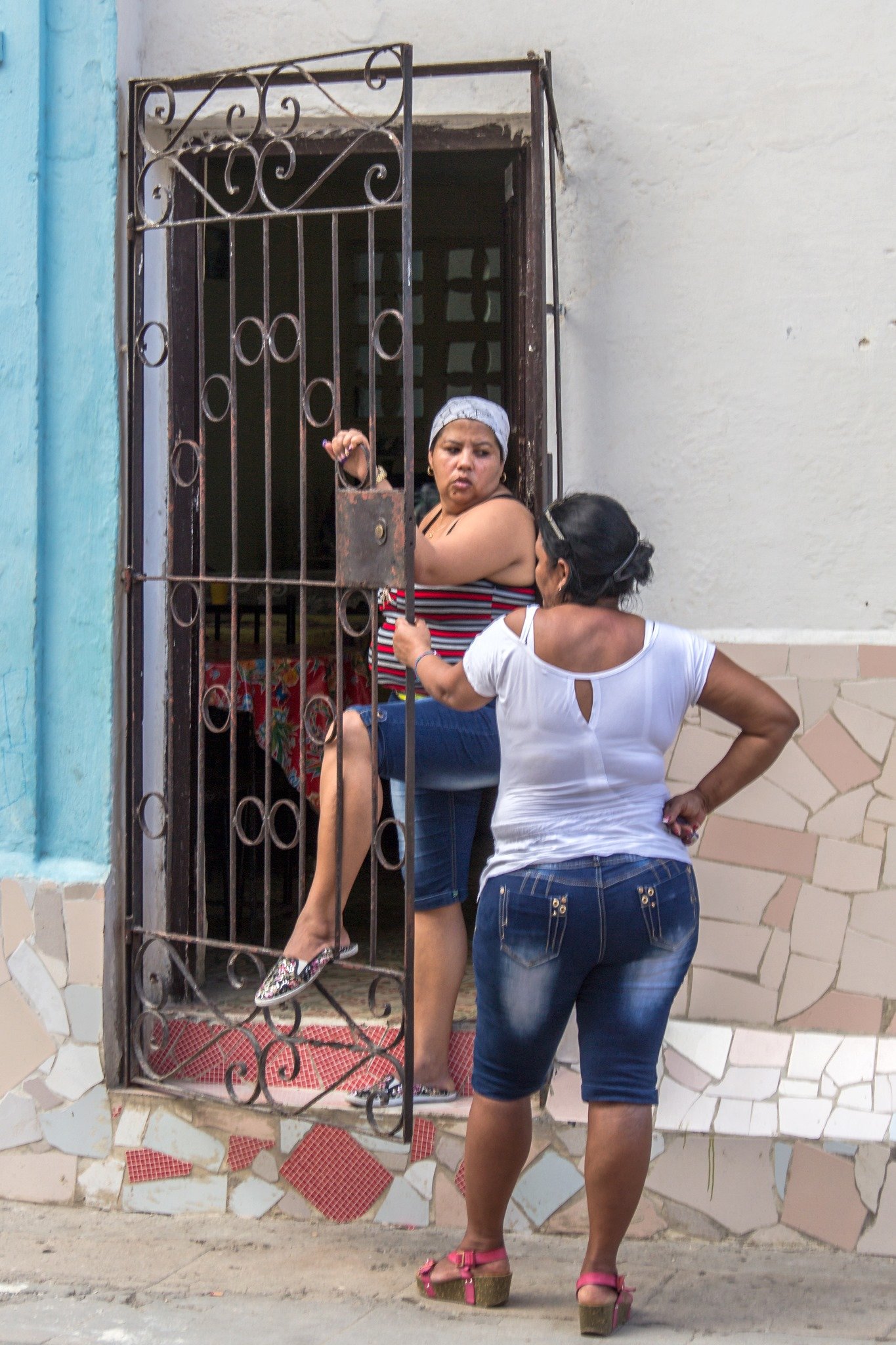
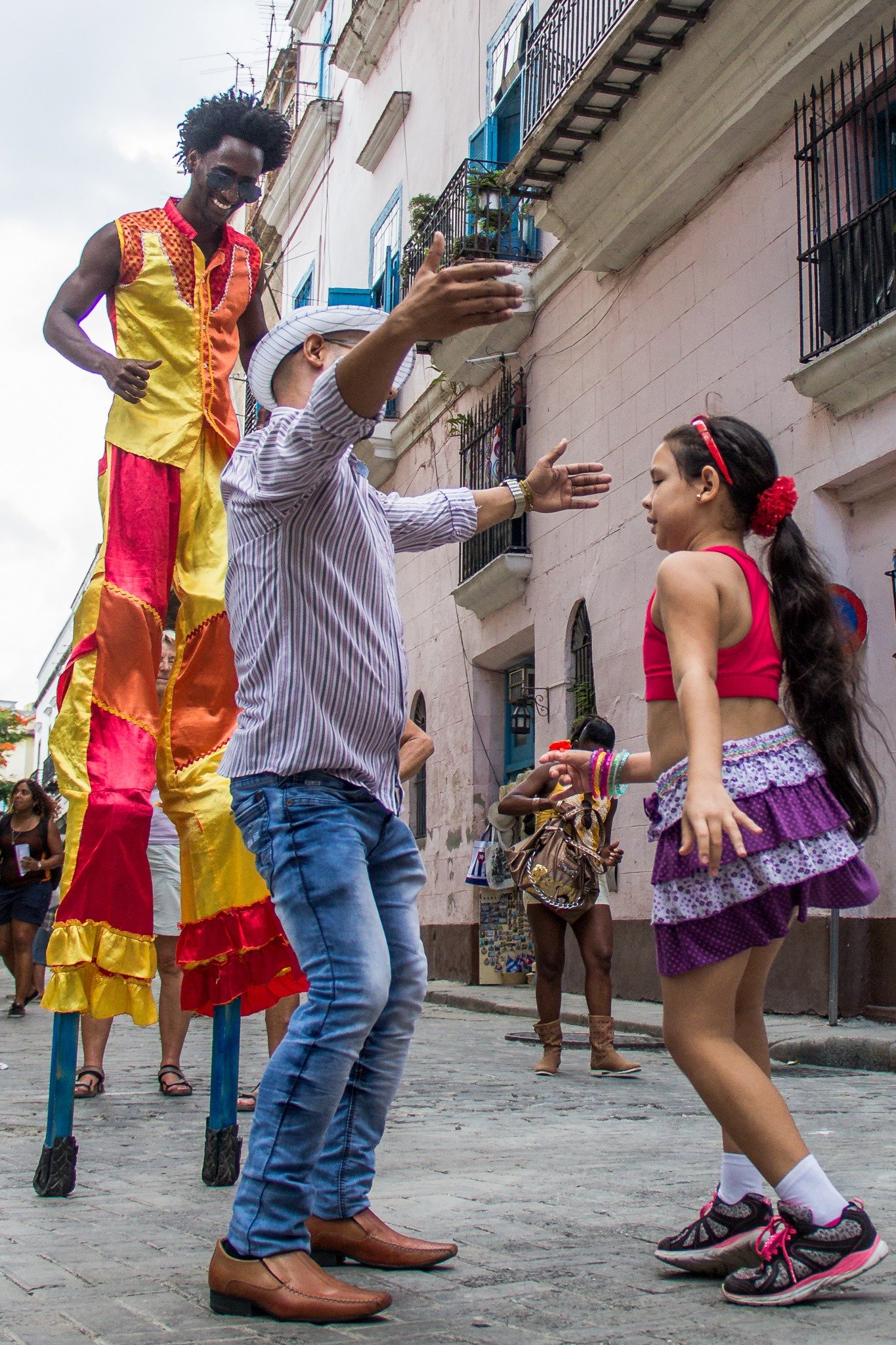
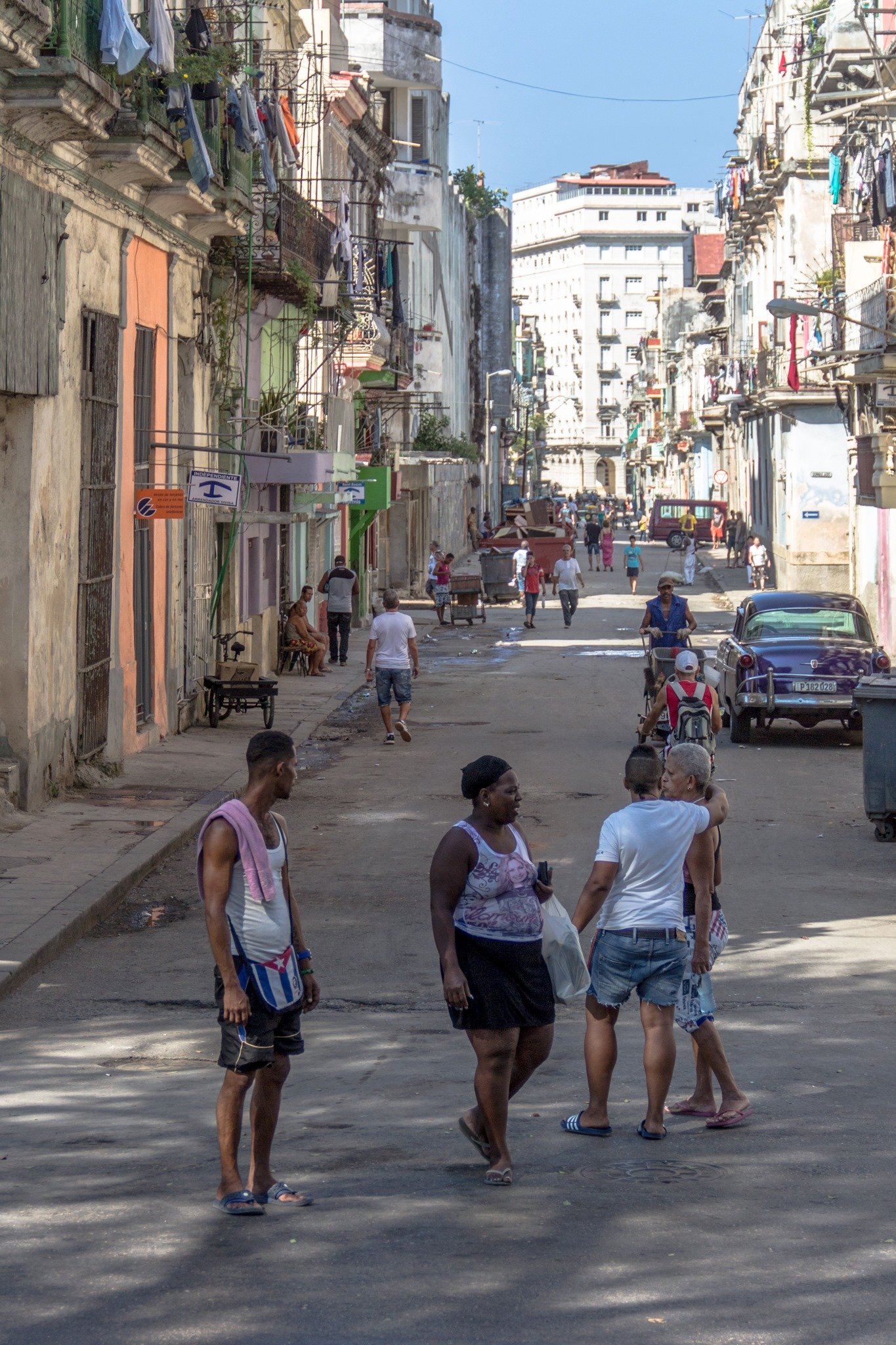
Why Cuba by P-o Alfredsson

Why Cuba?

by P-o Alfredsson

"People often ask me: Why Cuba? What is so interesting about pictures from Cuba?

I usually say that these photos speak for themselves. Personally, I think that all places and countries are interesting to photograph in.

The reason is that I am above all interested in people and their activities in the streets and cafes, in urban environments, but also in the countryside. Man is most important, to me. The environment is also important but comes second. For me...

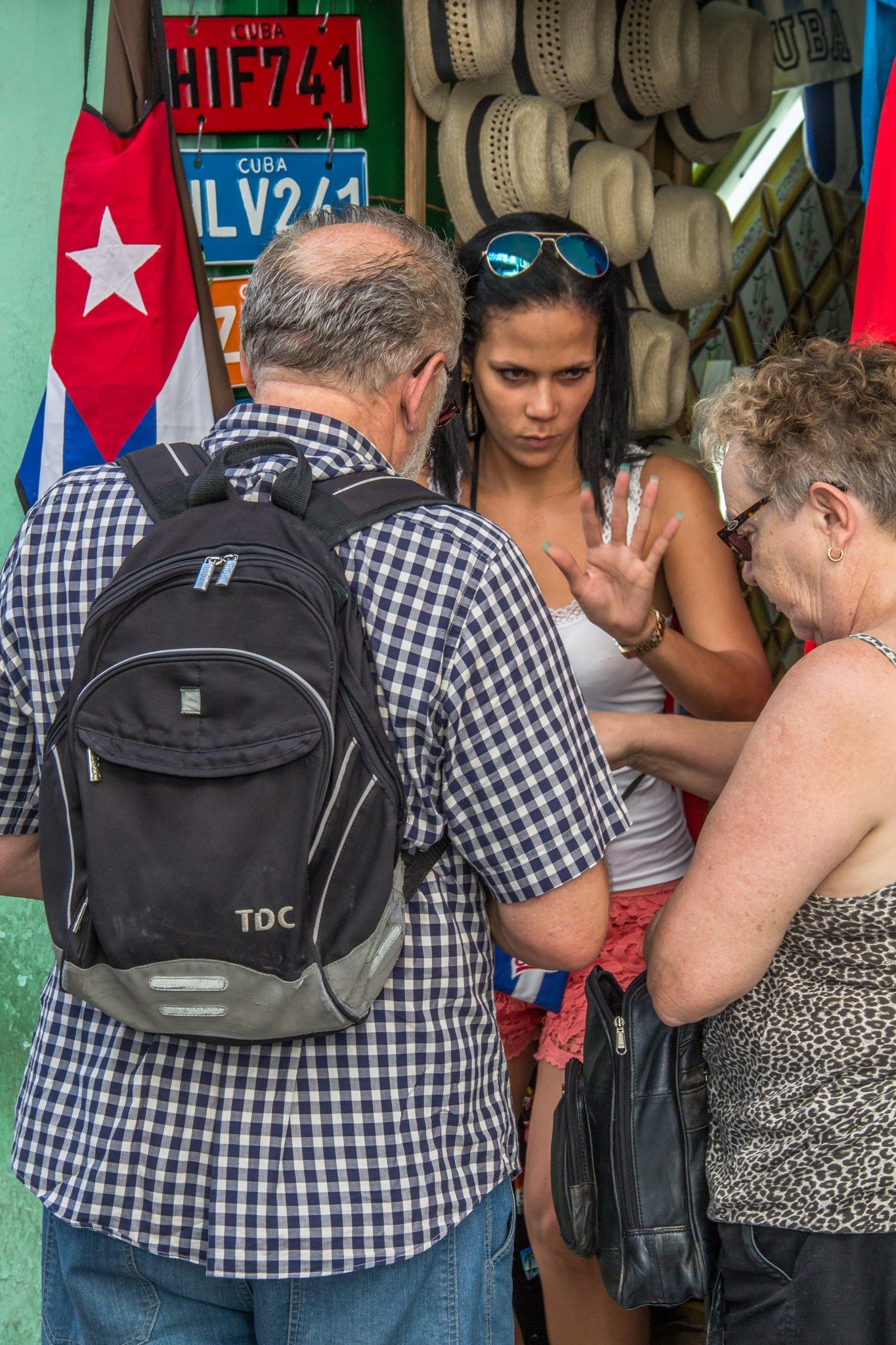
Actually, I'm not the right person to talk about what it's like to photograph in Cuba, because I only stayed there for sixteen days, five years ago. But I have many friends who have visited the country many times and for many years. So therefore I dare to generalize: It is easier to street photograph people in Havana and other cities in Cuba than in most other countries.

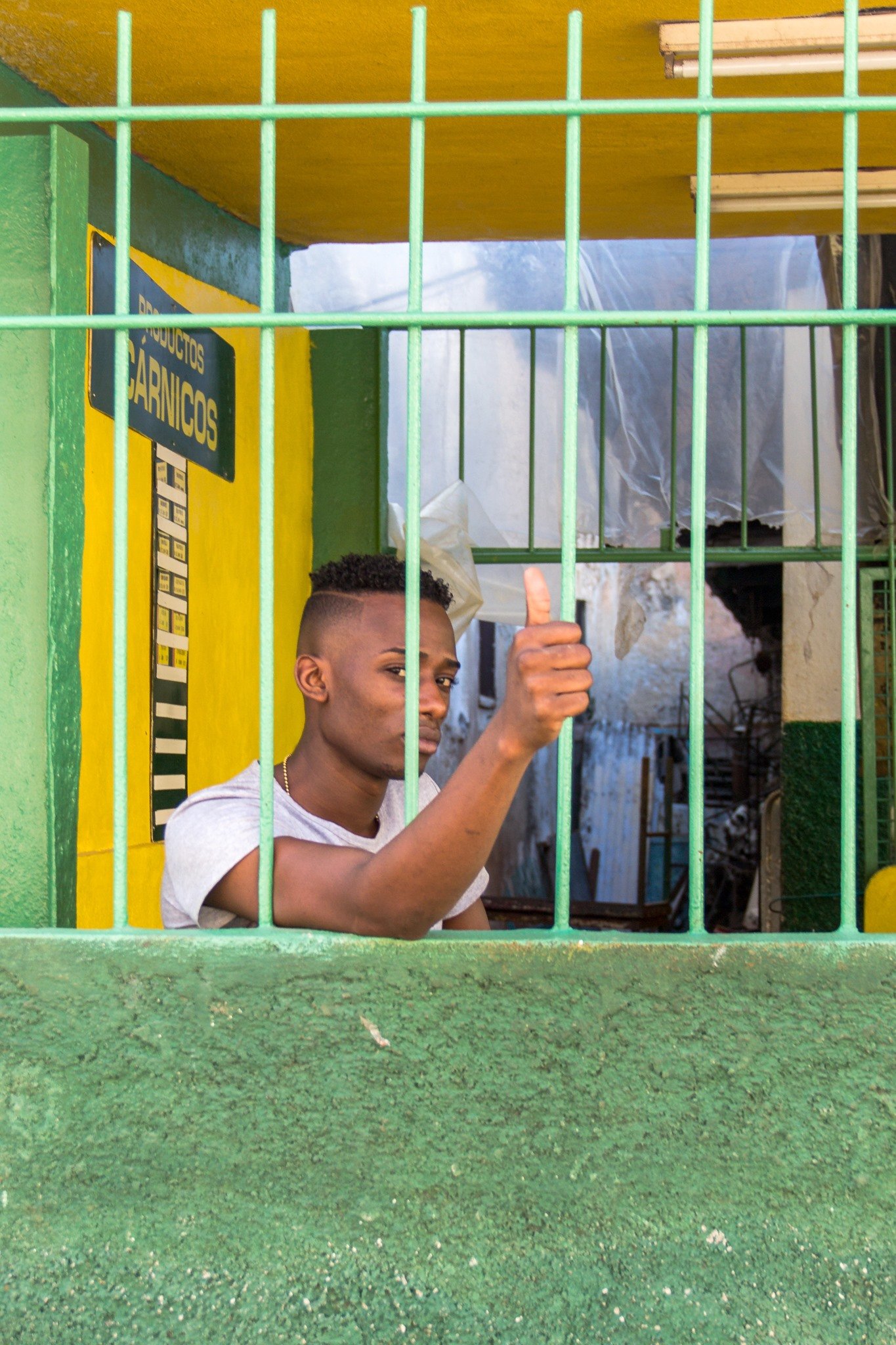
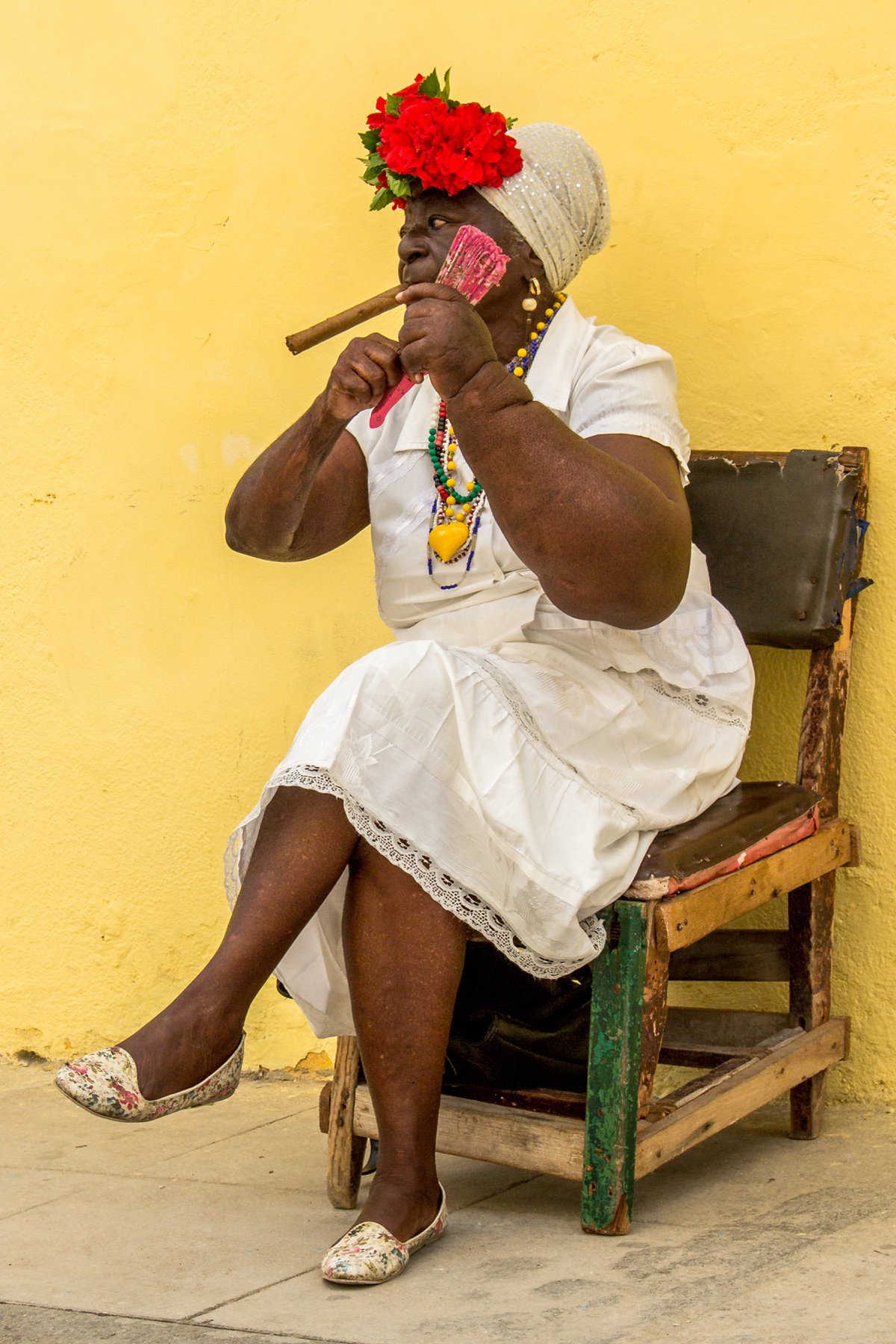
People on the streets often give a thumbs up when they point the camera at them. Without them demanding anything in return. They know that Cuba cares about foreigners and tourists for the country's economy. Yes, most of them are friendly. This also applies to night walks. But of course, there are often (at least in Havana's picturesque old town) people in the form of tourist traps who want nothing more than to be photographed. Street musicians, women in traditional classical clothes, animal tamers, etc. who want a penny to pose, but I do not count them."

215314197_772058423486445_3016908468862859365_n.jpg
211403582_419534162531508_2270625510975265392_n.jpg
201333290_1217657658676351_6436447215071730754_n.jpg
213949385_362869298557895_4525406407687372284_n.jpg
211298241_231614955460118_4967491951245127454_n.jpg
213907367_850021995623118_577732829414756611_n.jpg
View fullsize 214308491_4133740786704607_2448047218878000483_n.jpg
View fullsize 214541897_340574397604202_5308811188765817636_n.jpg
View fullsize 214346478_505703137308530_2345516382881780123_n.jpg
View fullsize 214782181_966550050864995_6298187921197878154_n.jpg
View fullsize 213466048_323434466098024_2183674056632085935_n.jpg
View fullsize 214341603_555555132110653_845272778519627499_n.jpg
 
 
P-o Alfredsson
Monday 06.20.22
Posted by Progressive-Street
 

ON THE GARDEN OF REMEMBER

ON THE GARDEN OF REMEMBER

Emin Önder Sertçelik

ON THE GARDEN OF REMEMBER PROJECT

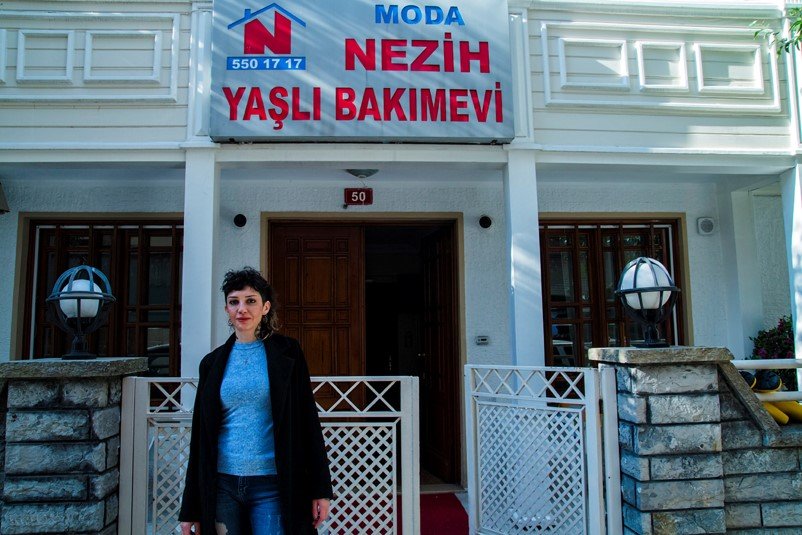
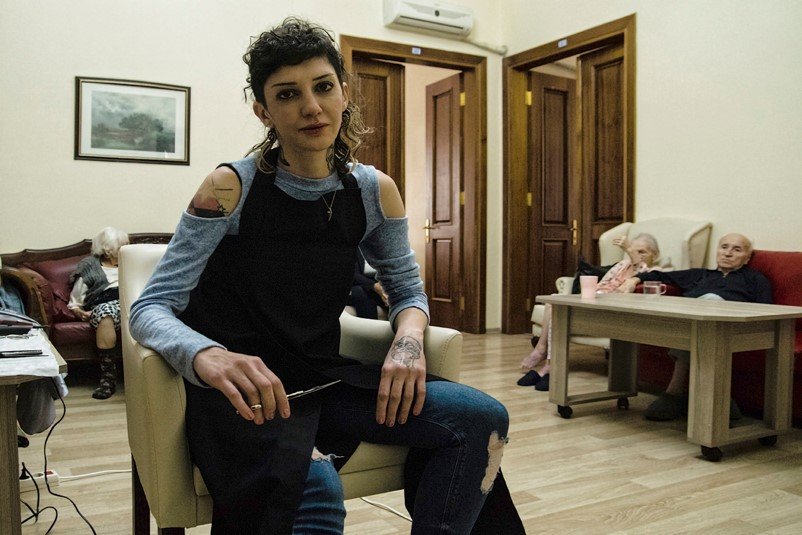
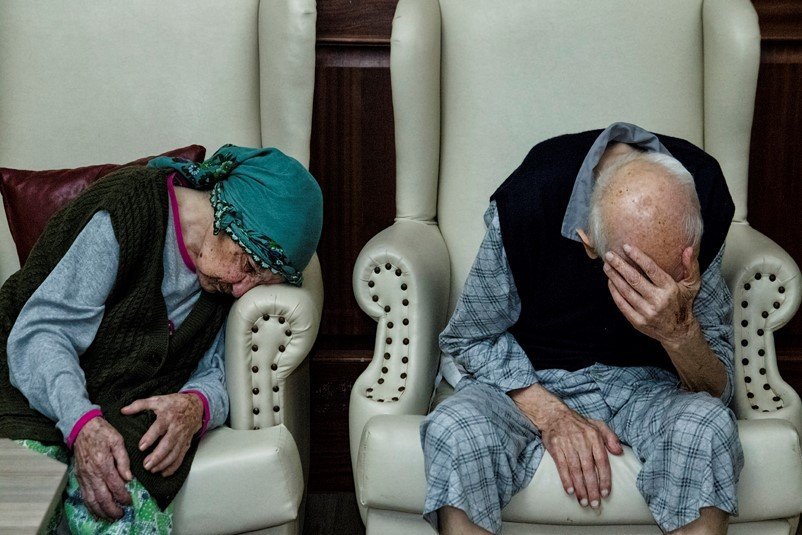
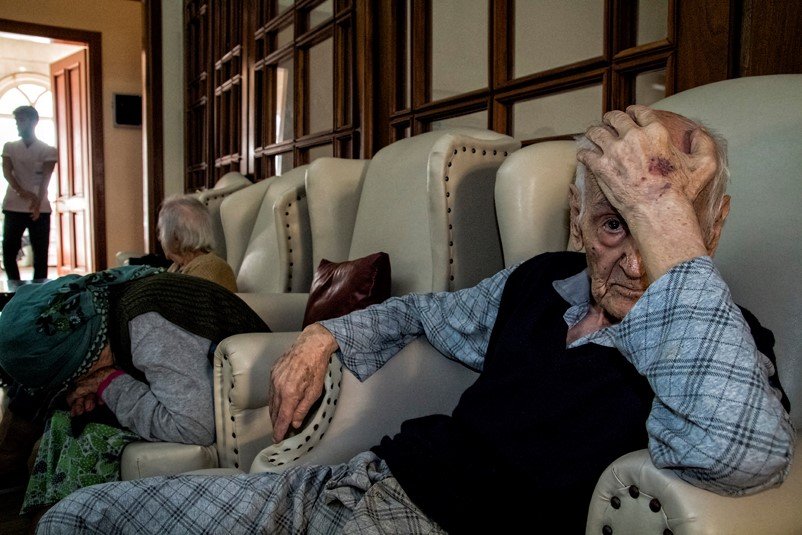
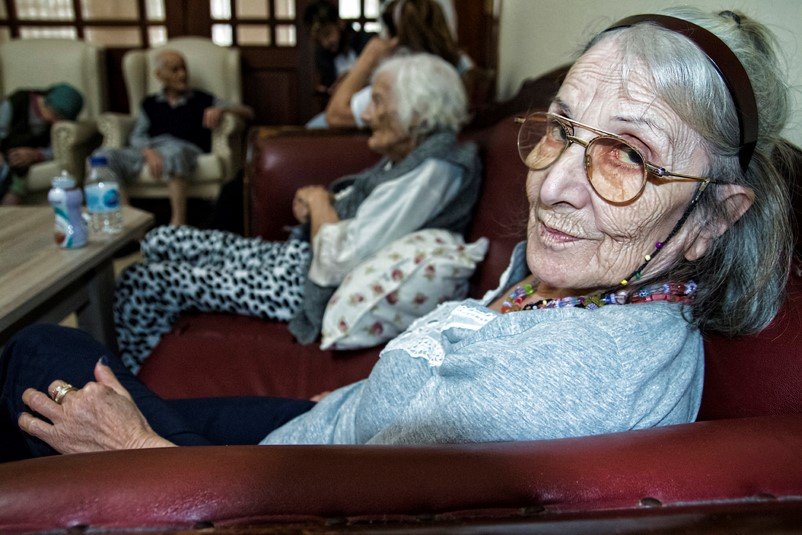
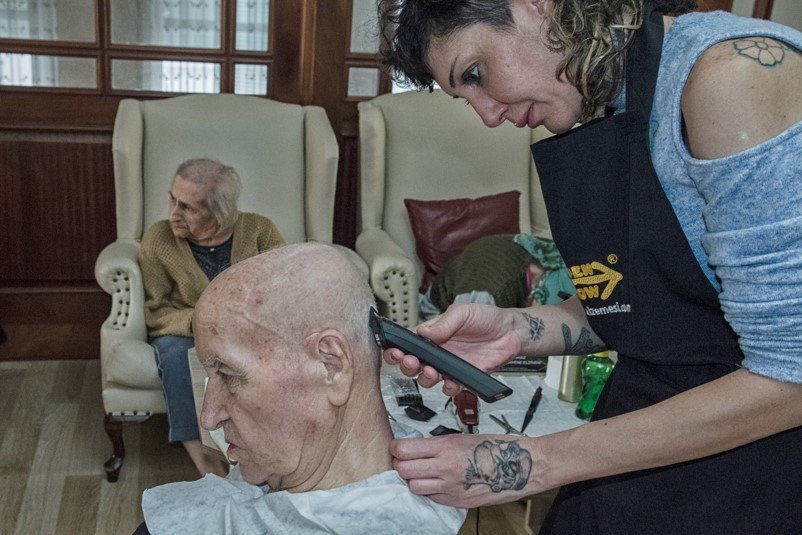
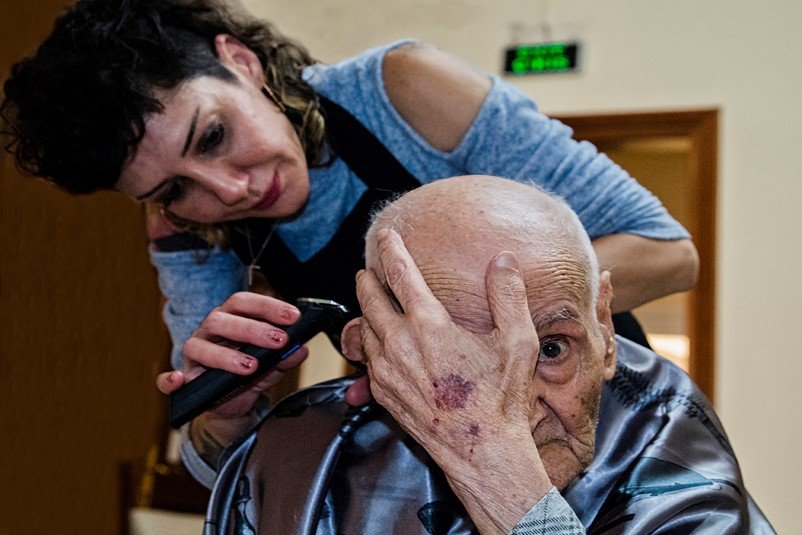
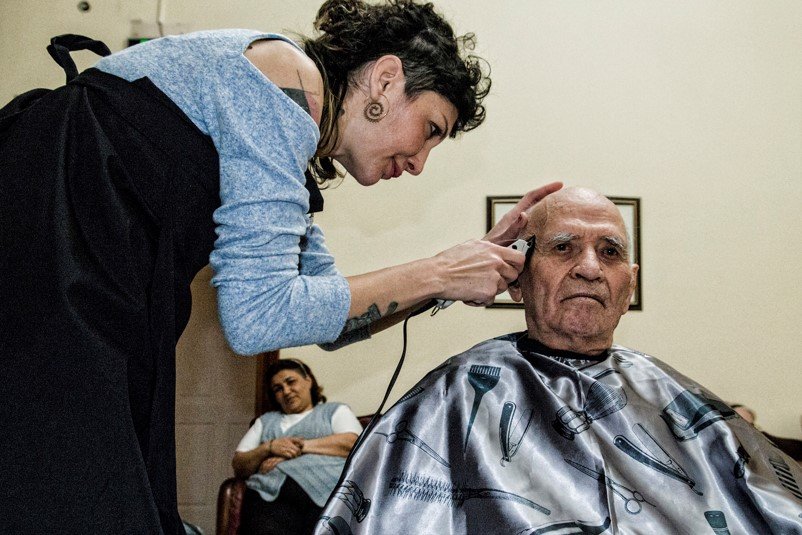
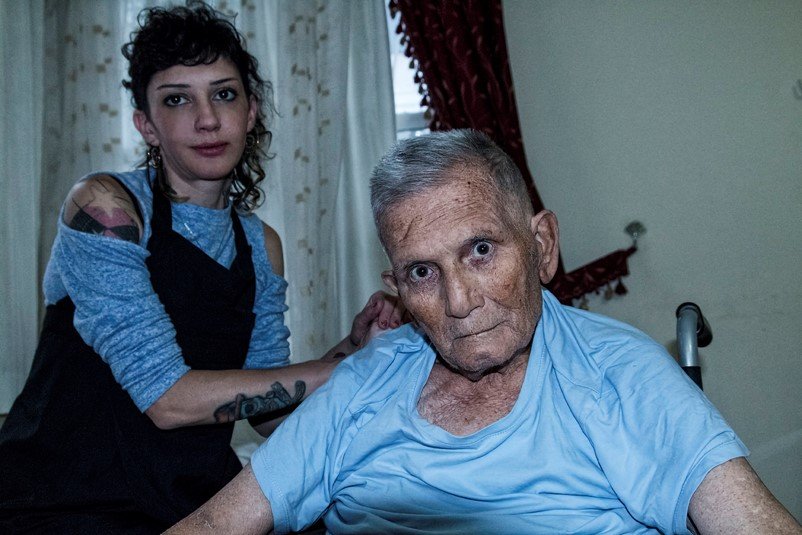
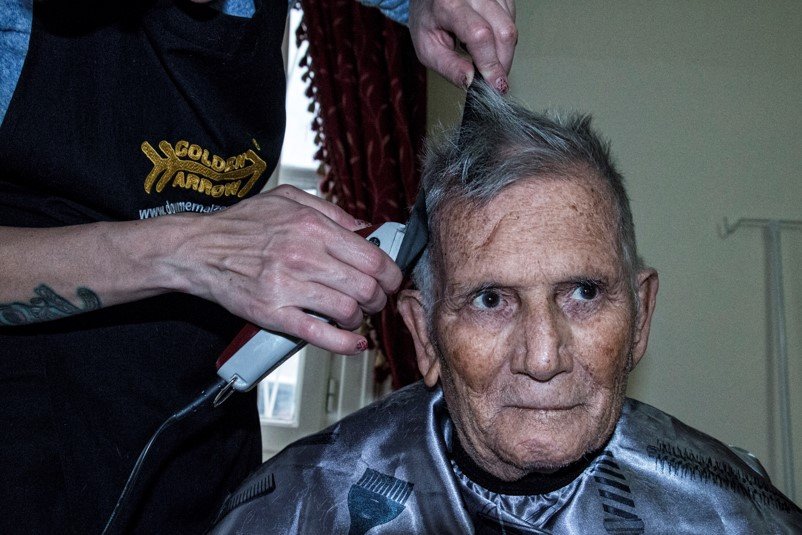
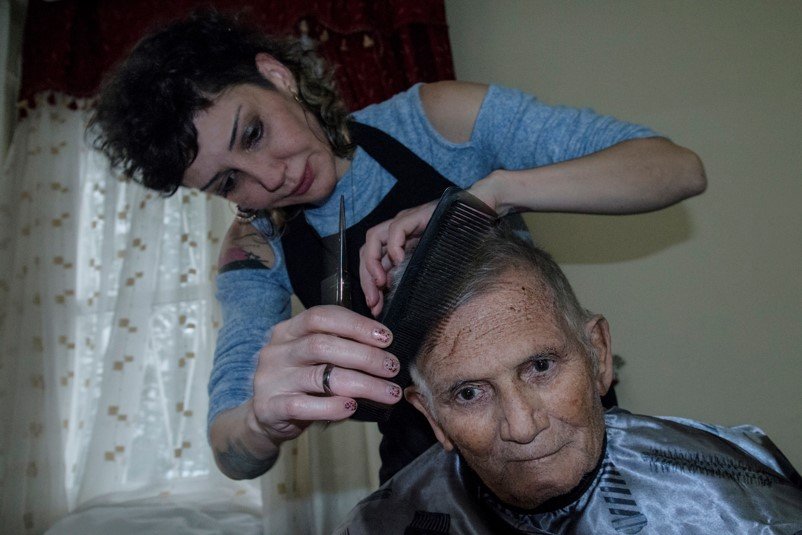
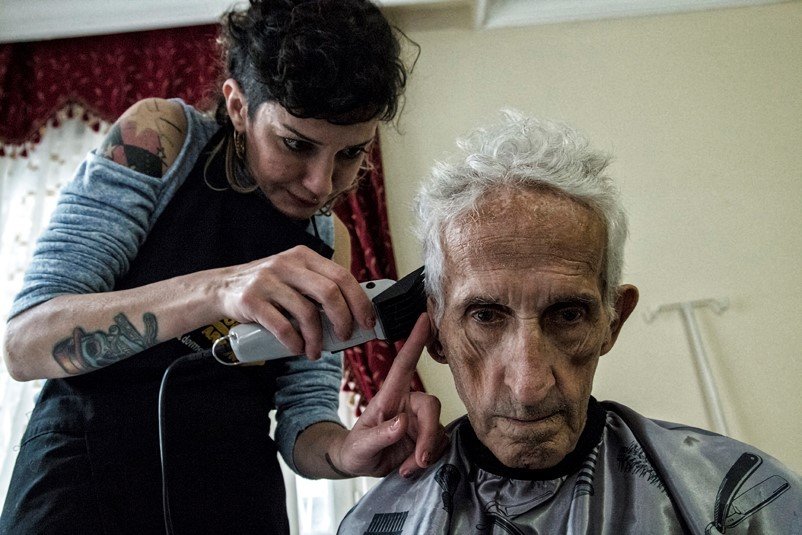
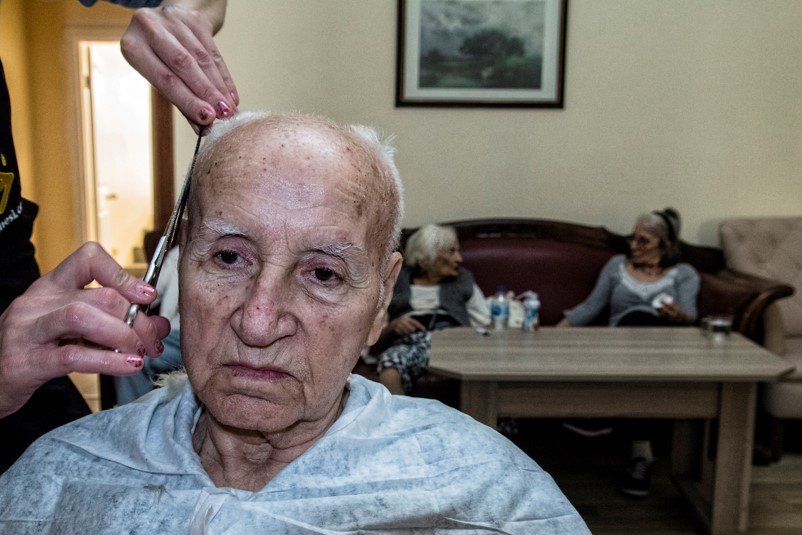
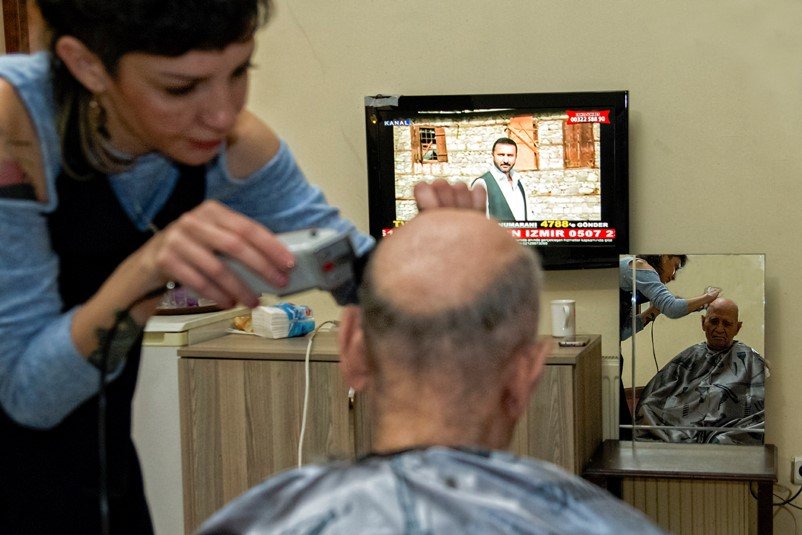
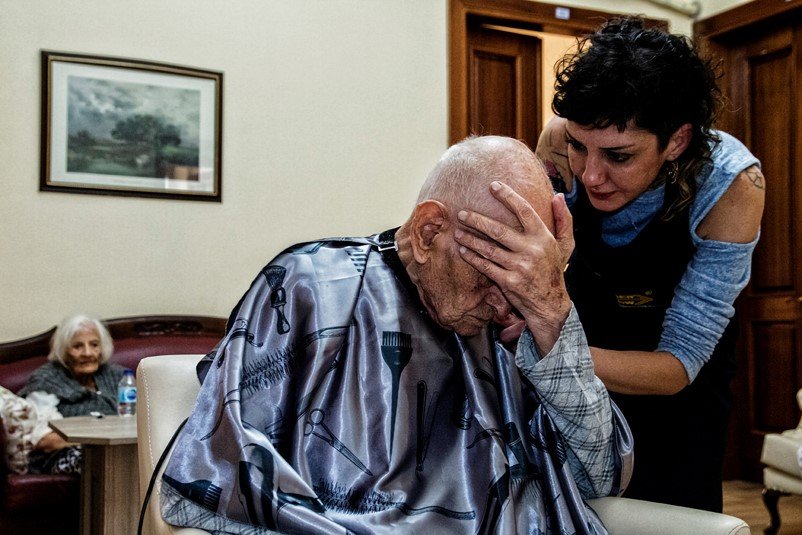
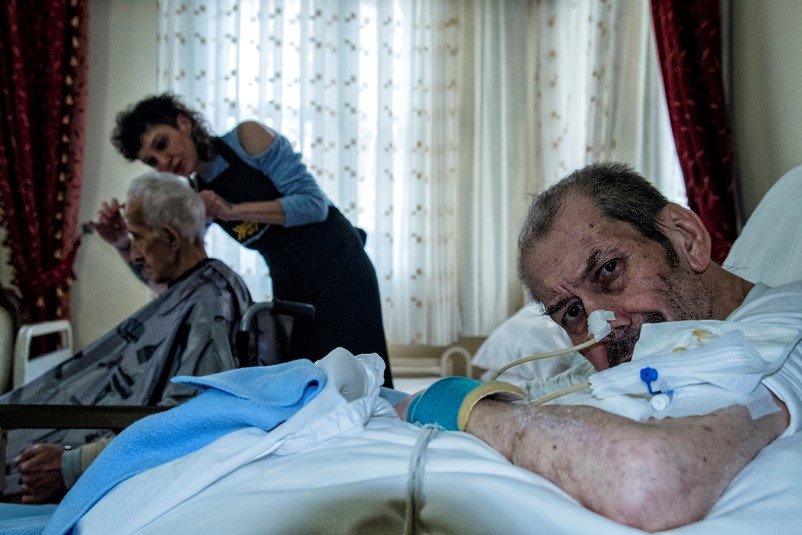
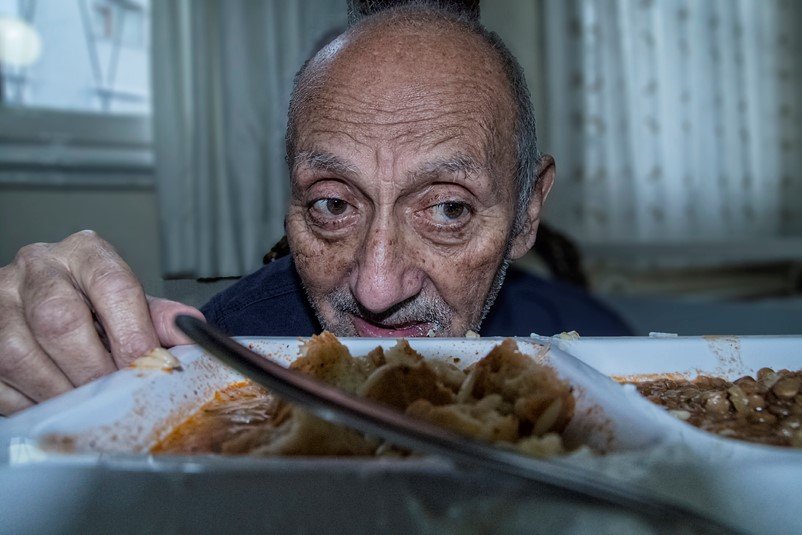
He did a project work on elderly people with Alzheimer's disease. Name: Garden of Remembrance. This project was published in Kadıköy newspaper, Birgün newspaper by interviewing me and it was published on Kadıköy.mag on Instagram.

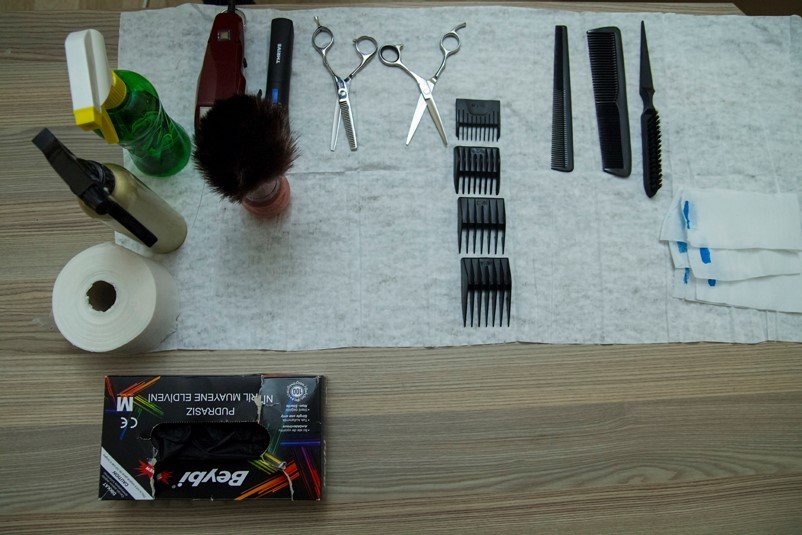
The idea for this project came about when a friend of mine who works as a hairdresser told me that he would cut the hair of elderly people with Alzheimer's in a nursing home. Since my grandfather passed away due to Alzheimer's disease, I wanted to recall my memories of him, even symbolically, and I also found the idea of ​​a young female barber cutting the hair of elderly people with Alzheimer's and photographing the bond he would establish with them, which was interesting and exciting to me.

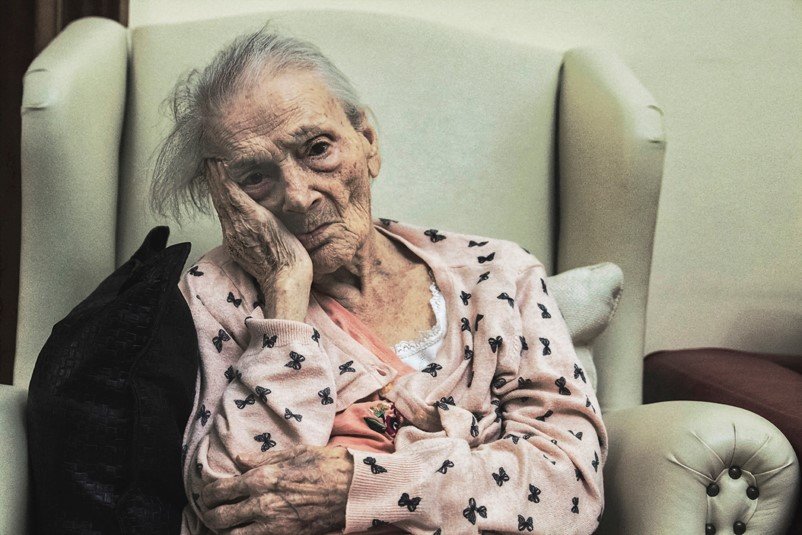
While the age we live in, daily life progresses very fast and we have difficulties keeping up with this speed, such speed was not in question in the memory of these elderly people with Alzheimer's.

They had completely lost their sense of time and space, and all their memories were almost erased. It was very frightening and frankly, as human beings, the comfort of our age did not allow us to face these facts.

While we were collecting good memories with our loved ones in our healthy lives, there were hardly any memories where they could feel better.

Here's to confronting the facts that I talked about through my grandfather during this project and that we usually don't want to realize or really don't realize; it was painful. But still, the bond I formed with them made me feel good.

8ABBBD5D0DB34850946314865213D25A.jpg
7DC863C467344C5DA6D922476CC5800C.jpg
8537A411E6E64BB89689CA6F90F90084.jpg
FAB90648831B4064B4E1556D4C4E921F.jpg
194CFE9045414541BD52B4B8968BF062.jpg
A2F725717A28409CA21F6A901C1BF6CF.jpg
C6861D2A8B2E44D99850A8ECAB835771.jpg
2A11B64E3BA346F59FCAF031553CF6EC.jpg
5E38FF2B54B64F12AA41B2239B4E2BDB.jpg
6B20700358A1495893C4E6BE24634832.jpg
98A5713F8C9D425D84F5A3E5B06F3D84.jpg
6454116415A1419E839EDCB6E62D2F74.jpg
C3A931BA584B43D6B75C24C18F19E14D.jpg
C4597AC1C2FB47E0B0055E2A601DEC1B.jpg
D5E2FA69FDA64734BA1BFD99F9E3DECB.jpg
EEEC57443DA64799A239BF637C96111B.jpg
D8913D7832A8475588ADB1E296712660.jpg
EDCFC911951B404E96D75173EDF1BAC4.jpg
E2796289914C440E8D62CAE4EC7E6953.jpg
 

The lives in the fabric of street and geometry

View fullsize (sertcelik),(onder)-(attack)_(ıstanbul)_(2019).jpg
View fullsize _DSF0204.JPG
View fullsize _DSF8806.jpg
View fullsize DSCF0955.jpg
View fullsize DSCF3020.jpg
View fullsize DSCF4038.jpg

“Önder Sertçelik is a Turkish photographer who started his photographic journey in 2009. In 2018, he studied documentary photography at İfsak, the Istanbul Amateur Photography and Cinema Society. There, he completed two documentary projects, one of which was presented in a collective exhibition.
He began by taking photographs of architecture and buildings, and, while doing so, he realized that some details in the structures could blend well with passersby’s actions. The street textures and their connections with people started to draw his attention, and Istanbul was very inspiring in this regard since it has rich and vivid urban scenery. After some time, from the static and wide-ranging architectural photographs, he switched to a more active and narrow style, coming close to the people and shooting in the streets. As his perception of composition improved in learning from the masters, he began taking more layered and thought-provoking pictures. Lately, he has been shifting to framing human actions and complex situations on the street.
In the future, he wishes to develop a project in which human connections are mirrored by taking photographs of objects. Other than that, he is planning to make a documentary project reflecting on his view of social and cultural issues.” www.eyeshotstreetphotography.com

 
instagram
Sunday 06.12.22
Posted by Progressive-Street
 

Life Through A Bus Window by Cameron Scott

Life Through A Bus Window

by Cameron Scott

One dark winter’s morning a few years ago I happened to be standing on a street corner in Glasgow city centre, as usual nothing much happening, when a bus stopped in front of me, presenting a wonderful colour scene the intensity of which I had not been aware of before. Blues, yellows and greens all blended in a manner reminiscent of an old master canvas, randomly punctuated by coloured specular highlights and reflections, and framed in black like an unmounted Kodachrome slide. Behind a veil of condensation, one could make out the form of a few passengers, granted backlit anonymity and lost in their own world of thoughts.
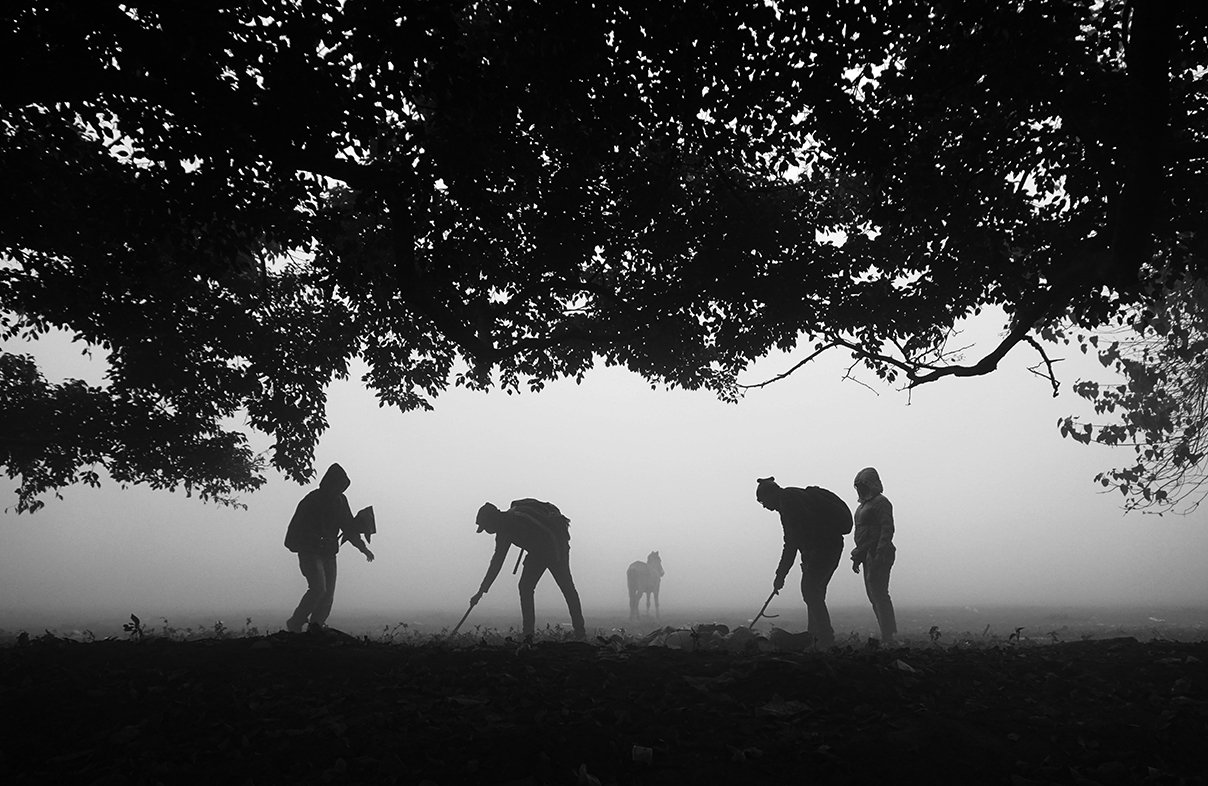
Click! I was hooked and wanted more.

Over the course of that winter and into the next I continued to seek out such images. The success rate was very low – conditions had to be just right, cold and damp to allow the condensation to build up, plenty of varied backlight from sources such as shop windows and other vehicles, and always a passenger or two. As we know buses always come along in groups of two or more, so to help in my quest the button on the pedestrian crossing became my new go-to photography accessory, much to the annoyance of the bus drivers.

A small collection of such images soon expanded into a dedicated project. Then, just as the lighter mornings were appearing with the first signs of Spring, the world went into lockdown and over two years would pass before the project could start again.

Fast forward to Autumn 2021, and as the world emerges from successive restrictions the project can resume. Or so I had thought! As suitable conditions began to present themselves it became apparent that most of the buses had been upgraded at some point since my last attempt at these shots. New, more efficient models with better heating systems now presented themselves before me. No veil of condensation, no exciting colour palates, nor a clear view of the occupants. The magic had gone.
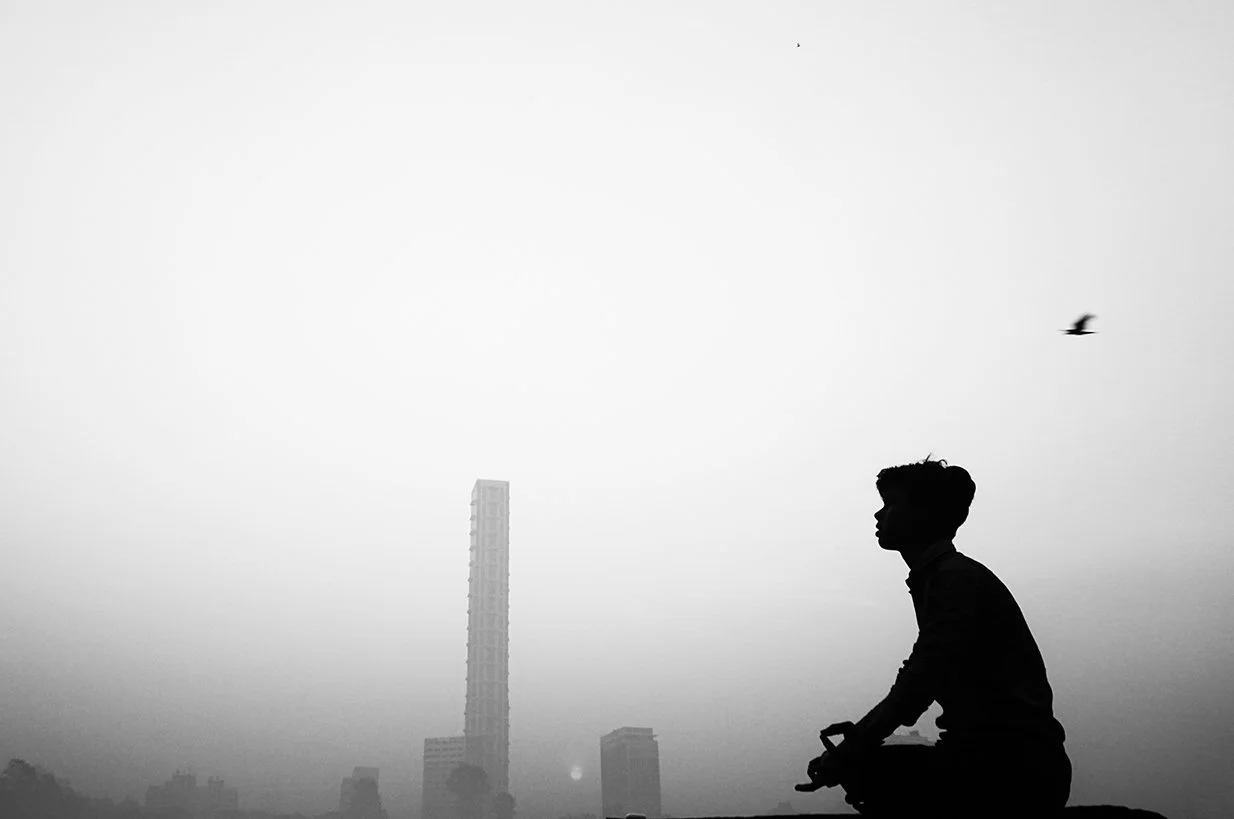
It had been fun while it lasted and I’m glad that I managed to make the images that are now contained herein.

 
View fullsize CameronScott_Bus_Project-001.jpg
View fullsize CameronScott_Bus_Project-002.jpg
View fullsize CameronScott_Bus_Project-011.jpg
View fullsize CameronScott_Bus_Project-012.jpg
View fullsize CameronScott_Bus_Project-004.jpg
View fullsize CameronScott_Bus_Project-009.jpg
View fullsize CameronScott_Bus_Project-010.jpg
View fullsize CameronScott_Bus_Project-013.jpg
View fullsize CameronScott_Bus_Project-015.jpg
View fullsize CameronScott_Bus_Project-016.jpg


I am an award winning and published photographer based in South Lanarkshire, Scotland. My photography journey started at school in the 1970s and ever since then I have had a keen interest in candid and documentary photography. After dabbling in various genres over the years I now specialise in candid street photography in various styles from traditional documentary through to creative and abstract. I have been featured in Eye-Photo magazine, F-Stop magazine, Inspired Eye magazine (Issue 80), Street Photography magazine (Nov 2021) and a few more online publications.
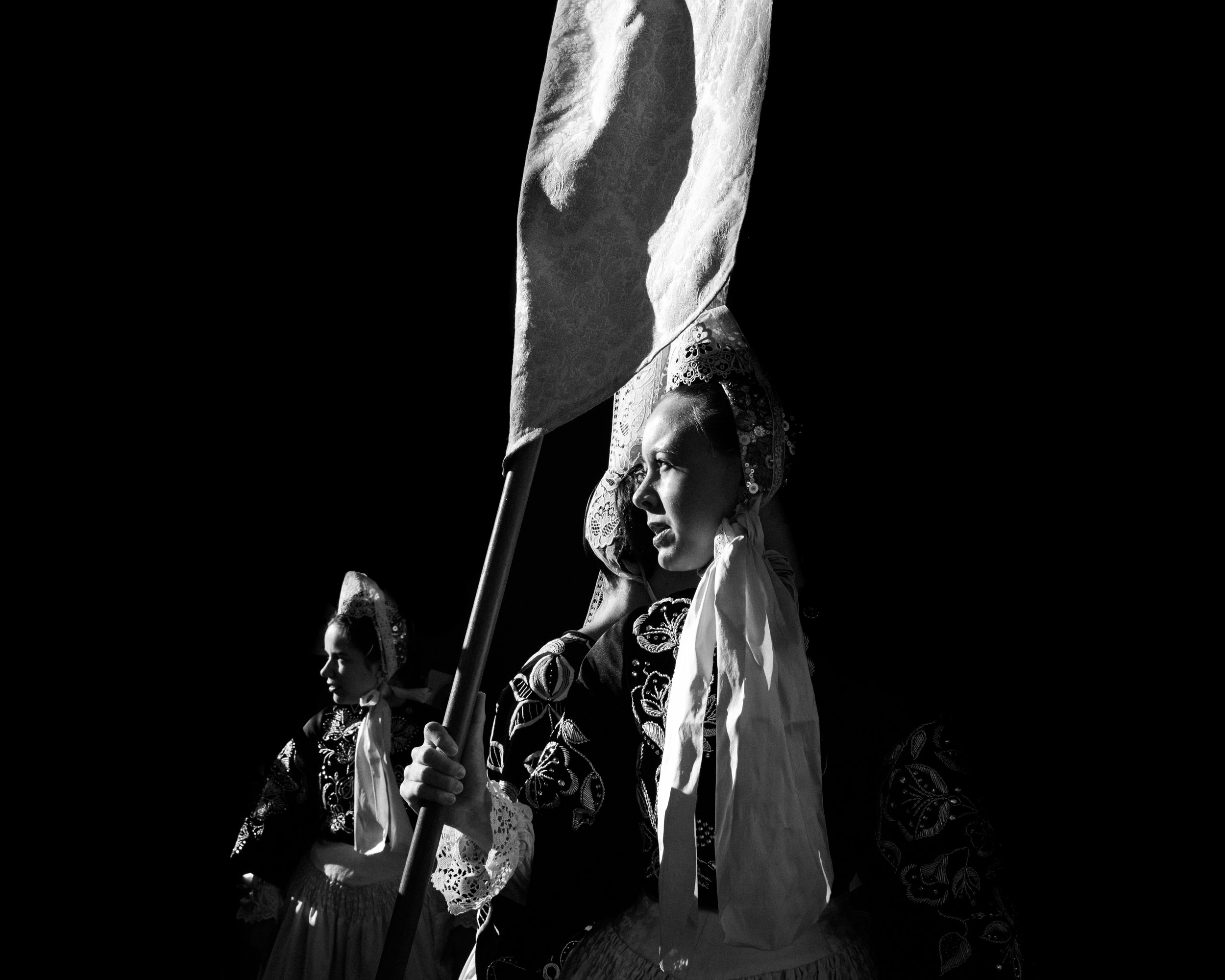
 
 
Cameron Scott
Saturday 05.21.22
Posted by Progressive-Street
 
Newer / Older
Subscribe to newsletter